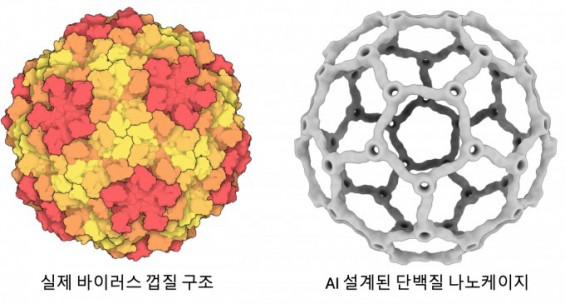
A Korea-U.S. team used AI to design self-assembling protein nanocages that formed spherical structures of 70 to 220 nm, demonstrating a new approach to virus-like protein assembly. The AI-designed proteins, created with RFdiffusion and produced in E. coli, could enable drug delivery and vaccine antigen-display applications. The result was published in Nature and highlights a potentially important platform technology for bio and medical uses, though near-term market impact should be limited.
This is more important as a platform-validation event than as a near-term commercial revenue driver. The key economic shift is that AI is moving from optimizing known protein folds to generating higher-order assembly rules, which lowers the iteration cost for custom delivery vehicles and could compress timelines for any company trying to build proprietary vaccine, gene-delivery, or intracellular transport systems. The first-order winners are not just the authors’ institutions; it is the broader enablement layer across AI protein design, contract biologics, and advanced manufacturing tools.
The second-order competitive effect is that this weakens the moat of incumbent delivery technologies that depend on hard-to-reproduce empirical know-how. If programmable nanocages become reproducible at scale, the value capture moves upstream to design software, computational biology IP, and downstream to platform biotechs with payload libraries, while commodity liposome/viral-vectored approaches face margin pressure over time. The supply-chain implication is also meaningful: simpler cell-free or bacterial expression routes could reduce dependence on more expensive mammalian manufacturing for certain cargoes, which favors lower-cost biologics and decentralized production models.
The market is likely underestimating the timeline asymmetry. The science is real, but the investable inflection is likely 12-36 months away unless a partner announces a licensed platform or a preclinical vaccine/oncology payload shows differentiation versus existing carriers. The main tail risk is that large, elegant assemblies may prove brittle in vivo, with immunogenicity, cargo leakage, or scale-up variability neutralizing the platform thesis before it reaches GLP or IND stage.
Consensus is probably over-weighting the novelty and under-weighting IP. The most valuable asset here may be the design grammar itself: if the quasi-symmetry rules are patentable and reproducible across multiple structures, whoever controls those methods can become a toll collector across a broad set of indications. That creates a hidden option value in AI-enabled biotech infrastructure, not just in the eventual therapeutic products.
AI-powered research, real-time alerts, and portfolio analytics for institutional investors.
Request DemoOverall Sentiment
strongly positive
Sentiment Score
0.72
