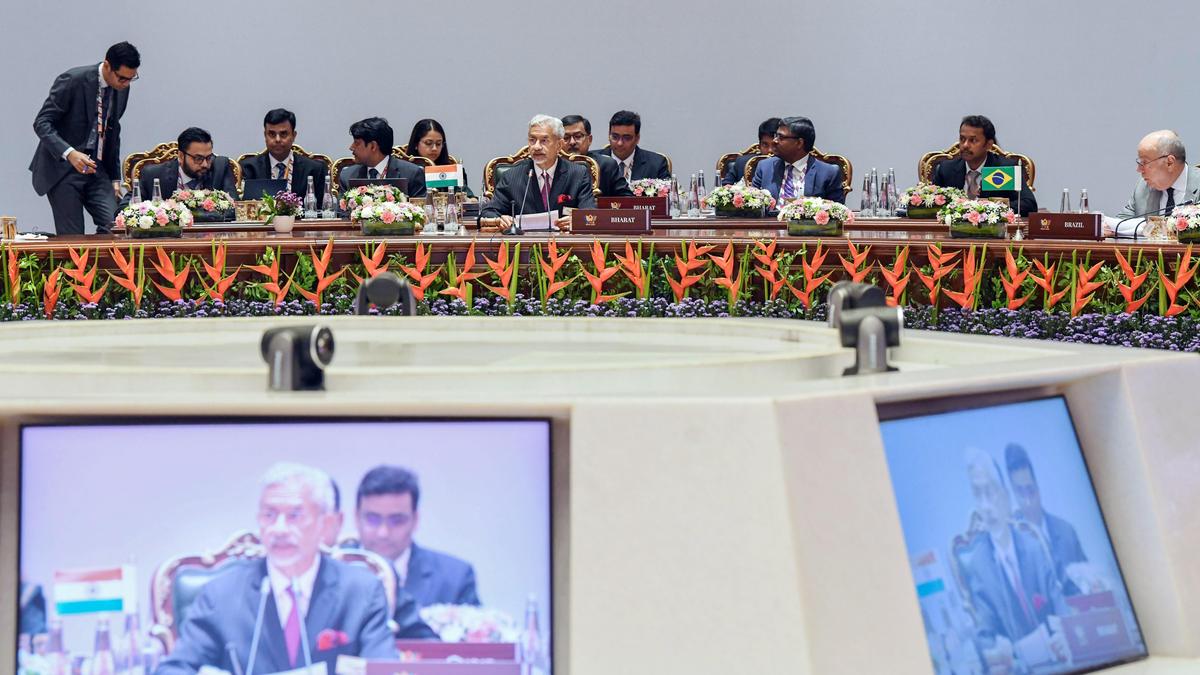
BRICS foreign ministers failed to issue a joint statement after sharp disagreements over Gaza, the Strait of Hormuz, and Red Sea security, though they reaffirmed support for Palestinian statehood within pre-1967 borders with East Jerusalem as capital. Iran and the UAE exchanged objections over wording on Gaza, maritime security, and regional control issues, while Iran’s foreign minister reiterated that the Strait of Hormuz lies within the territorial waters of Iran and Oman. The meeting was broadly geopolitical in nature, with limited direct market impact beyond added risk around Gulf shipping and regional diplomacy.
The investable signal here is not the public diplomacy theater; it is the widening gap between symbolic multilateral alignment and the operational fragmentation of the Gulf transport network. Any increase in rhetorical pressure around Hormuz, Bab al-Mandab, or Red Sea security adds a risk premium to marine insurance, tanker day rates, and inventory buffers, even without a kinetic escalation. That tends to flow first into non-OPEC crude benchmarks, regional refiners, and Asia-bound freight, with a lag into broader EM import inflation.
The second-order winner is not necessarily oil producers, but logistics intermediaries and sovereigns positioned as redundancy nodes. Chabahar’s strategic value rises if shippers and governments want an alternate corridor that bypasses contested maritime chokepoints; that is constructive for India-linked trade routes, rail-linked port assets, and container volumes into Central Asia over a 6-18 month horizon. The loser set is anyone dependent on just-in-time Gulf routing: refiners in India, Pakistan, and East Africa face higher working capital needs, while European and Asian consumers absorb a small but persistent energy and freight tax.
A more interesting contrarian read is that the market may be underpricing how little actual policy convergence exists inside BRICS on West Asia. That fragmentation reduces the odds of a unified bloc-driven disruption, but increases headline volatility because each member can independently escalate verbal posturing without coordination. In practice, this means event-driven spikes in crude, shipping, and defense names may fade unless followed by measurable interdiction data, sanctions, or insurance repricing.
The base case over the next 1-3 months is rangebound but jumpy freight and energy volatility rather than a sustained supply shock. The cleanest risk is an options-based one: long convexity around shipping/energy chokepoints, short any complacency in freight-sensitive EM proxies, and wait for confirmation from insurance or AIS disruption before adding beta.
AI-powered research, real-time alerts, and portfolio analytics for institutional investors.
Request DemoOverall Sentiment
neutral
Sentiment Score
-0.12
