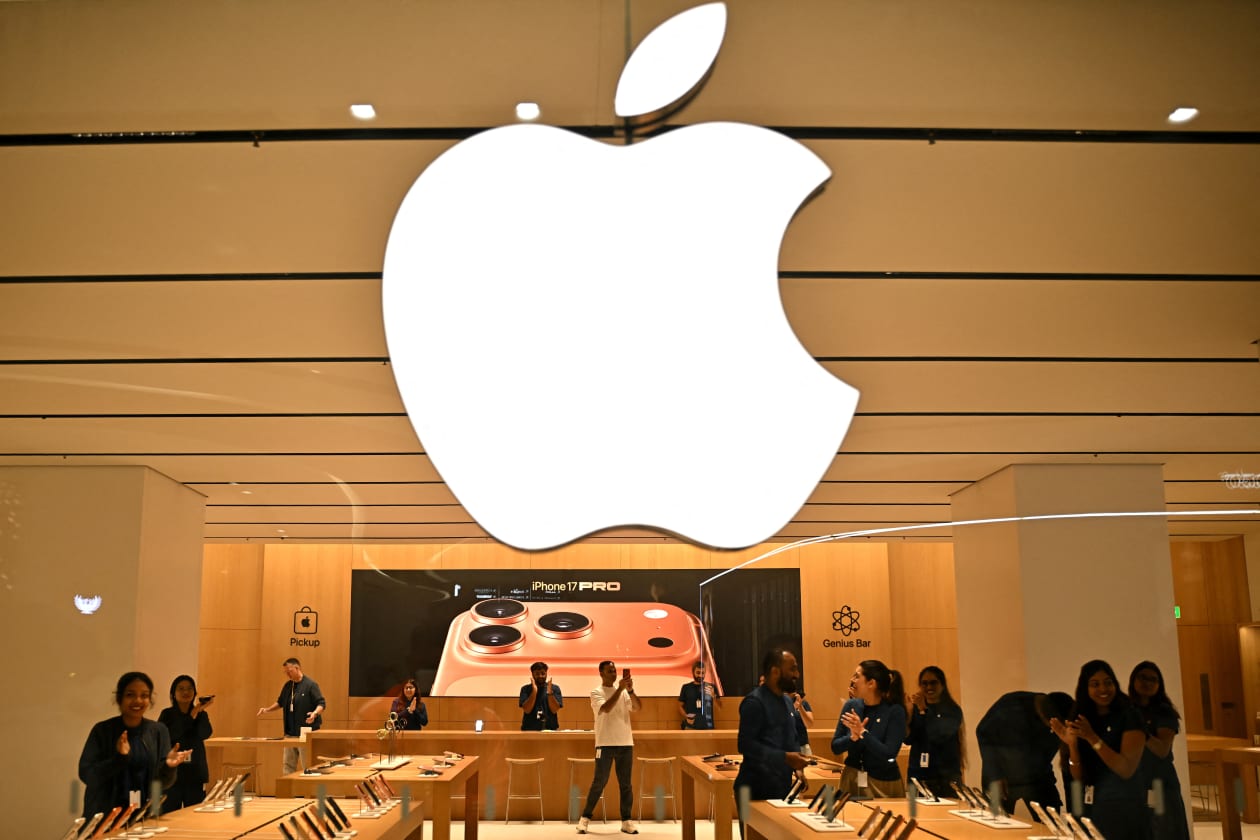
Apple’s CEO transition in September (Tim Cook stepping down, hardware chief John Ternus taking over) is viewed by Wall Street as a potential shift in the company’s AI-era strategy. Expectations center on more product innovation and a likely willingness to spend more, pursue larger mergers, and accelerate AI-focused initiatives. With no quantified guidance or financial figures provided, the near-term impact appears more narrative/positioning than immediately fundamental.
The market is likely underestimating how much of Apple’s premium is tied to operational predictability, not just product quality. A more aggressive AI posture would probably be a near-term margin headwind before it becomes a revenue driver, because the first dollars go to compute, talent, and acquisitions while monetization remains vague. That creates a subtle but real setup for multiple compression in AAPL even if the long-run innovation narrative improves.
The clearest second-order winners are the AI infrastructure names that benefit from any shift toward heavier model training, inference, or custom silicon: NVDA, AVGO, and TSM. If Apple becomes less insular, there is also spillover upside for enterprise AI software and cloud adjacencies, but the bigger read-through is that Apple’s internal rate of return on incremental R&D may fall before it rises. The competitive threat is less about a single product launch and more about Apple becoming a more active buyer of external AI capability, which would validate spend across the ecosystem.
The catalyst path is mostly event-driven over 1-3 months: succession messaging, the first earnings call with a new CEO, and any explicit capex/M&A language. The thesis is falsified if management keeps capital allocation unchanged, preserves buyback intensity, and frames AI as mostly on-device optimization rather than a broader spending step-up. Over 6-18 months, the structural question is whether Apple can turn distribution into a monetized AI layer without sacrificing the cash generation that supports its premium valuation.
Consensus may be missing that a CEO change does not solve Apple’s hardest problem: AI is a balance-sheet and product-cycle issue, not just a narrative issue. If the market crowds into a "more innovative Apple" trade too early, the risk/reward actually favors fading enthusiasm until there is proof of monetization rather than just rhetoric.
AI-powered research, real-time alerts, and portfolio analytics for institutional investors.
Request DemoOverall Sentiment
neutral
Sentiment Score
0.05
Ticker Sentiment
