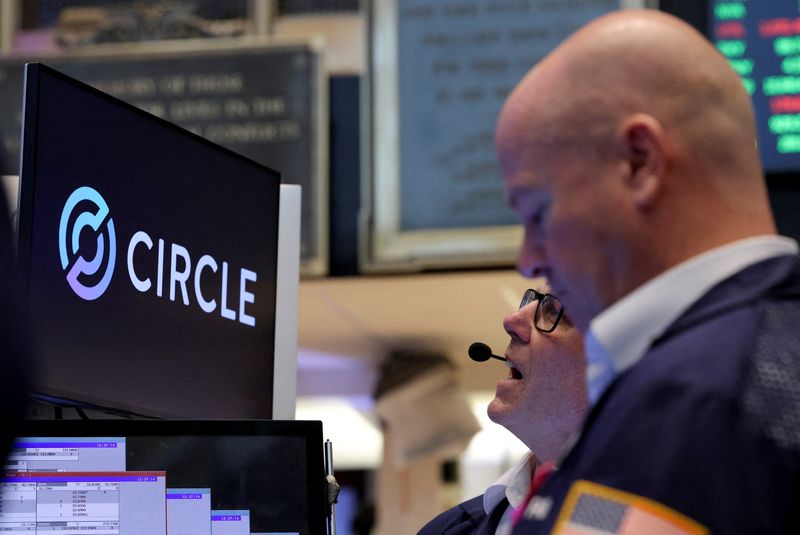
Circle reported Q1 fiscal 2026 adjusted EPS of $0.21, ahead of the $0.18 consensus, but revenue and reserve income of $694 million missed the $715 million estimate, leading to a 3% premarket decline. USDC circulation rose 28% year over year to $77.0 billion and onchain transaction volume jumped 263% to $21.5 trillion, while adjusted EBITDA increased 24% to $151 million. The company reaffirmed FY2026 guidance and announced a $222 million ARC Token presale plus new Agent Stack products tied to AI-driven payments use cases.
CRCL is increasingly behaving less like a payments processor and more like a toll collector on the AI-agent economy. The strategic implication is that the upside is not just stablecoin circulation growth, but wallet, orchestration, and marketplace monetization if developer adoption compounds; that creates a higher-quality long-duration narrative than a simple transaction-volume story. The market may still be valuing it as a crypto proxy, but the real optionality is whether Agent Stack becomes the default settlement rail for autonomous software over the next 12-24 months.
The miss on top-line versus the beat on earnings suggests a familiar pattern: profitability is improving faster than revenue recognition, which usually matters more for valuation in the near term. That can cap multiple expansion if investors worry that usage is not translating into take-rate fast enough, but it also reduces the chance of a financing overhang. If ARC and the broader ecosystem accelerate, BlackRock’s involvement is the key second-order signal: it lowers institutional friction for adjacent tokenized products and could pull more balance-sheet capital into the ecosystem, benefiting CRCL and potentially select private-markets rails.
The risk is that the market is extrapolating adoption too far ahead of regulatory and distribution reality. Stablecoin growth is high-beta to crypto risk appetite, but the agentic payments thesis will likely take quarters to prove in actual enterprise usage; any slowdown in onchain velocity or adverse policy language could compress the stock quickly. In the near term, the post-earnings selloff may be an opportunity if it reflects revenue noise rather than a change in product trajectory, but the setup is vulnerable to multiple compression if guidance is treated as non-committal rather than conservative.
AI-powered research, real-time alerts, and portfolio analytics for institutional investors.
Request DemoOverall Sentiment
mildly positive
Sentiment Score
0.18
Ticker Sentiment
