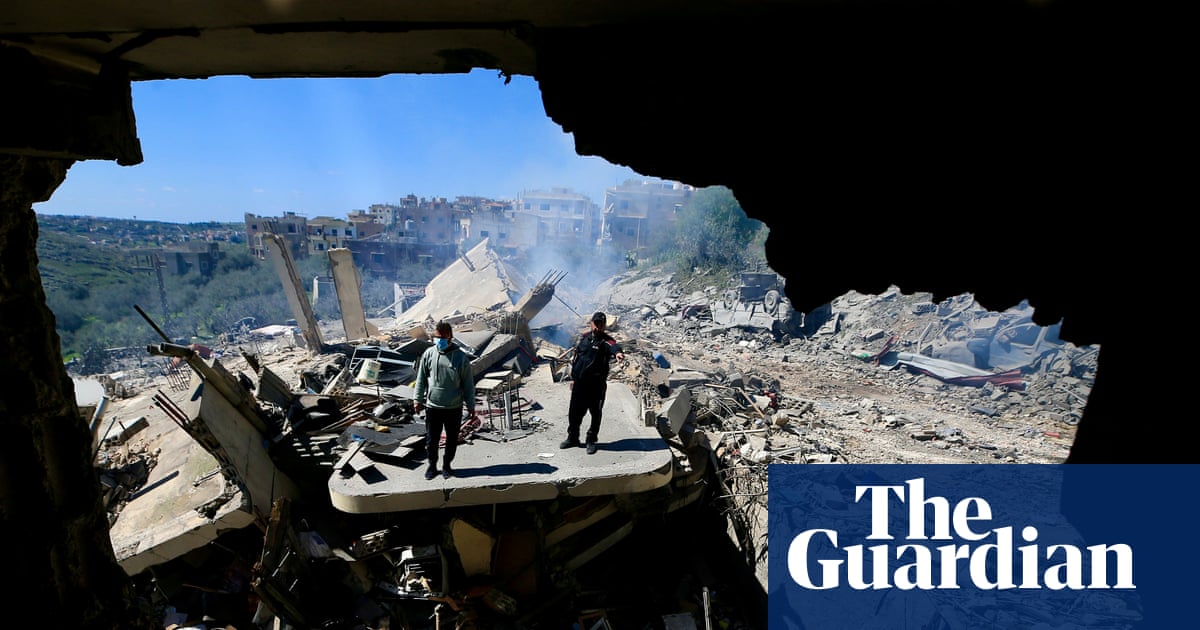
Israel’s campaign in Lebanon has displaced more than 1.2 million people and destroyed or damaged at least 2,154 buildings, with over 2,846 people killed and 8,693 wounded since the war began. The article describes ongoing strikes, forced evacuations, and demolition of villages and bridges, including the occupation of roughly 608 sq km or about 6% of Lebanese territory under the 'yellow line.' The conflict remains active despite the 17 April ceasefire, raising the risk of further regional escalation and renewed war.
The market implication is not “war premium” in the abstract; it is the creation of a semi-permanent uninsurable perimeter that suppresses private investment across south Lebanon for quarters, not weeks. Once roads, bridges, schools, and village centers are repeatedly destroyed, the economic damage compounds through population flight, collateral mortgage stress, and a collapse in local SME cash flows — a classic liquidity-to-solvency transmission that can outlast any formal ceasefire.
The second-order beneficiary is the regional security/services stack, not conventional defense primes alone. Border hardening, ISR, counter-UAS, secure communications, and reconstruction logistics become recurring spend categories for Israel and for Gulf states watching the model exported from Gaza to Lebanon; the more the conflict shifts to controlled demolition and occupation, the more the spend migrates from munitions to persistent perimeter management. That favors companies with software-heavy defense exposure and border-tech vendors over pure ammunition names.
The bigger risk is escalation asymmetry: the article suggests a lower-intensity war can still produce a sudden regime shift if strikes move deeper into Beirut or if Hezbollah decides the ceasefire is already dead. That tail risk matters on a 1-4 week horizon, while the rebuild/occupation thesis is a 6-18 month story. The contrarian read is that markets may be underpricing the duration of Lebanese displacement; once 1M+ people are uprooted, the political economy of return becomes far harder than the tactical ceasefire narrative implies, keeping a drag on sovereign credibility, bank asset quality, and any reconstruction-linked rally.
AI-powered research, real-time alerts, and portfolio analytics for institutional investors.
Request DemoOverall Sentiment
extremely negative
Sentiment Score
-0.95
