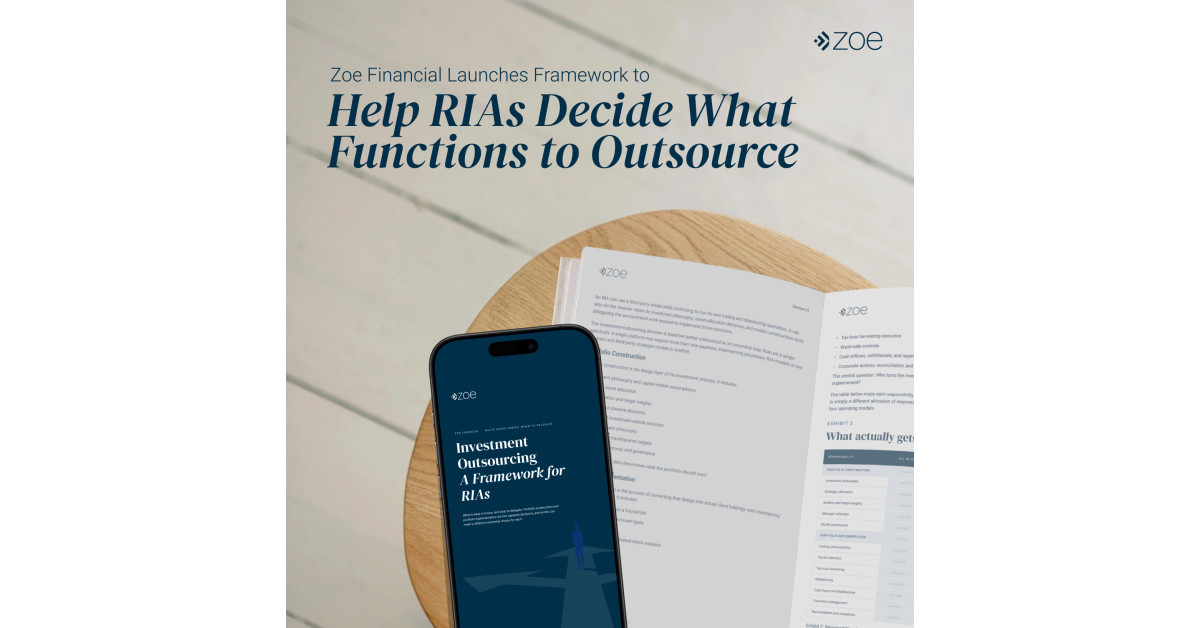
Zoe Financial launched a free white paper, “Investment Outsourcing: A Framework for RIAs,” breaking investment management into two separable functions—portfolio construction and portfolio implementation—to help advisory firms decide what to keep in-house vs delegate. The guide also estimates outsourcing fee ranges for models at $500 million in AUM and outlines practical checklists (including questions to ask TAMP/implementation partners) plus ways to transition books without tax headaches. This is a product/educational offering with limited direct market impact, but it signals ongoing fintech traction and support for RIA operational decisions.
This reads like distribution content, not a revenue inflection. The investable takeaway is that the winners are the platforms that sit inside RIAs’ operating workflow, not the firms publishing thought leadership: SEIC and SSNC are better positioned than pure-play model shops because modular outsourcing tends to bundle software, rebalancing, reporting, and implementation into a sticky stack. By contrast, smaller TAMPs and boutique OCIOs face fee compression if advisors can unbundle construction from execution and shop each layer separately.
The second-order effect is on RIA operating leverage and M&A. If outsourcing meaningfully lowers fixed costs, firms can absorb acquisitions faster and centralize compliance/trading, which should increase demand for standardized wealth tech over 6-18 months. But the near-term impact is mostly pipeline creation; the catalyst is only real if conversion shows up in partner wins, asset movement, or segment growth in the next 1-2 quarters.
Contrarian view: the market may be overrating how quickly an educational framework changes behavior. Most RIAs already know outsourcing is attractive; the friction is trust, transition risk, and whether they can justify an added basis-point layer. In a strong equity tape, many firms will keep portfolio construction in-house to preserve differentiation, which limits the upside for pure implementation vendors and makes this more of a slow-burn adoption story than a tradeable catalyst.
The supplied tickers are not clean economic proxies for this theme, so there is no high-conviction immediate equity read-through. If anything, the cleaner public expression is on the wealth-platform side rather than asset managers or banks.
AI-powered research, real-time alerts, and portfolio analytics for institutional investors.
Request DemoOverall Sentiment
mildly positive
Sentiment Score
0.15
Ticker Sentiment
