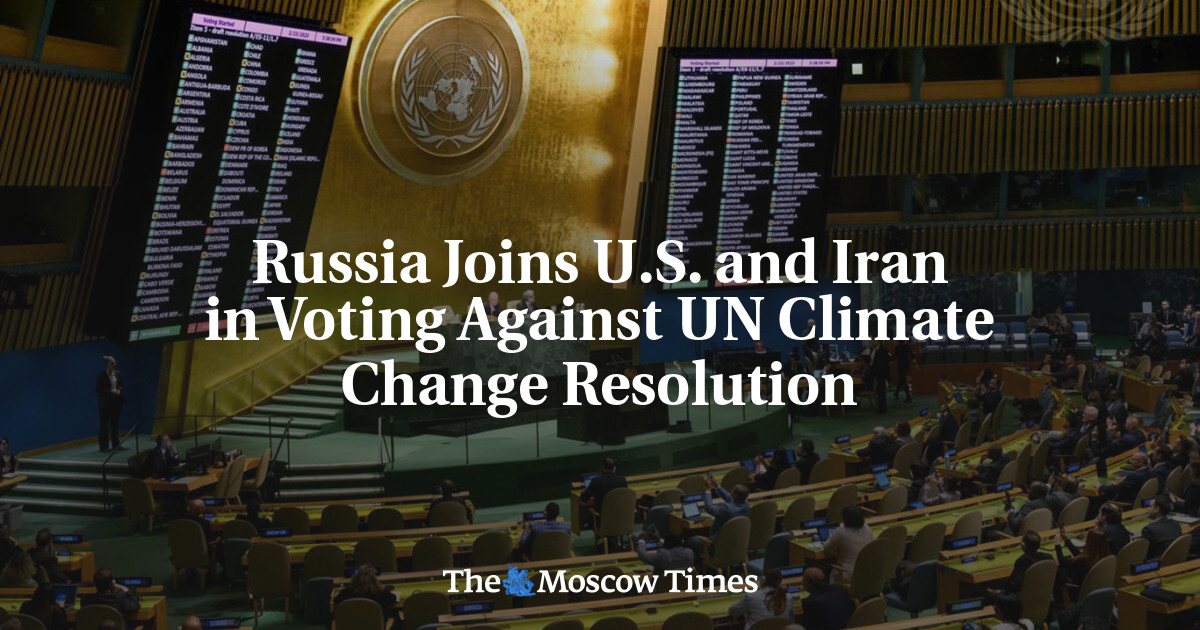
The UN General Assembly voted 141-8, with 28 abstentions, to back stronger climate action and endorse a July 2025 ICJ advisory opinion saying countries may owe "full reparation" for neglected climate commitments. Russia, the U.S., Iran, Saudi Arabia and several others voted against the non-binding resolution, underscoring continued resistance from major emitters. The vote is policy-significant for climate governance but is unlikely to have immediate direct market impact.
The immediate market read-through is not a commodity move, but a legal-risk repricing for carbon-intensive sovereigns and the listed companies most exposed to jurisdictions that are already fiscally stressed. The key second-order effect is that this vote strengthens the narrative for climate-linked claims against states and, by extension, for stricter disclosure, permitting, and financing conditions from European banks, multilateral lenders, and insurers underwriting projects in frontier markets. That does not hit every fossil asset equally; it disproportionately raises the cost of capital for long-duration, high-capex projects where repayment depends on public balance sheets or export revenues.
The more investable consequence is that this could widen dispersion inside “green finance.” Asset managers and banks with large sovereign, project-finance, or reinsurance books in emerging markets are exposed to incremental litigation and underwriting friction, while pure-play renewables names may benefit only if policy follow-through becomes enforceable rather than rhetorical. In other words, the winners are less the climate beneficiaries and more the intermediaries that can monetize compliance, adaptation, legal defense, and catastrophe-risk transfer. Expect a medium-term bid for insurers, specialty law firms, data/monitoring providers, and firms selling climate resilience infrastructure rather than broad beta in clean energy.
The contrarian view is that this is likely more important as a signaling event than as an immediate earnings catalyst. The resolution is non-binding, and the market has repeatedly learned to fade UN-level climate headlines unless they are paired with domestic implementation, court rulings, or penalties that change cash flows. The stronger trade is not to chase renewable equities on day one, but to position for a slow grind higher in compliance and risk-transfer spend over the next 6-18 months, especially if more governments begin translating advisory language into procurement, disclosure, and litigation standards.
Tail risk cuts both ways: if the US or other major emitters escalate resistance, climate policy could become more polarized, delaying capital allocation decisions and keeping uncertainty elevated. That favors volatility strategies and relative-value pairs over outright directional exposure. Any reversal would likely come from a major sovereign election cycle, a fresh court interpretation, or a fiscal crisis in an exposed producer that forces policy concessions faster than markets expect.
AI-powered research, real-time alerts, and portfolio analytics for institutional investors.
Request DemoOverall Sentiment
neutral
Sentiment Score
-0.05
