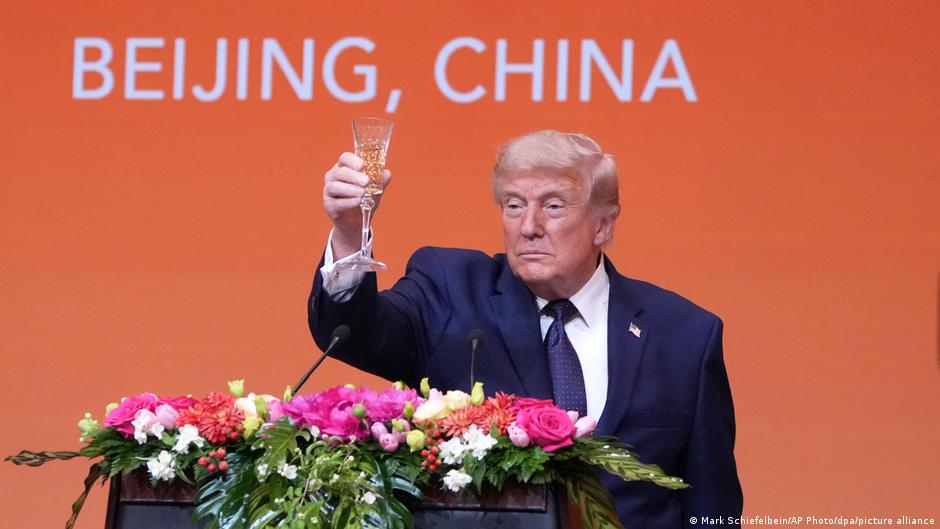
Trump and Xi ended their Beijing summit with upbeat rhetoric but no clear concrete agreements, while the Iran war and Taiwan remained the central flashpoints. Trump delayed a proposed $14 billion arms sale to Taiwan, and China reiterated opposition to US weapons transfers, increasing policy uncertainty. China also backed reopening the Strait of Hormuz, but it is unclear whether Beijing will provide any operational support, leaving geopolitics and shipping routes exposed to further disruption.
The market read-through is less about headline diplomacy and more about a temporary compression of policy risk premia around three names. NVDA has the cleanest second-order benefit: any thaw that reduces export-control intensity or delays new restrictions on advanced chips can extend the monetization window in China by quarters, not weeks, and the multiple impact is larger than the direct revenue impact because it lowers regime-risk discounting on the AI stack. AAPL gets a smaller but still real option value from reduced retaliation risk in consumer hardware, while TSLA remains the least protected because its China exposure is operationally meaningful and its brand is more easily weaponized in a dispute.
The deeper issue is leverage asymmetry: Washington appears to be using Taiwan arms timing as a bargaining chip, but that also signals to Beijing that U.S. commitments are negotiable when other theaters are under stress. That raises the odds of a slower-burn coercion campaign versus an outright kinetic event over the next 3-12 months — more gray-zone pressure, more customs friction, more informal consumer boycotts, and more delay in procurement/approval cycles. For semis and hardware, that matters because incremental deterioration in approval cadence can shave 2-4 turns off forward multiples before any actual revenue revision shows up.
The contrarian view is that the market may be overpricing a near-term détente. If the summit produced mostly symbolism, then the risk is a “false calm” where equities rally on optics while the underlying sanctions/export-control stack remains intact. In that case, the best trade is not to chase the beta pop, but to own the names with the most convex benefit from policy uncertainty resolving in their favor and fade the ones where China exposure is already embedded in optimistic margin assumptions. The biggest tail risk is a follow-on escalation in Iran that forces Washington back into a harder line on China within one quarter.
AI-powered research, real-time alerts, and portfolio analytics for institutional investors.
Request DemoOverall Sentiment
mildly negative
Sentiment Score
-0.15
Ticker Sentiment
