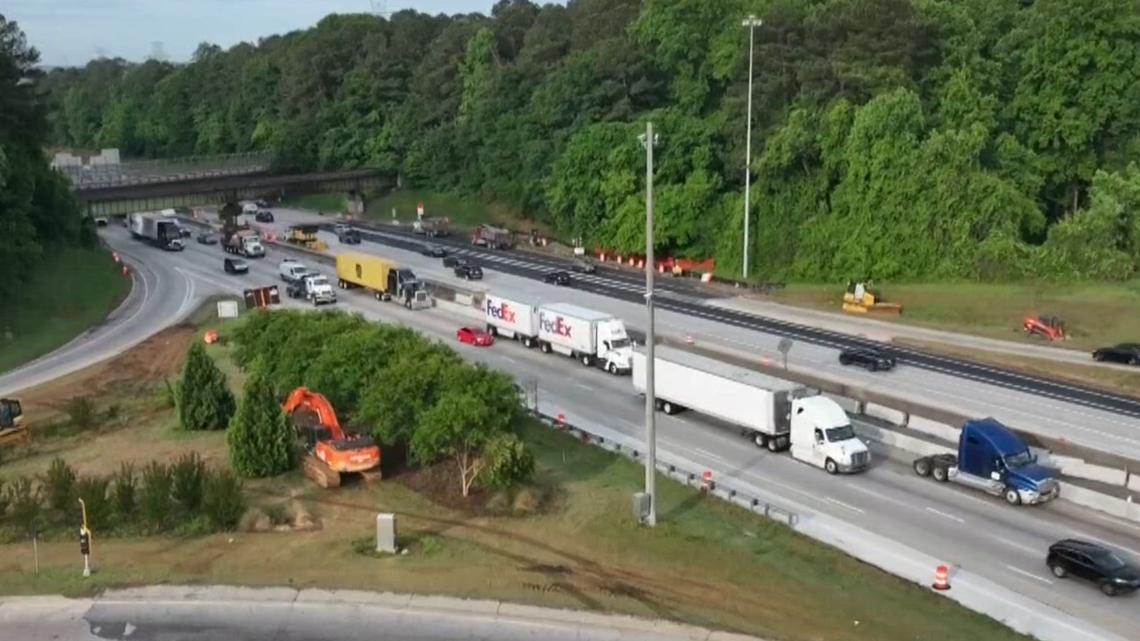
A full shutdown of I-285 in southwest Atlanta begins Friday at 7 p.m., with all lanes closed by 9 p.m. and reopening scheduled for 5 a.m. Monday as part of a three-year project to replace 15 miles of aging concrete. The closure is expected to create major congestion around Downtown Atlanta and the I-75/85 Connector, while nearby businesses along Cascade Road brace for lost weekend traffic.
The immediate market read is less about the road closure itself than the forced redistribution of demand. A one-weekend disruption near a major urban node tends to create a temporary convexity in traffic-dependent businesses: restaurants, convenience, fuel, and last-mile delivery can see sharp localized wins and losses, but the bigger second-order effect is on time-sensitive logistics that route through the downtown core. That kind of network congestion usually shows up first in labor productivity and same-day delivery performance, then in incremental fuel burn and overtime costs, which is why the economic damage can exceed the apparent geographic footprint.
The more interesting angle is that this is a rehearsal for a multi-year construction cycle, not a one-off event. Repeated closures create a medium-duration drag on businesses that depend on habitual customer routing, while beneficiaries are likely to be those with strong destination appeal or digital conversion, since convenience becomes a larger part of the purchase decision. If this repeatedly pushes discretionary trips away from the corridor, the damage compounds over months through lower visit frequency rather than just lost weekend sales.
From a trading perspective, the cleanest expression is not a direct bet on the roadway work, but on the congestion premium in adjacent consumer names and on any transport operator sensitive to Atlanta throughput. The risk is that the market may underreact because the headline impact is short-lived; however, the real catalyst is the cadence of future closures, which will matter more than this first weekend. Any evidence of broader event-related traffic spillover, delivery delays, or sustained rerouting would extend the trade from a nuisance event into a measurable local demand shock.
The contrarian view is that the disruption could improve awareness and traffic for businesses that are already destination-driven, meaning some of the obvious losers may recover faster than expected. In other words, the market may overestimate permanent demand destruction and underestimate the rerouting benefit to nearby corridors, especially if drivers adapt quickly after the first closure.
AI-powered research, real-time alerts, and portfolio analytics for institutional investors.
Request DemoOverall Sentiment
mildly negative
Sentiment Score
-0.25
Ticker Sentiment
