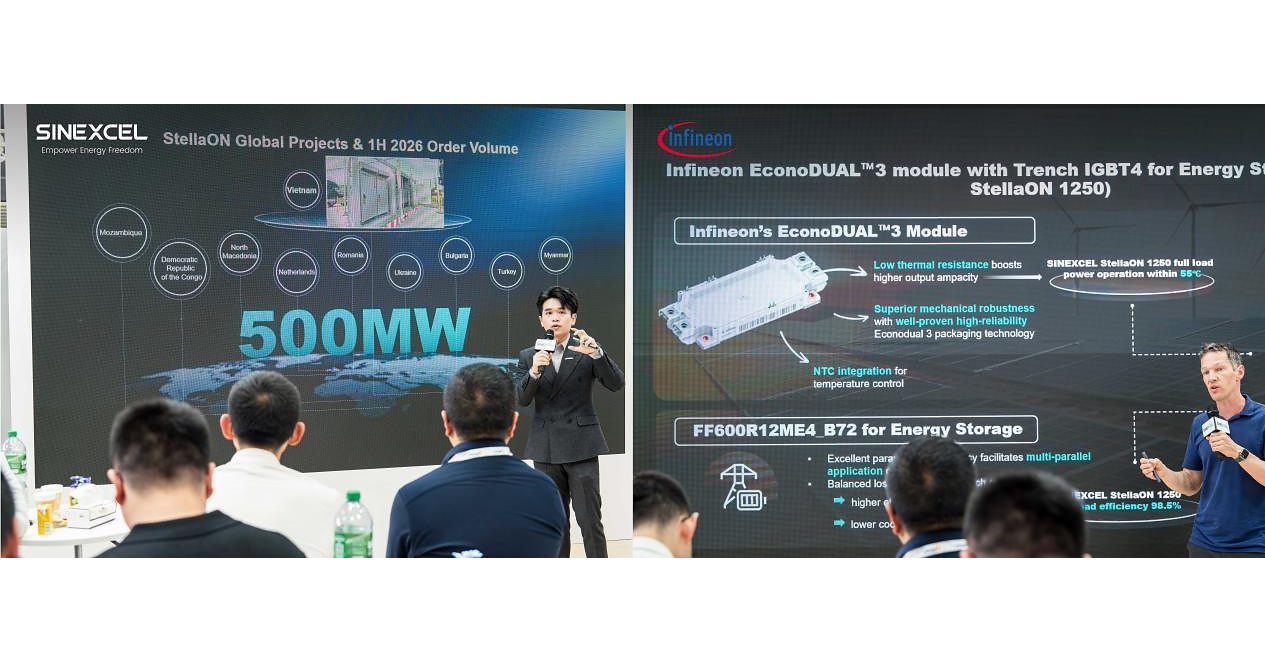
SINEXCEL launched its StellaON 1250K/1575K PCS energy storage system at Intersolar Europe, integrating Infineon modules to target higher grid stability and lifecycle economics. The system claims 98.5% efficiency at full load and 0.6% efficiency gain per transfer, while using EconoDUAL™3 to reduce performance degradation by 15%-20% and avoid oversizing costs of up to 20%. SINEXCEL reports >500MW orders in H1 2026 and 15+ projects across Europe/Asia-Pacific/Africa after successful Vietnam grid connection in March 2026, supporting a mildly positive outlook.
The investable signal is not the product launch itself; it is that high-temperature, grid-forming power electronics are becoming a qualification gate for utility-scale storage in Europe. That shifts value toward suppliers with differentiated module reliability and thermal headroom, which can translate into better pricing power and stickier design wins over time. For IFNNY, the near-term revenue impact is modest, but the mix effect could matter if this becomes a repeatable reference design across multiple OEMs and regions.
Second-order, the likely losers are lower-spec PCS vendors and storage integrators that have been relying on oversizing or derating to meet site requirements. If European projects increasingly demand grid-forming capability, the competitive moat moves from battery cells to power electronics, controls, and warranty credibility. That should also help developers and EPCs in hot-climate markets, because lower oversizing reduces capex and improves project IRR; the flip side is tighter vendor qualification and potentially slower procurement for low-cost entrants.
The key risk is that this is still a PR-driven demand signal, not independently verified earnings traction. The market can over-interpret a few hundred MW of orders; what matters over the next 1-3 months is certification progression in Spain/US and whether backlog converts into margin-accretive shipments. Over 6-18 months, the thesis is falsified if European storage growth slows, PCS pricing deflates faster than spec-led ASP expansion, or if competitors match the thermal/grid-forming performance without sacrificing cost.
Consensus may be missing that the real economic winner is the supplier that reduces project oversizing and downtime, not necessarily the OEM with the loudest launch. If that dynamic persists, the re-rating in power semis could be underdone versus the actual content increase per deployed MW.
AI-powered research, real-time alerts, and portfolio analytics for institutional investors.
Request DemoOverall Sentiment
mildly positive
Sentiment Score
0.25
Ticker Sentiment
