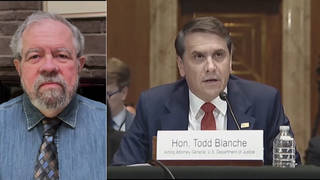
Iran is warning the war could spread beyond the Middle East if the U.S. attacks again, while Trump said Iran has just "two or three days" to reach a deal before renewed strikes. The Senate advanced a resolution to force an end to the war in Iran, with 4 Republicans joining most Democrats and 3 Republicans not voting; the measure still faces the GOP-controlled House and a likely Trump veto. The article also reports that U.S. and Israeli plans allegedly aimed to install Mahmoud Ahmadinejad as Iran's leader early in the conflict, underscoring elevated geopolitical escalation risk.
The market is likely underpricing the probability of a wider regional shock because the immediate headline risk is not the vote itself but the signaling cascade: once Washington’s credibility on follow-through is tested, every proxy actor in the region has an incentive to pre-position for escalation. That creates a nonlinear reaction path in energy, shipping, cyber, and defense procurement, where the first move is usually in vol but the second-order move is in insurance, logistics, and capex revisions. The timeline matters: the next 72 hours are about airstrikes and retaliation risk; the next 2-6 weeks are about whether this becomes a persistent Gulf premium rather than a one-off spike.
Domestic political resistance raises the odds of policy whiplash, which is bearish for risk assets because it lengthens the period of uncertainty without necessarily reducing tail risk. In these setups, the winners are rarely the obvious commodity beta names alone; the more durable beneficiaries are contractors and security vendors tied to replenishment, missile defense, ISR, and hardened communications. Civilian media exposure can also rise if the crisis broadens, but that is a second-order effect unless the conflict extends beyond the Middle East and starts to disrupt travel, transport, or cyber infrastructure.
The contrarian view is that the market may already be discounting an escalation premium too aggressively if the administration is using the threat window as leverage for a negotiated off-ramp. If a deal emerges quickly, the unwind in oil and defense vol could be sharp over 1-3 sessions, but any relief rally would likely fade unless there is a credible enforcement mechanism. The real asymmetry is in skew: downside in risk assets from a surprise strike is immediate, while upside from de-escalation is slower and capped by residual headline risk.
AI-powered research, real-time alerts, and portfolio analytics for institutional investors.
Request DemoOverall Sentiment
strongly negative
Sentiment Score
-0.70
Ticker Sentiment
