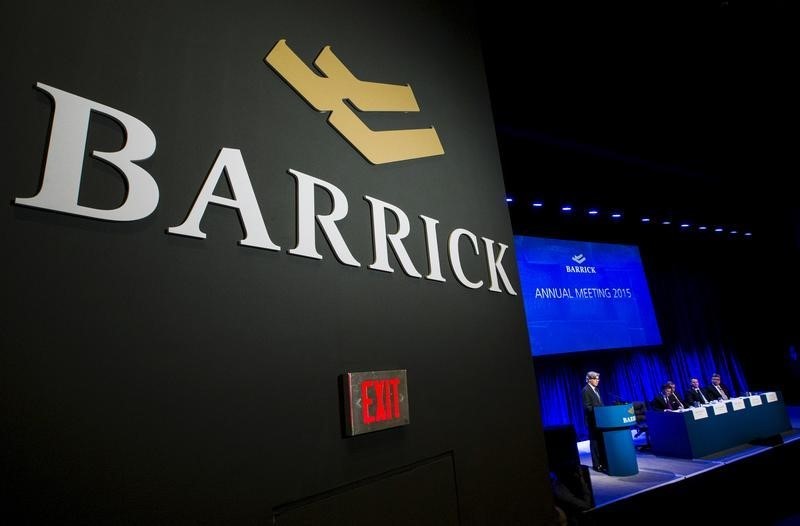
Barrick Mining delivered a strong Q1 beat, with adjusted EPS of $0.98 versus $0.81 consensus and revenue of $5.22 billion versus $4.84 billion expected, up 67% year over year. Gold production of 719,000 ounces exceeded guidance, while operating cash flow jumped 111% to $2.55 billion and free cash flow rose 195% to $1.21 billion. The company kept 2026 production guidance intact, raised shareholder returns via a $0.175 quarterly dividend and a new $3.0 billion buyback, and said the North American Barrick IPO remains on track.
Barrick is increasingly behaving like a self-funding cash machine rather than a simple gold beta. The mix of stronger unit economics, higher volume, and a larger repurchase authorization creates a mechanical bid for the stock: every incremental cash-flow beat now has a higher chance of being recycled into buybacks instead of sitting idle, which should compress the equity risk premium over the next 1-2 quarters. The planned asset separation is the more important catalyst because it can surface value currently buried inside a diversified structure, especially if the market starts assigning a higher multiple to the North American asset base than to the legacy consolidated vehicle.
The second-order winner is the gold-equity complex, but not uniformly. High-quality producers with low political risk and visible capital returns should outperform the metal itself if gold stays elevated, while higher-cost or jurisdictionally fragile miners may lag as investors rotate toward cleaner free-cash-flow conversion. Barrick’s improving operating cadence also raises the bar for peers: any company missing guidance or lacking buybacks will now look weaker by comparison, which could widen valuation dispersion across the group.
The main risk is not production execution; it is a reversal in the macro tape. If real yields rise, the multiple can de-rate faster than cash flow grows, and the stock’s operating leverage works both ways over a multi-month horizon. The separation also introduces execution risk: if investors perceive the IPO as a financial engineering exercise rather than a genuine simplification, the valuation uplift could be delayed or partially clawed back.
Consensus is likely underestimating how much optionality is embedded in the structure change versus the quarter itself. The quarter confirms durability, but the real edge is that Barrick now has enough cash generation to fund shareholder returns while simultaneously preparing a value-unlocking transaction. That combination typically supports a rerating only after the market believes the capital return policy is not temporary; the buyback announcement helps, but sustained repurchases over the next 2-3 quarters will matter more than the headline authorization.
AI-powered research, real-time alerts, and portfolio analytics for institutional investors.
Request DemoOverall Sentiment
strongly positive
Sentiment Score
0.72
Ticker Sentiment
