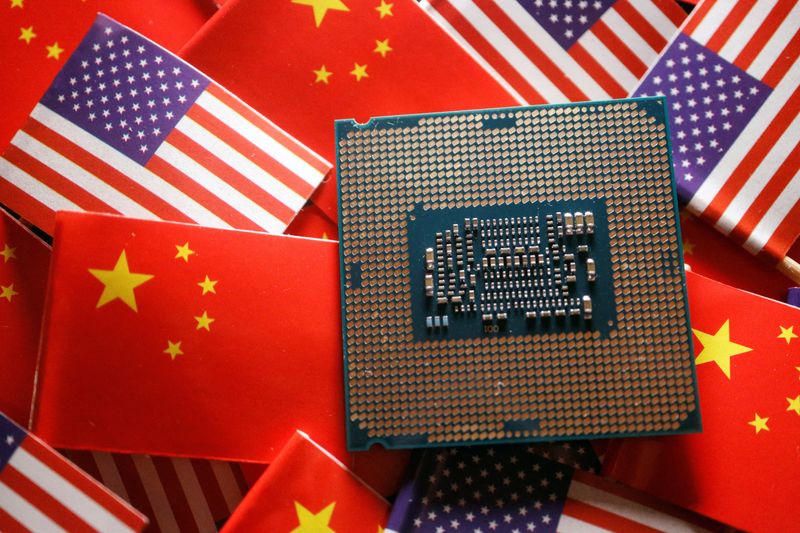
U.S.-China talks did not materially advance chip export controls, but Reuters reported Nvidia’s H200 AI chip was approved for sale to 10 Chinese companies, with no sales yet made. The article also highlights expectations for larger U.S. agricultural purchases from China and continued soybean commitments. Nvidia CEO Jensen Huang’s presence alongside Trump, Musk, and Cook underscores ongoing policy sensitivity around AI chip access to China.
The market implication is not that export controls are disappearing, but that enforcement is likely shifting from a blanket choke point to a more selective, transaction-by-transaction regime. That is constructive for NVDA because even modest re-openings of China access can add meaningful incremental revenue without requiring a full policy reversal; the second-order effect is that supply chain capacity, not just policy, becomes the binding constraint if orders re-accelerate. The immediate beneficiary is NVDA, while domestic China AI chip vendors face a tougher competitive bar if high-end U.S. silicon becomes intermittently available again.
The bigger read-through is to Tesla and Apple sentiment, but for different reasons than headline optics. Tesla benefits only indirectly: improved U.S.-China dialogue lowers the probability of a punitive tech-trade spiral that would have hit China EV demand and consumer confidence, but it does little for near-term fundamentals. Apple is the more interesting second-order beneficiary because easing geopolitical tension reduces the odds of asymmetric retaliation against a premium U.S. consumer hardware brand with a large China footprint.
The key risk is that this remains highly reversible: one adverse comment on Taiwan, semiconductor leakage, or a failed negotiation could re-tighten the policy overhang within days. Over a 1-3 month horizon, the trade is less about actual H200 shipment volume and more about expectations of future rule relaxation, which can drive multiple expansion before revenue shows up. If China starts buying at scale, the upside for NVDA is real; if approvals stay symbolic, the stock may give back gains once the market realizes revenue contribution is delayed.
Consensus may be underestimating how bullish even partial ambiguity is for semi multiples. Investors are positioned for either complete restriction or complete détente, but the more likely path is a messy middle that preserves optionality for the biggest U.S. AI platform names while keeping Chinese competition constrained enough to avoid immediate share loss. That dynamic favors NVDA on a relative basis over equipment names and over China-exposed hardware suppliers that need clean policy clarity to de-risk forecasts.
AI-powered research, real-time alerts, and portfolio analytics for institutional investors.
Request DemoOverall Sentiment
neutral
Sentiment Score
0.15
Ticker Sentiment
