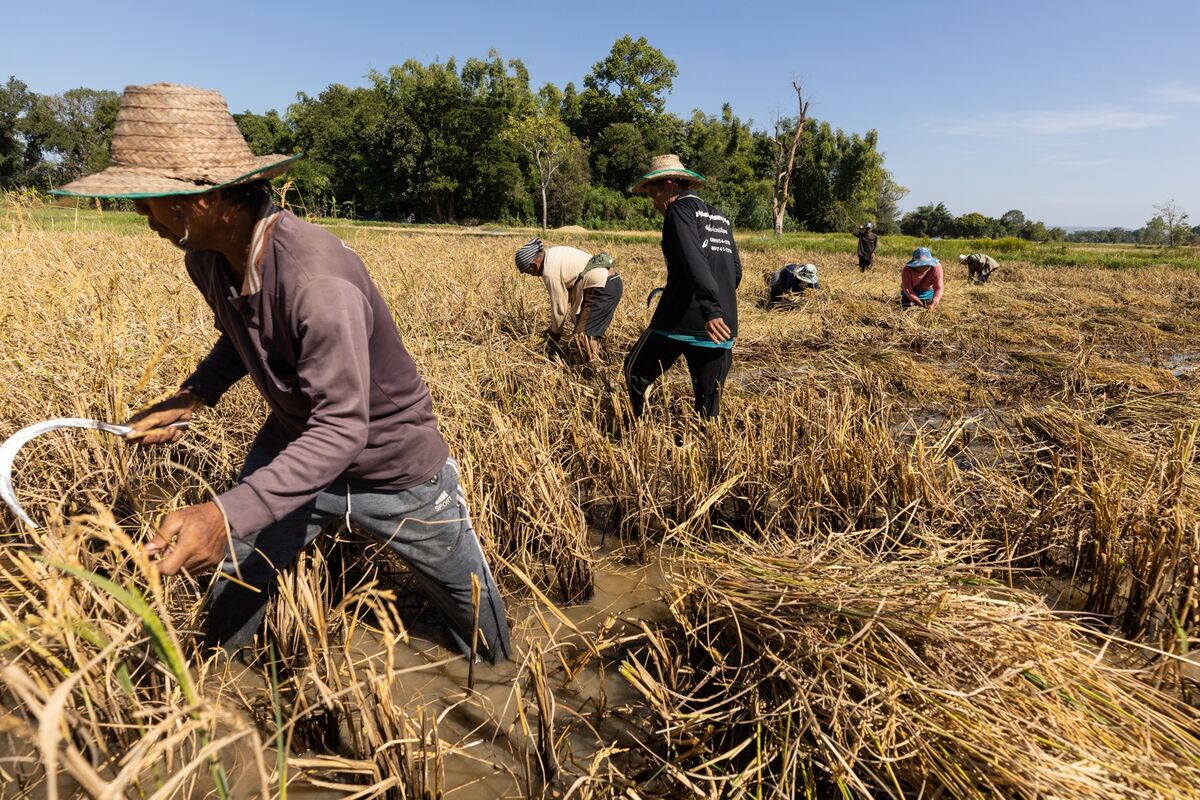
Thai 5% broken white rice rose to $446 a ton, the highest since February 2025, marking a third straight weekly gain as crop concerns mount across Asia. The move follows USDA forecasts for global rice production to decline in the 2026-27 season for the first time in 11 years. The article signals tighter supply conditions in a key food commodity, but it is largely informational rather than a broad market catalyst.
This matters less as a single-commodity rally and more as a signal that food inflation pressure is re-accelerating in Asia at the margin. The first-order winners are upstream agribusiness inputs — seed, fertilizer, irrigation, and crop protection — because a higher price regime typically incentivizes acreage protection and input intensity even when farmers are cash constrained. The second-order loser is any food manufacturer or retailer with weak pricing power and heavy Asia sourcing exposure; margins can compress before the inflation basket visibly re-prices, creating a lagged earnings risk over the next 1-2 quarters.
The key catalyst is whether this becomes a self-reinforcing inventory cycle. If buyers start pre-loading inventories on fear of tighter 2026-27 supply, nearby prices can overshoot fundamentals for several months even if the eventual production decline proves modest; that would favor traders over physical users. Conversely, the move can reverse quickly if India, Thailand, and Vietnam all respond with export-friendly policy or if weather normalizes, because rice is unusually sensitive to policy intervention and substitution at the margin.
The market is likely underestimating the inflation transmission risk to countries where rice is a high share of household calories. Even a small rise in staple prices can tighten consumer discretionary spend and pressure politically sensitive EM governments to intervene, which can create volatile policy-driven gaps rather than smooth trends. The contrarian view is that the price move may be more about thin liquidity and headline-driven positioning than a durable multi-year shortage, so chasing spot strength without a policy hedge is poor risk/reward.
From a portfolio perspective, this is more attractive as a relative-value theme than a directional grain bet. The best setup is to own beneficiaries of agricultural capex and nutrient demand while fading consumer exposure in rice-dependent markets or food producers unable to pass through input costs. A breakout in rice above recent highs could also spill into broader grain volatility, so optionality is preferable to outright futures exposure.
AI-powered research, real-time alerts, and portfolio analytics for institutional investors.
Request DemoOverall Sentiment
neutral
Sentiment Score
0.15
