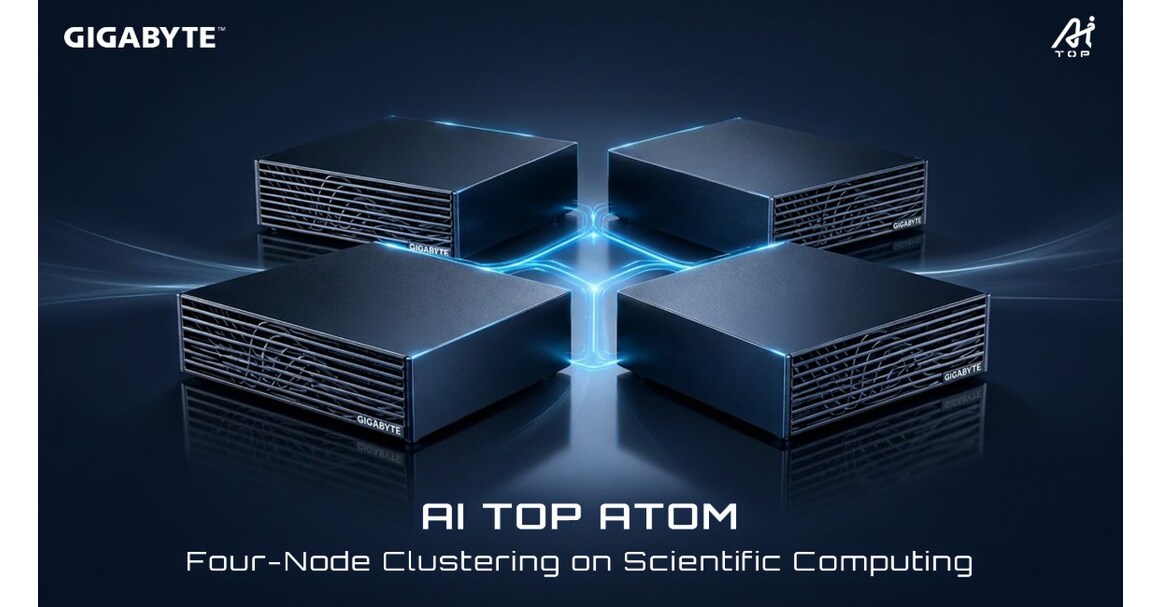
GIGABYTE showcased an AI TOP ATOM four-node cluster designed to scale local AI/scientific computing: each node delivers 1 PFLOPS FP4 performance and 128GB unified memory, with four nodes connected via a RoCE-capable 200GbE switch. The company claims the clustered setup lifts molecular-dynamics simulation capacity from ~10 million atoms on standalone systems to 30+ million atoms for TIM development supporting advanced semiconductor packaging, using NVIDIA NemoClaw blueprints and Nemotron-3-Nano-30B-NVFP4 models plus GROMACS. This is a product/technical demonstration with limited near-term financial implications, but it modestly supports the narrative of improving AI-infrastructure scalability and on-prem data sovereignty.
This is a small but telling signal for the AI infrastructure stack: the economic value is not in the demo itself, but in the validation that on-prem, memory-heavy inference and simulation can be packaged into a repeatable enterprise product. That tends to favor the highest-end silicon and the vendors that can bundle compute, memory bandwidth, and networking into a single procurement decision; it is less supportive of commodity box-builders unless they own the software/workflow layer.
The more interesting second-order effect is substitution. If private clustered systems become “good enough” for a wider set of research and engineering workloads, some spend that would have gone to hyperscale cloud GPUs gets pulled back on-prem, which is constructive for hardware attach but not necessarily for cloud utilization rates. Over 1-3 months, the read-through is mainly sentiment and pipeline; over 6-18 months, the bigger implication is that enterprise AI capex may broaden from chat/inference into simulation-driven R&D, which increases total GPU demand per site but also raises the bar on power, cooling, and networking.
For NVDA, the upside is that clustered local deployments reinforce the premium tier of the market and make software ecosystem lock-in more valuable. The risk is that these deployments remain niche demonstrations until buyers see clear ROI, in which case the announcement becomes a marketing proof-point rather than an order driver. For WWRL, there is no clear standalone catalyst unless it has direct exposure to clustered systems, enterprise HPC integration, or advanced packaging supply chain; otherwise this is noise.
Contrarian view: consensus may over-index on "more AI demand" and underweight the fact that local clusters can also redistribute spend away from cloud and toward lower-margin integrators. The near-term bull case is real for NVIDIA ecosystem share, but the durable winner is whichever vendor can convert this from a one-off cluster into a standardized, repeatable enterprise workflow with measurable throughput gains.
AI-powered research, real-time alerts, and portfolio analytics for institutional investors.
Request DemoOverall Sentiment
mildly positive
Sentiment Score
0.15
Ticker Sentiment
