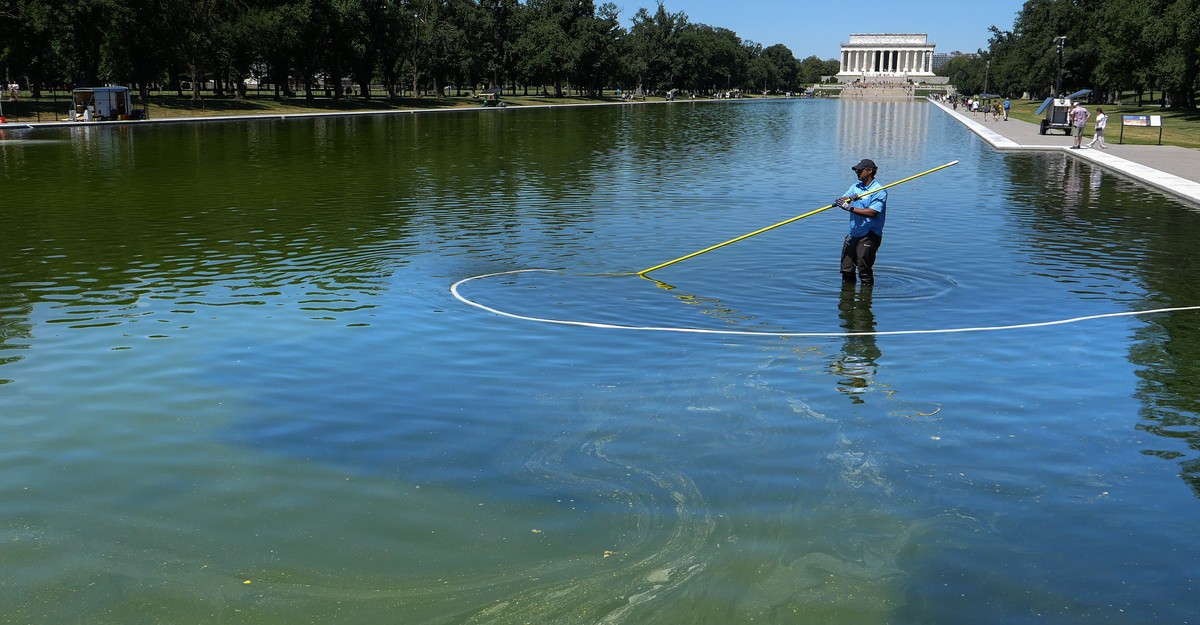
The Trump administration’s Lincoln Memorial Reflecting Pool renovation has ballooned to an estimated $16.4 million, roughly $14 million over budget, and is now mired in allegations of damage, no-bid contracting, and sabotage claims. The article frames the project as a case study in administrative dysfunction, highlighting bypassed procurement procedures, disputed arrest counts, and a pool that remains fenced off and under National Guard protection. While politically damaging, the story is unlikely to have direct market impact beyond modest sentiment effects around governance and federal spending.
This is less about a single absurd project than a governance signal: the administration is normalizing cost inflation, no-bid contracting, and post-hoc justification as a repeatable operating model. That matters for markets because it raises the probability of budget leakage into low-productivity capex while increasing headline risk around federal procurement, permitting, and litigation. The near-term beneficiary is not the contractor set so much as media engagement and political monetization; the real economic losers are firms exposed to federal execution quality, where timeline slippage and change-order risk can quietly compress margins.
The second-order risk is that the pattern spills from optics into process. If agencies become more willing to use urgency exemptions and then retrofit the narrative, we should expect more legal scrutiny, inspector-general attention, and bid protests over the next 1-3 months. That raises friction for infrastructure, defense support, and environmental remediation names that rely on clean federal procurement, while paradoxically helping the largest incumbents that can absorb compliance costs and litigate through delays.
For equities, this is a sentiment-negative but not yet macro-relevant event: the direct economic impact is small, but the governance premium on government-adjacent contracts is deteriorating. The market is likely underpricing the cumulative effect of repeated embarrassment on institutional trust, which can feed into higher discount rates for politically exposed revenue streams. The contrarian view is that the episode is so obviously farcical that investors may overreact on headlines while the actual P&L damage remains de minimis; in that case, any selloff in well-capitalized federal contractors should be bought, not shorted.
The bigger tail is reputational: if this becomes a durable template, agencies may become more operationally brittle and more expensive to insure, finance, and litigate against. That is a slow-burn negative for public-private project economics over quarters, not days, but it can create tactical dislocations around earnings calls and contract awards as management teams are forced to address process risk rather than growth.
AI-powered research, real-time alerts, and portfolio analytics for institutional investors.
Request DemoOverall Sentiment
strongly negative
Sentiment Score
-0.55
Ticker Sentiment
