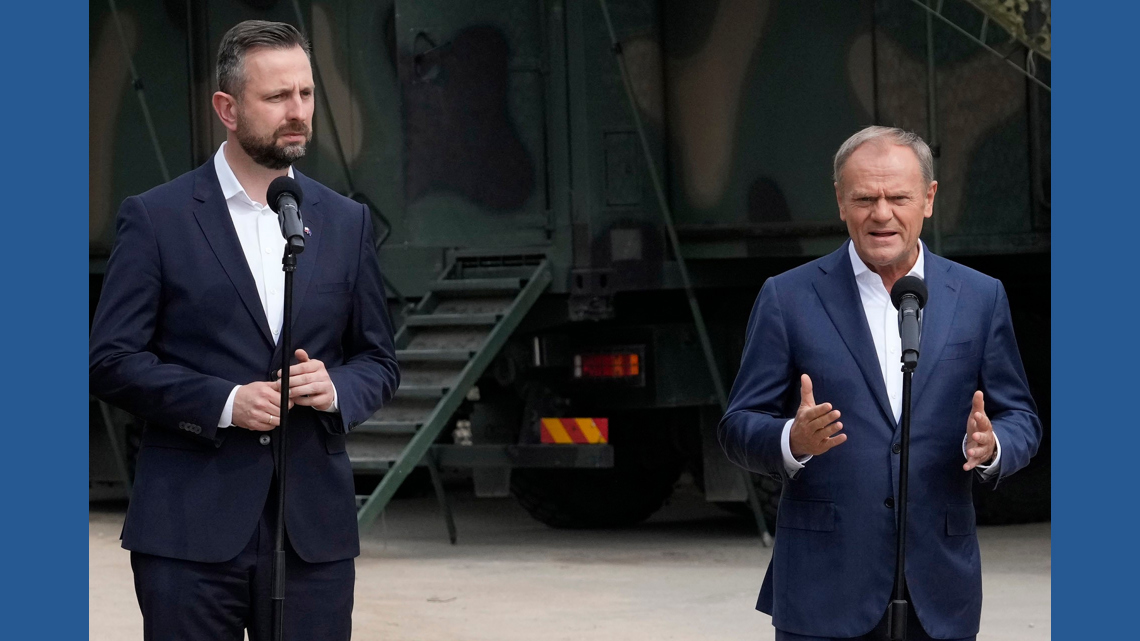
The U.S. said the planned deployment of 4,000 troops to Poland is only a temporary delay, not a cancellation, easing Polish concerns after last week’s surprise. The Pentagon cited a reduction in Europe’s assigned brigade combat teams from four to three, while NATO said allies have long expected Washington to draw down some forces and push Europe and Canada to take more responsibility. The issue centers on U.S. force posture in Europe, including around 10,000 U.S. troops typically stationed in Poland and at least 5,000 being drawn down in Germany.
The near-term market read-through is not about Poland alone; it is about whether Europe’s eastern flank is becoming the default absorber of U.S. force-mix volatility. That creates a subtle winner/loser split: Polish and broader Central European defense industrials gain a persistent procurement bid, while German-based NATO enablers and legacy host-nation infrastructure face higher policy uncertainty as Washington reallocates scarce brigade assets. The second-order effect is a higher “security premium” for logistics, air defense, artillery, and base-support capacity in countries closest to Ukraine, which should support multi-year demand even if the troop move itself is reversed.
The bigger signal is that rotational presence is being treated as a negotiable variable, which increases the value of domestic readiness spending and local industrial offsets. That is bullish for European primes with exposure to air defense, munitions, and vehicle sustainment because allied governments will likely hedge against future U.S. delays by front-loading orders over the next 2-4 quarters. It is also a relative negative for U.S. contractors whose European revenue depends on forward-deployed U.S. formations, since a slower or smaller troop footprint reduces near-term base, maintenance, and training spend in theater.
Contrarianly, the move may be less bearish for NATO cohesion than headlines imply: if Europe concludes the U.S. is still committed but more selective, the result could be a faster fiscal response rather than a lower one. The risk case is a longer-than-expected delay that becomes politically sticky ahead of European budget negotiations, or a broader drawdown that forces a reassessment of posture across Germany, Poland, and the Baltics. That would likely be a months-long repricing rather than a days-long headline trade, because procurement and force relocation decisions typically lag political signaling by 1-2 budget cycles.
AI-powered research, real-time alerts, and portfolio analytics for institutional investors.
Request DemoOverall Sentiment
neutral
Sentiment Score
0.05
