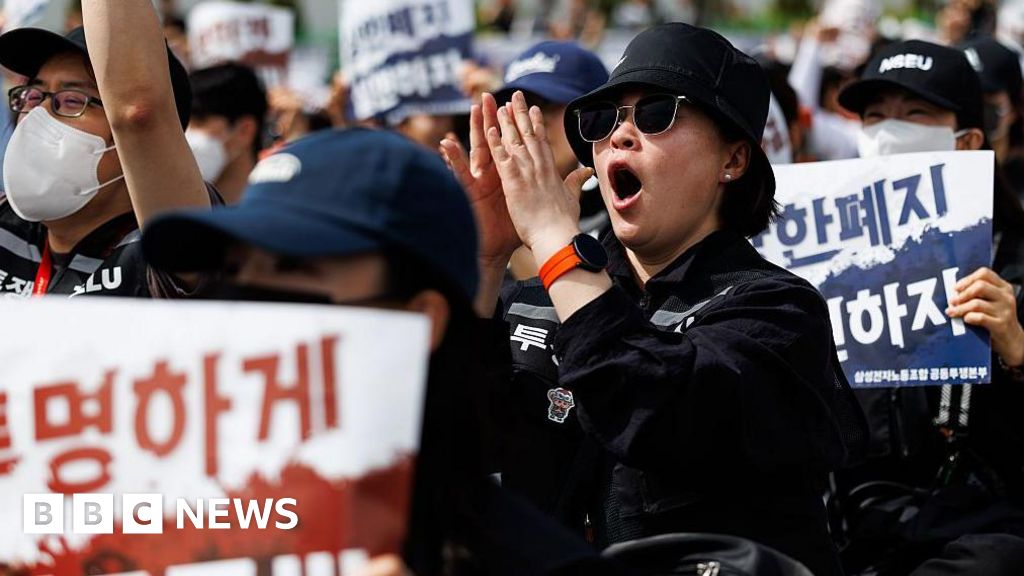
Samsung’s largest union has suspended a planned strike after reaching a tentative pay deal, reducing near-term disruption risk at the world’s largest memory chipmaker. The dispute centered on how to split AI-chip profits, with Samsung proposing bonuses of 607% of annual salary for memory-chip workers versus 50%-100% for other staff. Samsung warned a strike could have cut operating profit by 21 trillion won to 31 trillion won ($14.08bn to $20.79bn), though a court injunction and the temporary suspension limit the immediate impact.
The immediate market read is correctly mild relief, but the bigger signal is that Samsung is being forced to defend labor economics precisely when AI memory demand is re-rating the entire DRAM/HBM stack. If compensation compression inside the group persists, the real risk is not a full shutdown but incremental execution drag: slower yield ramps, less flexible staffing, and more bargaining power migrating to rival fabs that can poach skilled workers with cleaner incentive structures. That favors SK Hynix on talent retention and production prioritization, and it indirectly supports Micron by reinforcing the perception that supply remains structurally tight even without a formal strike.
The second-order issue is that Samsung’s margin pool is now competing across business lines, which can create a quiet capital-allocation problem. Memory is the profit engine, but if non-memory workers perceive permanent undercompensation, Samsung may have to raise fixed labor costs across weaker units, muting the operating leverage from the AI cycle. Over a 3-6 month horizon, that is more important than the headline strike risk because it can slow the rate at which Samsung converts demand strength into incremental supply.
For customers like Tesla and Nvidia, this is less about immediate component shortages and more about negotiating leverage. Any sign of labor instability at Samsung strengthens the case for dual-sourcing, higher strategic inventories, and longer-term supply contracts, which can temporarily inflate working capital and procurement costs. The market is probably underpricing the possibility that this episode accelerates sourcing diversification away from Samsung in favor of Hynix and Micron, even if the strike itself never materially interrupts output.
The contrarian view is that the rallied stock reaction may be too complacent: a suspended strike is not a resolved labor regime. If workers vote down the deal, the next flare-up could coincide with the most sensitive part of the AI memory upcycle, when customers are least able to absorb disruption. Conversely, if management concedes too much, the risk shifts from labor disruption to structurally lower operating margin quality, which is slower-moving but more durable.
AI-powered research, real-time alerts, and portfolio analytics for institutional investors.
Request DemoOverall Sentiment
mildly positive
Sentiment Score
0.15
Ticker Sentiment
