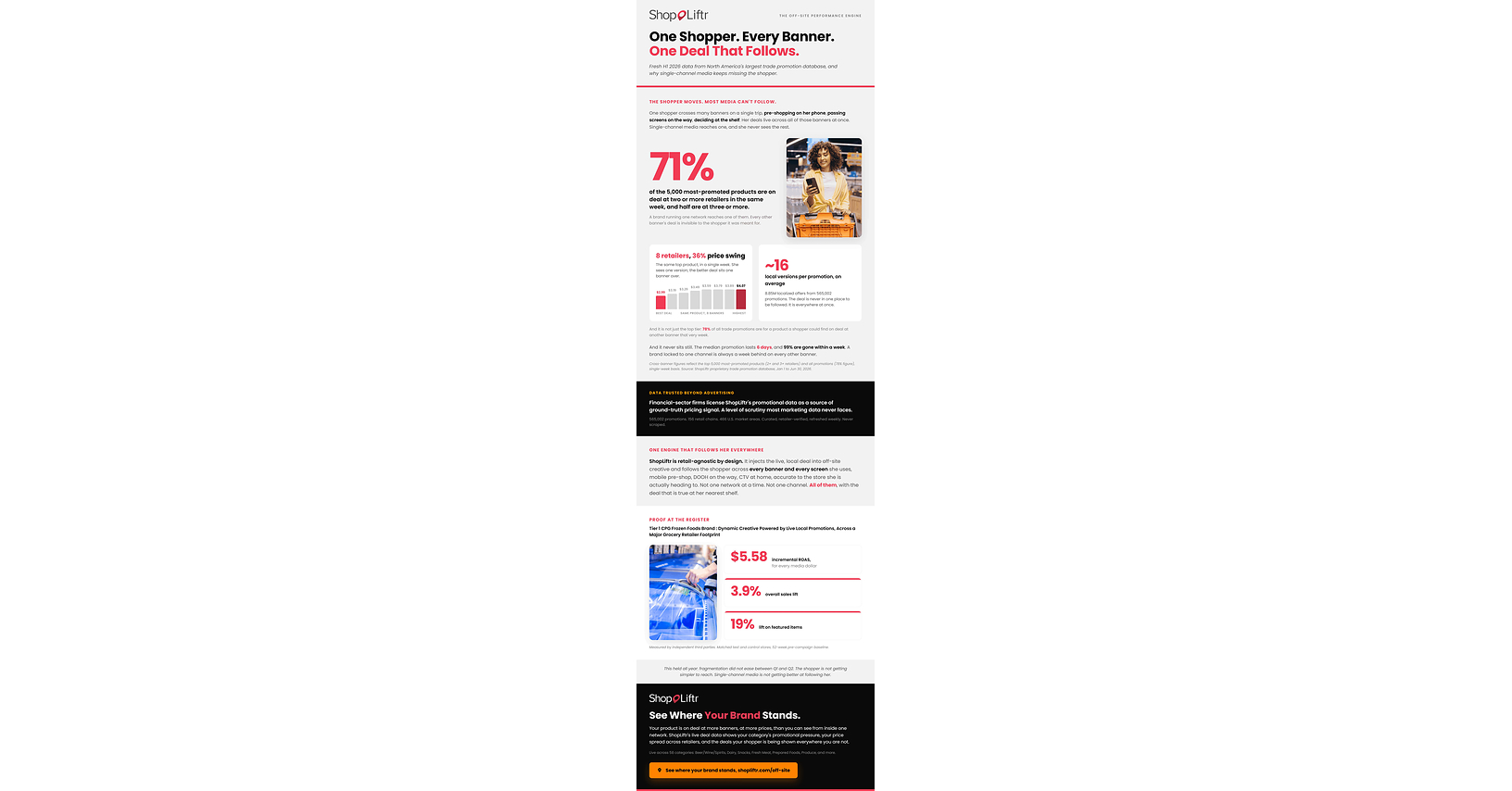
ShopLiftr reports that in the first half of 2026, a top promoted product is on deal at an average of 8 retailers in a given week, with a 36% swing between highest and lowest promoted prices. It also cites off-site retail media spend of $16.09B in 2026 (62.6% of US retail media display spend), growing 29.1% YoY, and claims store-level proof from a frozen foods campaign: +3.9% overall sales lift, +19% on featured items, and $5.58 incremental sales per $1 of media spend versus matched control markets.
The investable implication is less about one vendor and more about budget migration: brands are increasingly paying for measurable, location-specific conversion rather than broad reach. That favors open-web / CTV / DOOH infrastructure and data layers that can ingest first-party promo feeds, while compressing the edge of static retail-media execution and manual ad operations. In public markets, the cleaner beneficiaries are the platforms that can monetize incremental performance budgets, not the small private software layer itself.
Second-order, the pressure lands on merchants and CPGs with the most fragmented pricing architecture. If localized promotion becomes more visible and easier to optimize, categories with heavy couponing and frequent markdowns should see less waste, which is margin-positive for disciplined brands but negative for competitors that rely on blanket discounting to buy share. The biggest structural risk is that retailers with weak promo data or poor loyalty graphs lose traffic to better-targeted peers even if headline pricing is unchanged.
This looks more like a 1-3 month budget-planning catalyst than a same-day stock catalyst. The thesis is falsified if agencies report no meaningful reallocation toward measurable off-site channels in Q3/Q4 planning, or if incrementality studies fail to replicate outside a few categories; in that case, this remains a vendor narrative rather than a durable spend shift. Over 6-18 months, if AI-driven shopping assistants standardize shelf-to-ad matching, the data and measurement stack becomes more valuable, but only if the underlying retailer integrations stay proprietary.
AI-powered research, real-time alerts, and portfolio analytics for institutional investors.
Overall Sentiment
mildly positive
Sentiment Score
0.25
Ticker Sentiment
