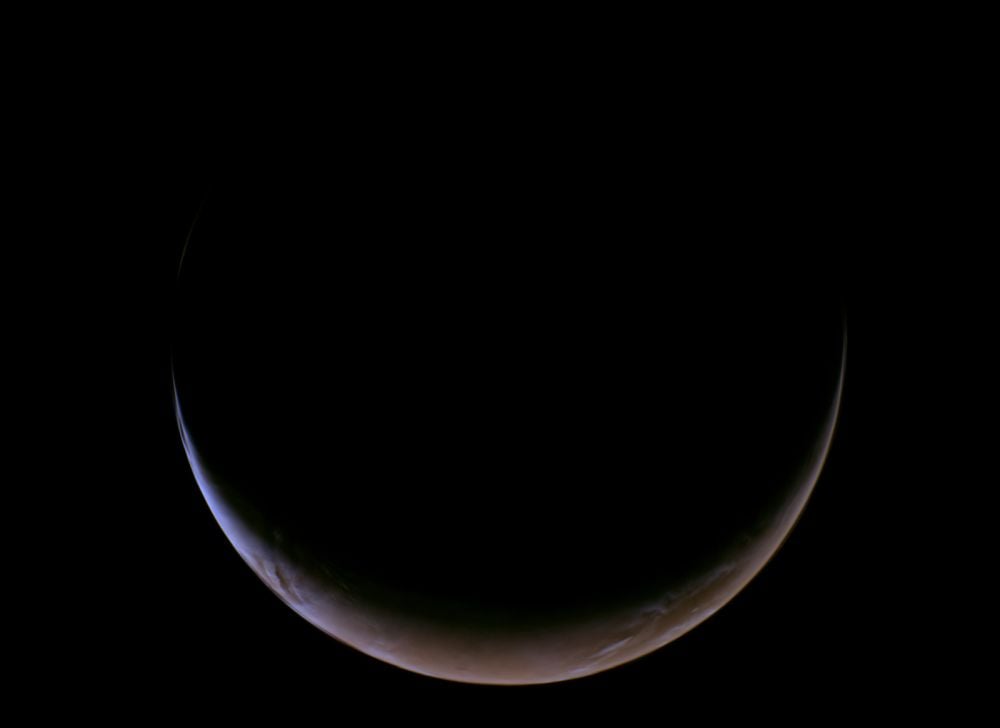
NASA’s Psyche spacecraft completed its Mars flyby on May 15, gaining a 1,000 mph boost and about a 1 degree orbital-plane shift, and remains on track for arrival at asteroid 16 Psyche in summer 2029. The mission will use its multispectral imager, gamma-ray/neutron spectrometer, magnetometer, and Deep Space Optical Communications system to test and calibrate instruments en route. The article is primarily mission progress and technical update, with no immediate market-moving financial implications.
This is less a “space story” than a quiet validation event for the industrial base behind deep-space autonomy. The mission’s ability to navigate, image, and communicate after a gravity assist is a live-fire demo for optical comms, onboard autonomy, low-power radiation-tolerant electronics, and long-duration thermal control — capabilities that matter for defense, Earth observation, and next-gen comms far more than for asteroid science alone. The second-order winner set is the subcontracting ecosystem around deep-space buses, optics, detectors, and high-reliability components; the market usually underprices these programs because revenue is lumpy, but the technology transfer path is durable.
The real catalyst is not the flyby itself but the 2029–2031 data window, which turns this into a multi-year call option on proof points. If the laser comms link works at scale, it pressures conventional RF incumbents by expanding the feasible bandwidth/latency envelope for future NASA and DoD missions; even partial success could accelerate procurement budgets toward optical terminals, pointing systems, and error-correction software. Conversely, any setback would not just hurt this mission — it would slow the adoption curve for a broader class of deep-space architectures, pushing back procurement by 12–24 months.
A contrarian read: the market may be over-anchored to the “core vs. primordial” headline and underestimating that ambiguity is itself valuable. If the asteroid turns out to be unusual or mixed, that does not diminish the platform — it increases the need for follow-on missions, higher-resolution instruments, and commercial deep-space services. The more likely underappreciated effect is budgetary rather than scientific: one successful flagship mission lowers political risk for adjacent programs, and that can feed a longer tail of contracts into the defense/space supply chain.
AI-powered research, real-time alerts, and portfolio analytics for institutional investors.
Request DemoOverall Sentiment
neutral
Sentiment Score
0.05
For investors, the key is to treat this as a staged catalyst stack, not a binary event. The next re-rating should come from any credible disclosure on optical comms throughput, instrument health, or extended mission planning, well before the asteroid arrival date.
