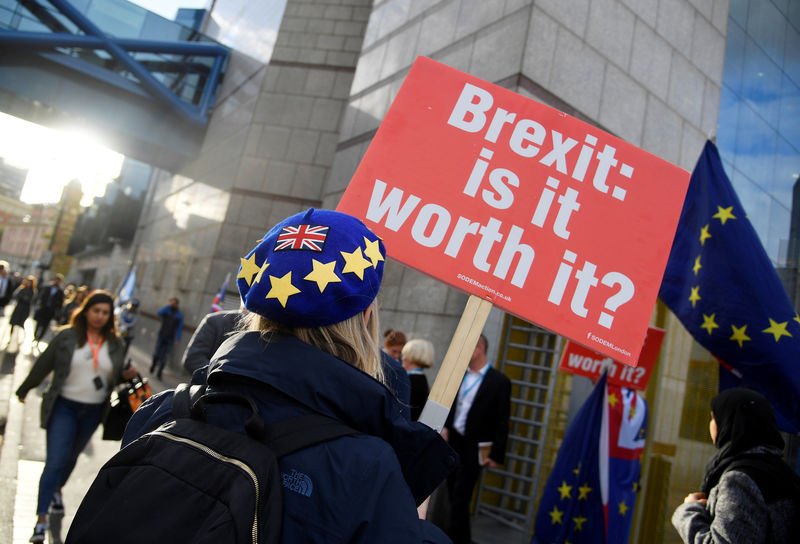
Deutsche Bank estimates Brexit has left the UK economy about 4% smaller than it otherwise would have been, cut employment by roughly 2% or 685,000 jobs, and lifted consumer prices by about 0.7%. The report says much of the divergence emerged after the pandemic and the 2021 UK-EU trade agreement, with business investment and EU goods exports notably weaker. Offset by some gains in regulatory flexibility, independent trade policy, and AI/financial services positioning, the overall read is still a net economic drag, though targeted TCA improvements could lift GDP 0.4% to 0.8%.
The market is still mispricing Brexit as a one-time regime shift, but the real equity impact is a slow-burn capital allocation tax: lower expected return on UK investment, higher hurdle rates for exporters, and a persistent discount to UK domestic cyclicals. That matters more for banks, brokers, and asset managers than for headline macro because weak business formation and lower capex suppress fee pools, loan growth, and M&A activity for years. For DB specifically, the story is not the lost UK growth per se, but the second-order drag on its London franchise and on cross-border corporate demand that would have benefitted a pan-European bank more than a more domestically oriented peer.
The more interesting implication is that a modest easing of EU-UK frictions could be a high-ROI policy lever without requiring a politically explosive rejoin path. If even a fraction of the estimated GDP uplift is realized, the winners are likely import-intensive UK retailers, logistics, and lenders with UK balance-sheet exposure, while the losers are pure exporters facing a stronger sterling and tighter relative cost pressure. The FX channel is key: any credibility around incremental trade normalization should support GBP, which would mechanically tighten conditions for domestically leveraged firms but improve real incomes and sentiment.
The consensus is too binary: either Brexit is permanently destructive or the damage is fully priced in. What is being underappreciated is that the largest incremental gains or losses now come from marginal policy changes, not the original vote — especially regulatory alignment in services, AI, and financial services. That creates a medium-horizon catalyst set over 6–18 months tied to UK politics, EU bargaining, and currency moves rather than the old Brexit headline cycle.
AI-powered research, real-time alerts, and portfolio analytics for institutional investors.
Request DemoOverall Sentiment
mildly negative
Sentiment Score
-0.15
Ticker Sentiment
