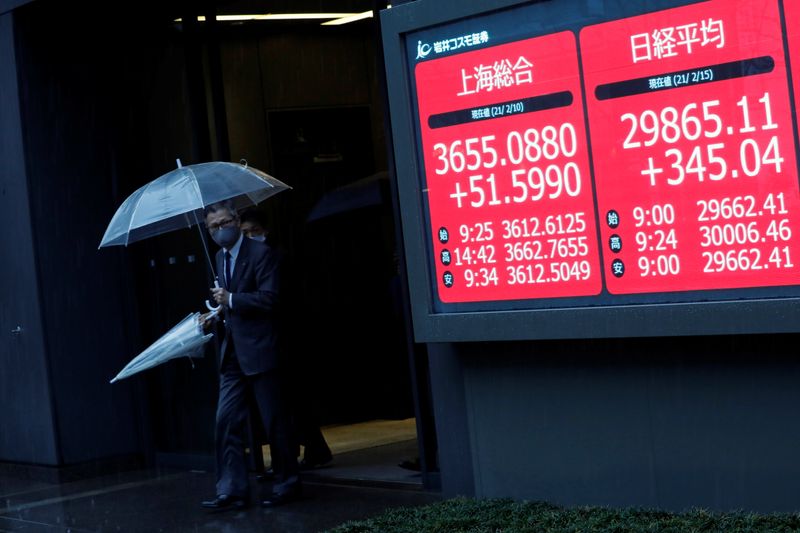
Tokyo stocks fell 0.49% as declines in Paper & Pulp, Transport, and Communication offset broad market gains, with rising shares outnumbering decliners 1,889 to 1,659. Nintendo dropped 8.44% to a 52-week low, while Ajinomoto rose 9.32% to a 52-week high; the Nikkei Volatility index fell 9.25% to 34.16. Commodities were firmer, with June crude up 3.78% to $99.03, Brent up 3.21% to $104.54, and gold down 0.90% to $4,688.15, while USD/JPY rose 0.21% to 157.00.
The dominant signal is not the headline index drift, but the simultaneous spike in energy, drop in JPY volatility, and sharp rotation in single-name losers: the market is pricing a higher geopolitical risk premium while still treating it as a contained macro shock. That combination usually favors upstream energy, shipping insurance, and defense-adjacent suppliers, while penalizing sectors with high import input exposure or consumer-discretionary beta. The key second-order effect is FX: a firmer USD/JPY near 157 tends to cushion exporters with overseas revenue but compresses domestic purchasing power, which is a quiet headwind for Japanese consumer names even if the index itself looks benign.
The move in volatility is important. A falling Nikkei vol index alongside a stronger oil bid suggests investors are not yet paying up for tail hedges, which means there is room for a catch-up re-pricing if the geopolitical story broadens or if oil holds above the psychological threshold for several sessions. If crude stays bid for a week, expect revisions to Japan transport, chemicals, and food chains through higher bunker, feedstock, and packaging costs; that usually shows up with a lag, so the first leg of the trade is in rates/FX-sensitive exporters, the second leg is in margin compression for domestically exposed sectors.
The contrarian point is that this kind of risk-off in a few crowded growth names often creates a better entry window than a broad index short. The sharp drawdown in high-beta technology is likely more about positioning and local flow than fundamental deterioration, while the commodity move may be more durable if it is tied to supply-risk escalation. That means the best risk/reward is probably not a directional bet on Japan equities overall, but a relative-value expression that isolates higher energy and geopolitical sensitivity from the market’s still-complacent volatility pricing.
AI-powered research, real-time alerts, and portfolio analytics for institutional investors.
Request DemoOverall Sentiment
neutral
Sentiment Score
-0.05
Ticker Sentiment
