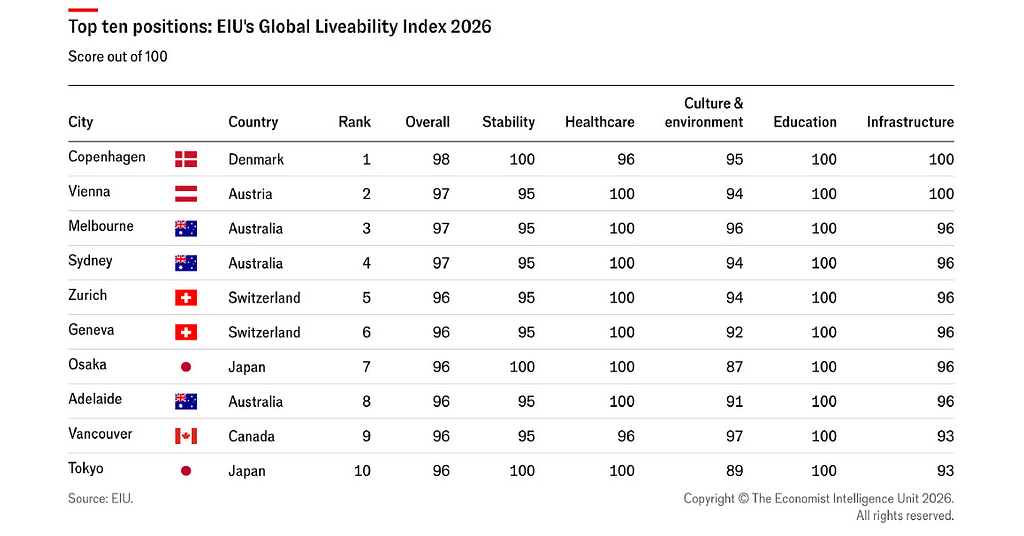
The EIU Liveability Index 2026 reports Middle East stability deterioration tied to the Iran war, with MENA cities down more than 3 ranking places on average; Muscat fell 14 places to 123rd and Kuwait City fell 12 to 105th. Offsetting this, Asian healthcare improvements increased the average Asian city score by 0.3 points to 73.9 and lifted Asia as the most improved region. Overall global average liveability is unchanged year-over-year as stability declines in the Middle East offset healthcare gains in Asia.
The tradable read-through is not the ranking change itself; it’s the widening gap between perceived institutional stability and capital allocation. Deterioration in MENA is a slow-burn tax on tourism, expatriate retention, insurer pricing, and real-estate cap rates, so the market impact is more likely to show up in sovereign spread drift and subdued FDI than in immediate equity reaction. That argues for a higher risk premium on regional consumer, hotel, and REIT cash flows over the next 6-18 months, especially where foreign labor and dollar funding are sensitive to security headlines.
Asia’s healthcare improvement is more interesting as a policy signal than as an earnings event. It supports a longer-duration thesis for healthcare infrastructure, managed care, and diagnostics, but the first-order effect on listed equities is likely small unless it is accompanied by visible reimbursement expansion or capex acceleration over the next 1-3 quarters. The better expression is relative: Asia quality screens are improving while the market still prices much of the region as a blunt EM beta trade.
The contrarian point is that liveability scores move slowly and often lag real capital flows; the consensus may be overestimating how much a one-year ranking shift changes next-quarter multiples. The cleaner catalyst path is a narrower set of second-order indicators: sovereign CDS, tourism receipts, and regional currency pressure for the losers; hospital spending and insurance penetration for the winners. If those do not confirm over the next 1-2 quarters, this is noise rather than a portfolio signal.
AI-powered research, real-time alerts, and portfolio analytics for institutional investors.
Overall Sentiment
neutral
Sentiment Score
-0.10
Ticker Sentiment
