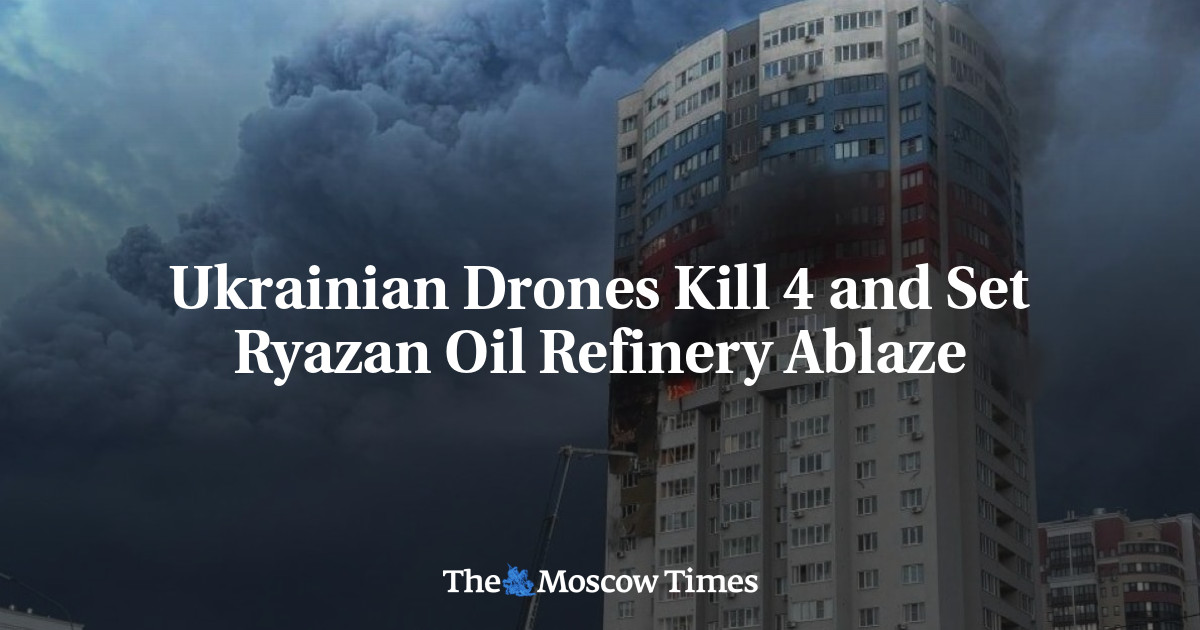
At least four people were killed and a dozen others wounded after a Ukrainian drone attack hit Ryazan, with reports indicating a fire at the Rosneft-operated Ryazan Oil Refinery, one of Russia’s largest fuel plants processing about 17 million tons of crude annually. Satellite imagery showed a smoke plume extending more than 100 kilometers, underscoring potential disruption to Russian refining capacity. The strike is part of an escalating exchange of attacks on energy infrastructure and could add volatility to regional fuel markets.
This is a directional positive shock for refined product markets rather than crude per se: the marginal effect is tighter diesel/gasoline availability inside Russia and the Black Sea export complex, with spillover into European middle distillates if substitute barrels need to be pulled from elsewhere. The key second-order issue is that refined products are harder to reroute than crude, so even a temporary refinery outage can create a sharper near-term price response in ULSD/gasoline cracks than in Brent. That matters most over the next 1-3 weeks, when local outages and precautionary logistics disruptions can exceed the physical damage itself.
The broader winner set is not just upstream producers but non-Russian refiners with optionality in Europe, India, and the Middle East. If Russia has to divert more crude to export because domestic conversion capacity is impaired, that can mechanically pressure Urals differentials while supporting seaborne crude flows, but the tighter domestic product balance can still export inflation via diesel scarcity. The market often underprices this asymmetry: a refinery hit can be more bullish for global refining margins than a comparable upstream supply hit because product inventories are leaner and substitution is slower.
Risk-wise, the main reversal is rapid repair, inventory drawdown absorption, or Russian administrative rerouting that limits physical shortfall. The bigger tail risk is escalation: repeated strikes on energy infrastructure could trigger more aggressive Russian response, which raises the probability of broader energy infrastructure disruptions and a bigger risk premium in crude, LNG, and freight. Over a multi-week horizon, watch whether the attack frequency forces Russian product exports lower; that would be the first evidence of a durable market impact rather than a headline spike.
AI-powered research, real-time alerts, and portfolio analytics for institutional investors.
Request DemoOverall Sentiment
strongly negative
Sentiment Score
-0.65
