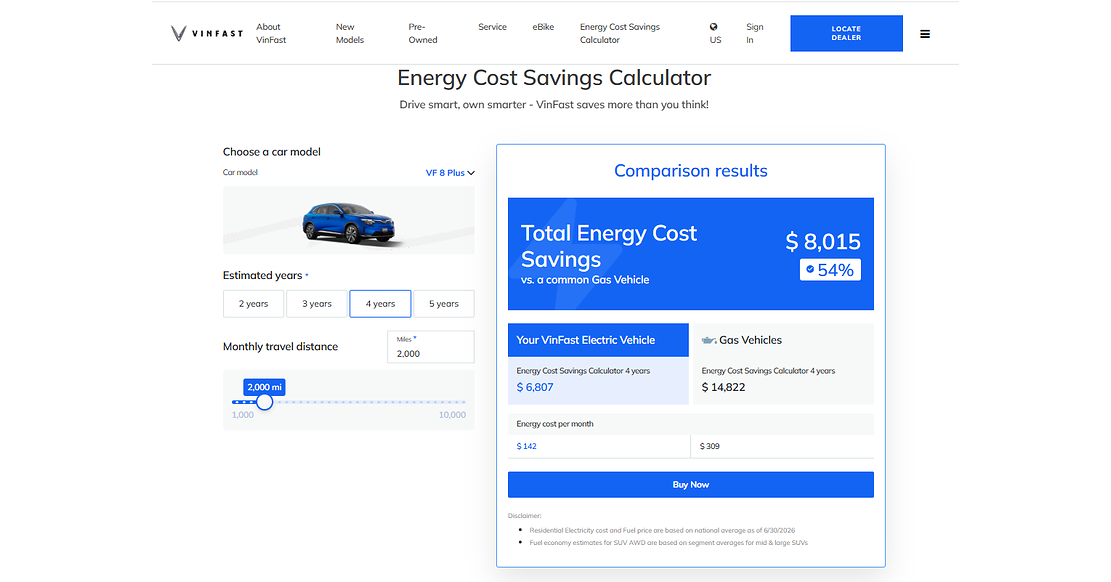
VinFast launched a U.S. “Energy Cost Saving” calculator to improve how shoppers value EV total ownership costs versus upfront price. Using a 2,000-mile/month example for a VF 8 over five years, the tool estimates ~$7,811 in energy costs vs ~$18,528 for a comparable gas SUV (about 58% lower energy costs, ~$130/month vs ~$309/month). The article also cites studies showing that adding full cost-of-ownership information increases EV choice (e.g., +14.3% in Vietnam, with ECS adding a further +4.5%), supporting VinFast’s push to accelerate EV adoption in the U.S.
The incremental edge here is not the calculator itself; it is the shift in how shoppers frame the purchase. Once the decision is expressed in monthly ownership cost rather than sticker price, the winners tend to be OEMs with credible hybrids/PHEVs, strong residual values, and low-volatility financing—because they can win on total cost without asking the buyer to accept charging inconvenience. That makes Toyota and, to a lesser extent, Hyundai/Kia better positioned than pure-play EV sellers; the marginal buyer is more likely to move to “electrified but familiar” than to a fully new consumption pattern.
For VFS, this is mostly a conversion tool, not a business model inflection. The key question over the next 1-3 quarters is whether it improves lead-to-sale conversion enough to matter against high burn and a still-competitive U.S. EV market; if not, the market should treat it as low-cost marketing, not a demand breakthrough. The second-order risk is that making ownership economics explicit may actually steer some shoppers toward hybrids rather than BEVs, diluting the intended EV-only upside.
Contrarian read: the market may be overestimating how much consumer education can change behavior when financing, insurance, and depreciation dominate the real payment stack. If gasoline weakens or EV insurance remains elevated, the narrative loses force quickly. The thesis is falsified if U.S. unit growth and dealer traffic do not improve over the next two quarters, or if competitors’ incentives compress VFS’s relative monthly-payment advantage.
AI-powered research, real-time alerts, and portfolio analytics for institutional investors.
Overall Sentiment
mildly positive
Sentiment Score
0.20
Ticker Sentiment
