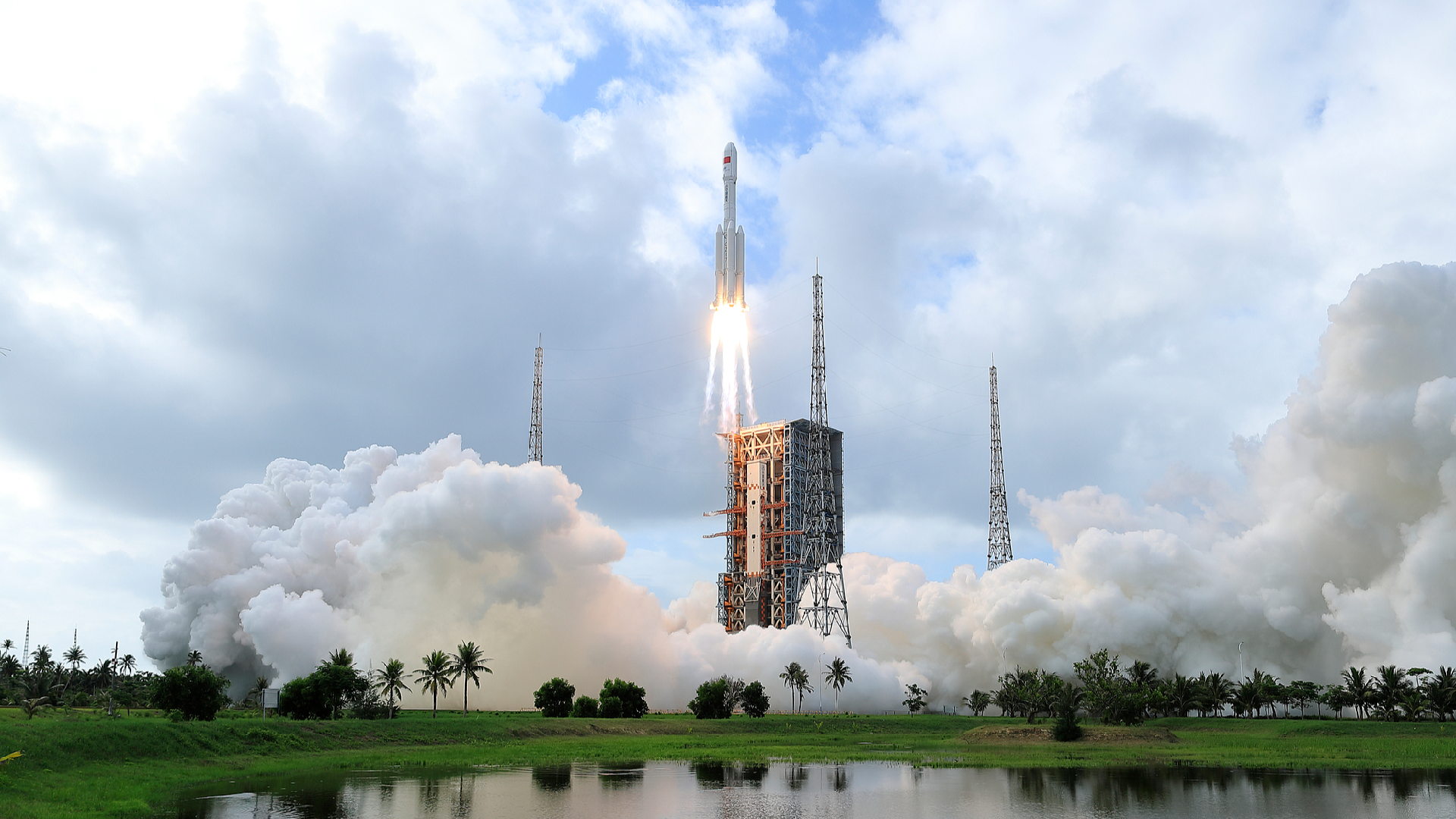
Tianzhou-10 launched with 41 scientific experiments and 67 pieces of equipment, highlighting new space life-science research and a flexible mono-crystalline silicon solar cell that weighs less than 1 kg per square meter. The mission also carries a Hong Kong University of Science and Technology detector for measuring CO2 and methane, supporting climate monitoring and emissions tracking. The article is broadly positive for China’s space research and space-tech innovation, but the immediate market impact is limited.
This is less a single-spaceflight story than evidence of China turning the space station into an industrial testbed for dual-use technology development. The most investable implication is not near-term launch revenue, but the acceleration of domestic substitution in space hardware: lower-cost solar substrates, compact power systems, and onboard sensing reduce the economics of Chinese satellite deployment and improve payload density. Over 12-24 months, that can widen the gap between Chinese and non-Chinese smallsat operators on cost per watt and cost per kg, especially if the new cell survives radiation and atomic oxygen with acceptable degradation.
The solar-cell angle is the cleanest commercial signal. If the price claim holds beyond lab conditions, it pressures incumbents in high-cost gallium arsenide supply chains and makes power generation a less binding constraint for LEO constellations, edge compute, and relay infrastructure. Second-order winners are launch providers, deployment integrators, and downstream broadband users; the losers are premium-space-material vendors whose moat depends on expensive performance per unit mass. The climate-monitoring payload is a separate, slower-burn catalyst: better methane/CO2 attribution raises enforcement quality, which can become a policy force multiplier for industrial decarbonization and carbon-market scrutiny.
The biotech component is longer-dated and mostly optionality today. Space embryology and microgravity physiology are not revenue drivers now, but they matter because they de-risk human endurance in extended missions and create IP around organoids, stem-cell differentiation, and radiation biology. That has a non-linear spillover into terrestrial biotech and defense-adjacent human-performance research, but commercialization is likely years away, not quarters.
Contrarian view: the market may overestimate the speed of translation from station experiments to scalable procurement. Space qualification is a brutal filter, and most 'cheap' materials fail when radiation, thermal cycling, and lifetime specs are applied. So the better trade is not chasing the headline winners immediately; it is positioning for a slow re-rating in Chinese space industrial self-sufficiency while fading overly aggressive reads on near-term global satellite capex displacement.
AI-powered research, real-time alerts, and portfolio analytics for institutional investors.
Request DemoOverall Sentiment
mildly positive
Sentiment Score
0.28
