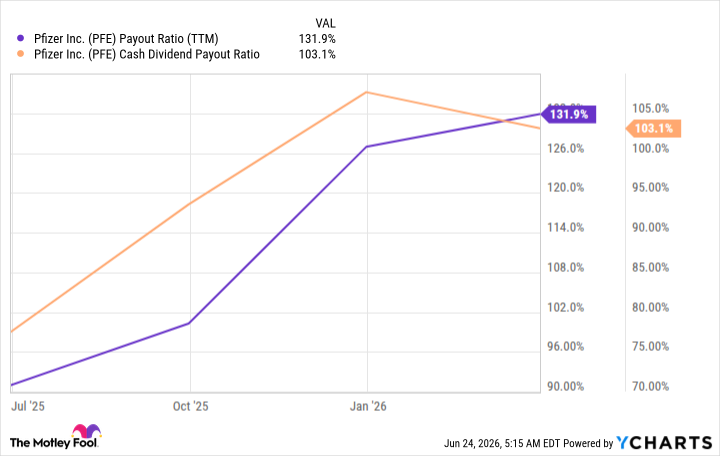
Pfizer offers a 6.9% dividend yield, far above the S&P 500's 1% and the average pharmaceutical yield of 1.6%, but its stock remains roughly 60% below its late-2021 high. The article highlights weak investor sentiment, a 130% earnings payout ratio, and the failed 2025 GLP-1 weight-loss drug effort, while noting management says sustaining the dividend is a priority and free-cash-flow payout is closer to 100%. Despite near-term uncertainty, the piece argues Pfizer's long R&D pipeline and balance-sheet flexibility make it a potential time-arbitrage opportunity.
The market is effectively pricing Pfizer as a slow-motion ex-growth utility with a binary dividend risk overlay, but that framing may be too static. In pharma, the second-order driver is pipeline optionality versus patent-cliff timing: if management can bridge the next 12-24 months without a dividend cut, the equity can re-rate sharply because the current valuation already embeds a prolonged period of capital destruction. The key is that the downside from “nothing works” is partially funded by operating cash flow, while the upside from even one credible late-stage success is leveraged through sentiment more than fundamentals.
The competitive read is more interesting than the headline yield comparison. LLY and NVO remain the obvious winners in GLP-1, but their dominance also creates a valuation and expectation overhang: anything that slows weight-loss growth, or any safety/regulatory friction, would disproportionately punish those multiples. Pfizer doesn’t need to win the category to benefit; it only needs a credible adjacent asset or bolt-on to stop the market from treating it as structurally incapable of innovation. That makes the recent acquisition behavior meaningful because it shortens the distance between capital and pipeline replacement, which is exactly where the market tends to be wrong in late-cycle pharma turnarounds.
The main risk is not insolvency, but a dividend reset. With payout coverage stretched, equity holders are effectively underwriting management discipline and capital allocation quality over the next 4-8 quarters. If trial data disappoints or a large acquisition is poorly received, the market could conclude the dividend is being defended at the expense of long-term value, which would compress the stock further even if the payout remains intact.
Consensus appears to be underestimating the asymmetry in time horizon. Short-duration investors see a 6.9% yield with weak momentum and assume a trap; longer-duration capital may be getting paid to wait for a rerating that can happen quickly once one or two readouts de-risk the story. The setup is less about owning a high yielder and more about buying a neglected large-cap option on pipeline stabilization at a price that already discounts several more years of disappointment.
AI-powered research, real-time alerts, and portfolio analytics for institutional investors.
Request DemoOverall Sentiment
mildly positive
Sentiment Score
0.15
Ticker Sentiment
