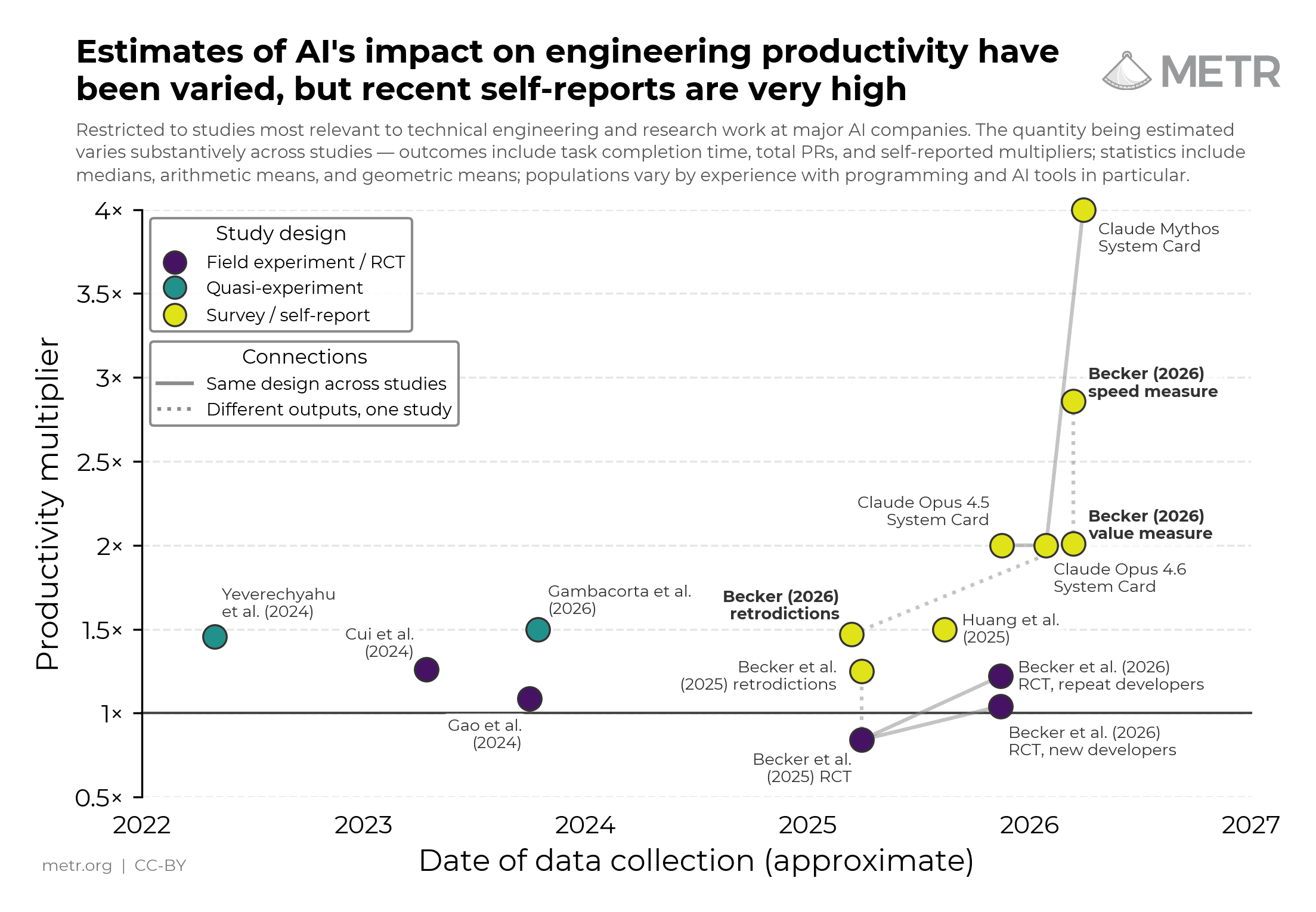
A 349-person survey of technical workers found median self-reported AI-driven value uplift of 1.4x–2x around March 2026, versus a 3x median speed gain, with respondents forecasting 2.5x value uplift by March 2027. The study highlights substantial internal consistency but warns that self-reported gains may be overstated, especially among the highest respondents, and notes METR staff reported the lowest uplift. The article is mainly methodological and unlikely to move markets directly.
The economically important signal here is not the level of claimed uplift, but that sophisticated technical workers already behave as if AI meaningfully raises the marginal product of labor. If that belief propagates inside firms, it should accelerate budget reallocation from headcount growth to tool spend, compute, and workflow redesign — a second-order tailwind for frontier model vendors, coding copilots, and agents, even if the self-reported magnitudes are overstated. The fact that heavier users and startups report the highest uplift suggests a compounding dynamic: AI adoption is likely to widen operating leverage dispersion between early adopters and laggards over the next 6-18 months.
The key bear case is that the survey is measuring perceived value, not realized output, and the gap matters for capital allocation. If workers are over-attributing gains to AI, firms may overinvest in seat licenses while underinvesting in process changes, review infrastructure, and agent guardrails — which would eventually compress realized ROI and slow renewal growth. That argues for separating “demo-driven” beneficiaries from companies with measurable workflow lock-in and usage-based monetization.
The contrarian read is that the market may be underestimating how fast AI spend per knowledge worker can scale even if productivity claims are noisy. A small increase in believed value can justify much larger budgets when the alternative is slower hiring in constrained talent markets. The real catalyst is not a benchmark breakthrough but management confidence: if finance and engineering leaders start budgeting AI as a productivity input rather than an experiment, adoption can inflect within 1-3 quarters.
The biggest risk to the bullish read is a disappointment cycle from internal audits or field evidence showing gains are closer to speed than value. That would hit names whose valuations assume rapid enterprise ROI and high net retention. Watch for survey-to-actual reconciliation over the next earnings season; if customer case studies remain qualitative while spend keeps rising, the trade is intact. If procurement scrutiny rises, a rotation from speculative AI enablers to cash-generative software becomes likely within months.
AI-powered research, real-time alerts, and portfolio analytics for institutional investors.
Request DemoOverall Sentiment
neutral
Sentiment Score
0.10
