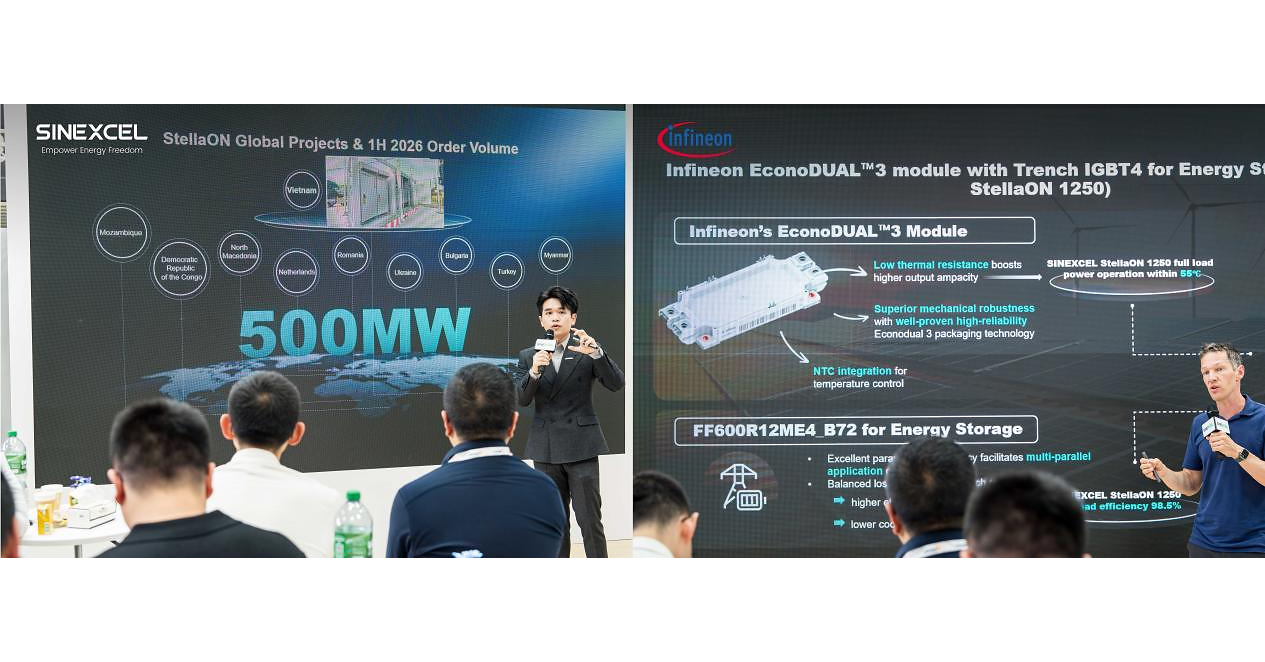
SINEXCEL stellte auf der Intersolar Europe 2026 den Wechselrichter StellaON 1250K/1575K vor, der dank Infineon EconoDUAL™3 eine kontinuierliche Ausgangsleistung bei 55°C bietet (10°C über Branchendurchschnitt) und Leistungsreduzierung um 15%–20% vermeidet; zudem senkt er Overdimensioning-Kosten um bis zu 20%. Der Wirkungsgrad wird mit 98,5% bei Volllast angegeben, LCOS durch +0,6% Round-Trip-Effizienz und Betriebskosten um 15% über die Lebensdauer, mit MTBF >300.000 Stunden (Verfügbarkeit 99%). Operativ meldet das Unternehmen >500 MW Aufträge im 1. Halbjahr 2026 sowie >15 Projekte in Europa, APAC und Afrika, nach Netzanschluss in Vietnam (März 2026).
This is less a demand breakout story than a proof-of-design event for high-power semis inside grid-scale storage. For IFNNY, the real leverage is not this shipment set itself, but the chance that a widely certified, high-ambient-temperature reference design becomes sticky across multiple projects, lifting module attach rates and improving mix toward higher-spec industrial power products. The near-term revenue contribution is likely modest; the market should treat this as an incremental validation of pricing power rather than a step-function earnings driver.
Second-order, the message is that utility-scale storage buyers are paying for derating avoidance, grid-forming capability, and faster serviceability, not just headline efficiency. That favors suppliers with credible thermal and reliability performance and hurts lower-spec inverter vendors that compete mainly on upfront price, because a few points of LCOS improvement can decide procurement in Europe’s more regulated markets. If European certification broadens, the addressable pool expands, but the competitive moat will come from compliance and field data, not press-release specs.
The contrarian risk is that this is being read as a Europe BESS demand signal when it is still mostly a product announcement from a Chinese OEM ecosystem. Actual upside for IFNNY depends on whether these projects ship into meaningful volume and whether BOM pricing holds; if power-semiconductor pricing rolls over or project awards stall, the share of wallet stays tiny. Medium term, the key falsifier is a slowdown in order intake or evidence that certified competitors win the same utility-scale slots at lower cost.
AI-powered research, real-time alerts, and portfolio analytics for institutional investors.
Request DemoOverall Sentiment
mildly positive
Sentiment Score
0.35
Ticker Sentiment
