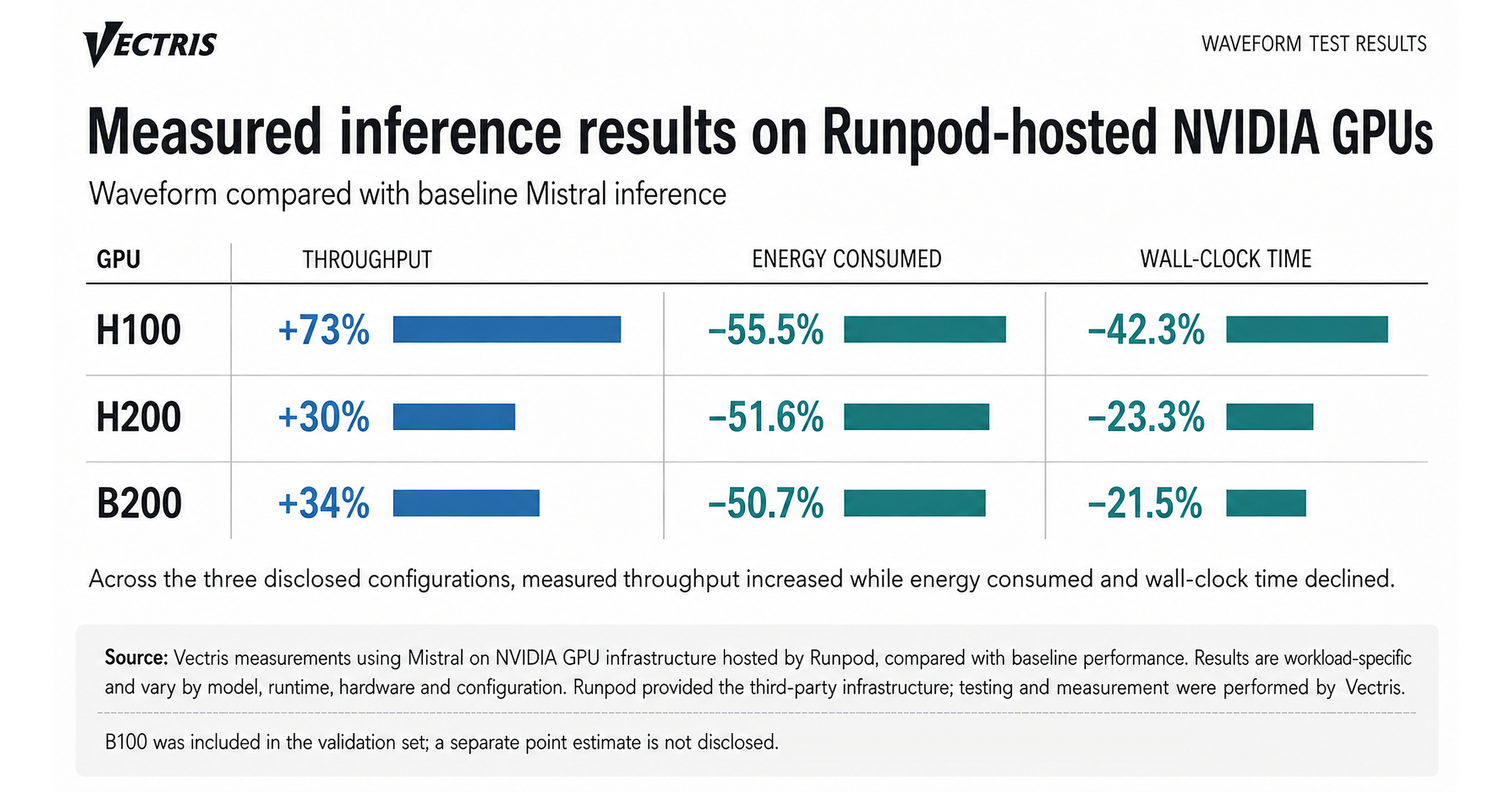
Vectris Labs says its Waveform control plane can unlock recoverable AI inference capacity on already-deployed NVIDIA H100/H200/B200 GPUs, boosting throughput by +30% to +73% while cutting energy use by -50.7% to -55.5% and reducing wall-clock time by -21.5% to -42.3% (Mistral workloads on RunPod). The company frames this as increasing “Compute Yield,” with a conservative example of a 10,000-GPU fleet achieving baseline-equivalent throughput comparable to 13,000 GPUs (+3,000 GPUs’ worth) without model retraining or kernel changes. Cross-silicon testing claims 67% energy savings and a 32% reduction in time-to-result on Intel via MLPerf LoadGen; Waveform is scheduled to launch Oct. 1, 2026 to limited design partners.
This is less a hardware breakthrough than a pricing-power event. If the efficiency claim holds in production, the first-order winner is the buyer of inference, because effective cost per accepted token falls and capacity becomes less tied to incremental GPU purchases; the second-order loser is the vendor whose valuation assumes ever-rising spend per deployed rack. That makes NVDA the highest-beta exposure: not because demand disappears, but because the mix shifts from scarcity rent toward utilization optimization, which can slow multiple expansion even if near-term utilization rates stay high.
AMD and INTC are more ambiguous. A vendor-agnostic control layer reduces the advantage of any single architecture, so it is not obviously a share-gain story for one silicon name versus another; instead, it commoditizes the stack above the chip and raises the bar for future procurement growth. The more durable beneficiaries are power-constrained operators and cloud customers that can defer capex, while colocation, power, and some data-center supply-chain names face a longer-lag demand headwind if software keeps extracting more output from fixed megawatts.
The contrarian read is that the market may over-interpret this as bullish AI demand when the real effect is margin transfer from infrastructure vendors to operators. The key risk to that thesis is adoption: the numbers are still workload-specific and not independently reproduced in customer production, so this can fade quickly if real-world utilization fails to match the lab. Over 1-3 months, the catalyst is not the launch itself but proof points from design partners; over 6-18 months, the question is whether compute-yield software becomes a tollbooth that compresses future GPU spend growth.
AI-powered research, real-time alerts, and portfolio analytics for institutional investors.
Request DemoOverall Sentiment
moderately positive
Sentiment Score
0.60
Ticker Sentiment
