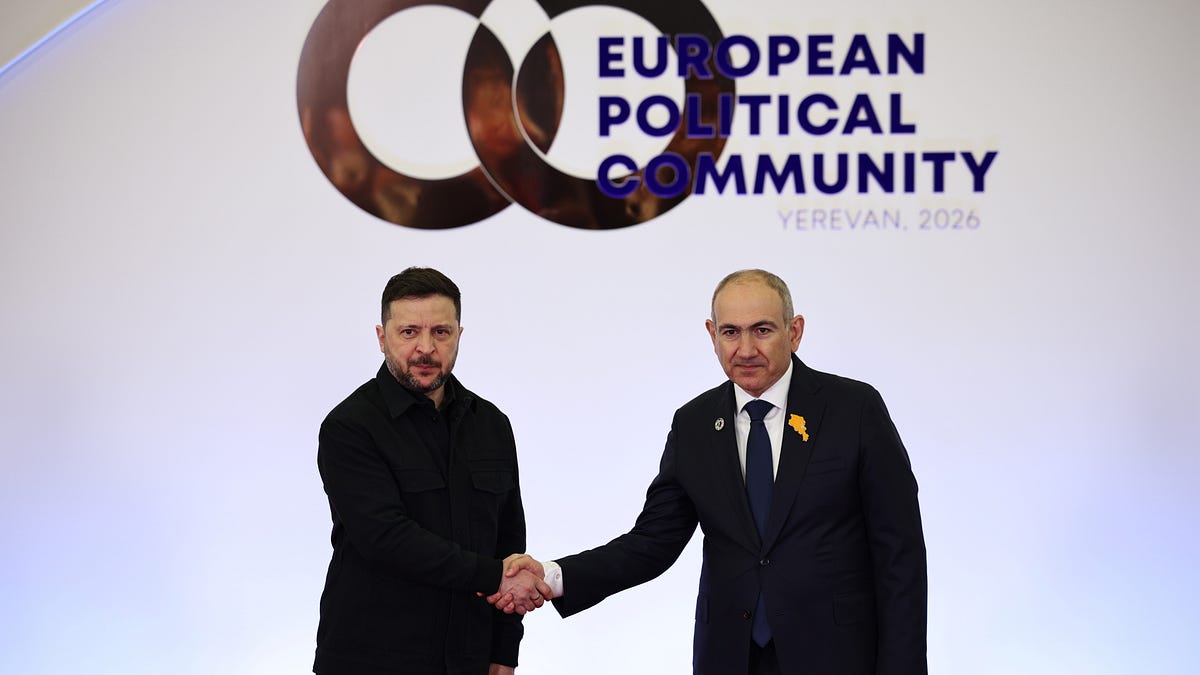
The article argues that Russia’s influence across the post-Soviet space is eroding, with Armenia, Azerbaijan, and potentially Belarus moving further away from Moscow amid fallout from the Ukraine war. It highlights Armenia’s June 7 parliamentary elections, worsening Russia-Armenia relations, and increased friction with Azerbaijan after the December 2024 downing of an Azerbaijani aircraft. The tone is broadly bearish on Putin’s regional leverage and suggests further geopolitical instability in the former Soviet sphere.
The market implication is not a clean “Russia weakens” trade; it is a widening of the premium for non-Russian corridors and a higher probability of policy-driven re-routing across the South Caucasus and Central Asia. That matters for freight, energy, and trade finance: any durable dilution of Moscow’s influence reduces the geopolitical discount on projects linking the Caspian to Turkey/Europe, while increasing the probability of sanctions leakage and customs friction in the near term. The beneficiaries are not just local incumbents but also European transport, logistics, and infrastructure assets exposed to east-west routing.
The bigger second-order effect is on Armenia’s and Azerbaijan’s external financing mix. As their strategic alignment shifts, they are more likely to attract Western-backed capex, sovereign support, and corridor-related investment, while Russian-linked trade, agribusiness, and retail supply chains face more inspection risk and payment frictions. The downside is that transitions like this are rarely linear: the Kremlin’s playbook is to create short, sharp disruptions rather than sustained blockages, so the next 1-3 months carry elevated tail risk around border incidents, cyber activity, and regulatory retaliation.
Contrarianly, the consensus may be underestimating how much of this is already priced in to regional risk assets. If the market is treating the Caucasus as a purely political story, it is missing the possibility that trade diversion persists even without regime change, because businesses reprice counterparty and route risk long before formal policy moves. The more interesting setup is not a broad emerging-markets long, but a relative-value trade on corridor beneficiaries versus Russia-exposed names, with catalysts clustered around election outcomes, customs enforcement, and any new transport agreements over the next 3-6 months.
AI-powered research, real-time alerts, and portfolio analytics for institutional investors.
Request DemoOverall Sentiment
strongly negative
Sentiment Score
-0.62
