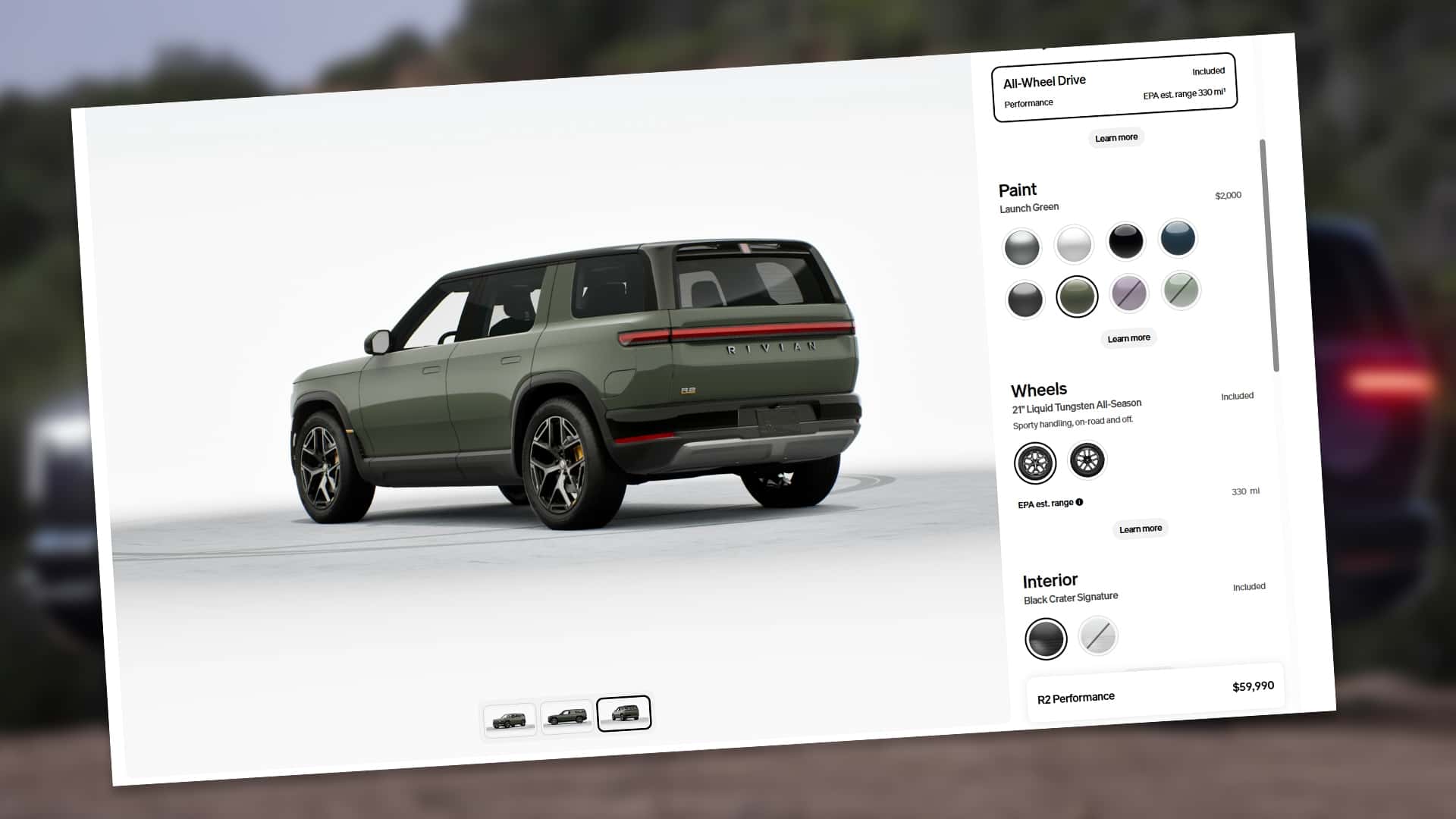
Rivian’s R2 configurator is now live, giving prospective buyers pricing, option details, and launch timing for the new electric SUV. The R2 starts at $48,490 for the Standard trim and $53,990 for Premium, while a fully equipped Launch Package Performance version costs $62,745. Rivian also said R2 production has started, deliveries to employees have begun, and customer configuration invitations will roll out in June, with 20,000-25,000 units targeted by end-2026 in Normal, Illinois.
Rivian’s configurator launch is more important as a demand-validation and pricing-architecture event than as a near-term revenue driver. The company is effectively using scarcity scheduling to monetize urgency: late availability on colors, wheel packages, and autonomy features lets it preserve option pricing while funneling early adopters into higher-margin trims. That matters because EV startups usually struggle not with interest, but with preventing reservation intent from leaking into cancellation when the wait becomes visible and the product becomes fully comparable.
The second-order effect is on competitor positioning in the mid-$50k SUV bucket. R2 appears to be setting an expectation that software, autonomy, and aesthetic personalization are monetizable line items, which pressures legacy OEMs to either match that bundling logic or accept lower realized ASPs. The risk is that transparent configurability can also expose value gaps: once buyers see how quickly the price rises with AWD, larger wheels, and autonomy, the “affordable EV SUV” story may narrow to a thinner base-trim audience than the reservation count implies.
Operationally, the bigger catalyst is not the configurator itself but the pace of June order conversion into deposits and employee-delivery feedback through summer. Any slippage in reservation-to-order conversion, or evidence that launch allocations are being pushed into 2027 for desirable specs, would be an early warning that demand is elastic even among enthusiasts. Conversely, if the company can sustain a high attach rate for AWD, autonomy, and premium paint, that supports a stronger gross-margin mix and reduces the need for promotional pricing elsewhere in the line.
The contrarian view is that the market may be underestimating how much of the current enthusiasm is reservation theater rather than hard demand. A large reservation pool can still convert into delayed, down-trimmed, or canceled orders if financing conditions tighten or if competing EVs get cheaper by the time delivery windows open. The setup favors Rivian only if execution stays ahead of the calendar; otherwise the long-dated launch timeline becomes a free option for competitors to improve their own products and pricing.
AI-powered research, real-time alerts, and portfolio analytics for institutional investors.
Request DemoOverall Sentiment
mildly positive
Sentiment Score
0.25
