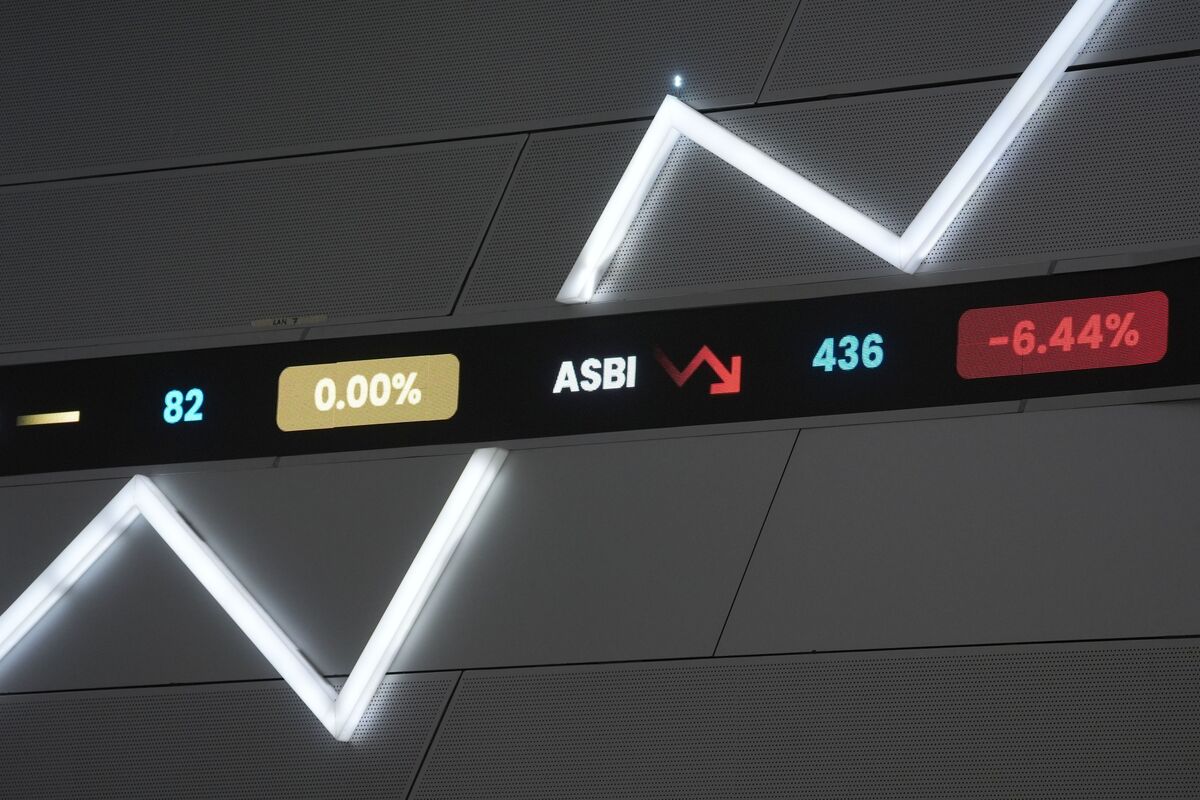
Indonesia’s listed market capitalization has fallen more than 30% from a January peak to $618 billion, allowing Singapore to overtake it as Southeast Asia’s largest stock market at $645 billion. The shift reflects weak market performance in Indonesia relative to Singapore and signals deteriorating investor sentiment toward the region’s largest emerging market equity market. The article is largely a market-structure update rather than a catalyst-driven event.
The key signal here is not the headline ranking change itself, but the message it sends about regional capital allocation. When a market loses size this quickly, passive and benchmark-aware allocators tend to reinforce the move: lower index weightings, tighter risk limits, and less tolerance for idiosyncratic EM exposure. That creates a reflexive loop where domestic equities face higher cost of capital even if macro data has not deteriorated proportionally.
Relative winners are likely to be the more institutionally trusted, higher-governance names and adjacent market proxies in Singapore, which can absorb regional rotation even without stronger earnings growth. The losers are Indonesian financials, property, and cyclicals that depend on local liquidity and domestic sentiment; they are the first to suffer when foreign ownership shrinks and local bid support weakens. A second-order effect is that corporates may delay equity issuance and M&A, which can suppress broker activity, underwriting fees, and capex-linked demand for several quarters.
The risk horizon matters: in the next 2-6 weeks, technicals and positioning can dominate and produce oversold bounces, but over 3-9 months the bigger issue is whether policy credibility stabilizes FX, rates, and fiscal expectations. What would reverse the trend is not a single positive data point but a sustained combination of currency stabilization, improved sovereign spreads, and evidence that foreign flows have stopped underweighting Indonesia. Without that, rallies are likely to be sold into by allocators who now have a cleaner regional alternative.
Consensus may be underestimating how much of this is an indexing and sentiment story rather than a pure fundamentals story. That means the dislocation can overshoot on the downside in the near term, but it also means the best entry is usually after forced selling exhausts and the market stops making new lows on negative flow. For now, the better risk/reward is to fade Indonesia beta only selectively, not indiscriminately, and to express the view through relative-value structures rather than outright emerging-market shorts.
AI-powered research, real-time alerts, and portfolio analytics for institutional investors.
Request DemoOverall Sentiment
mildly negative
Sentiment Score
-0.35
