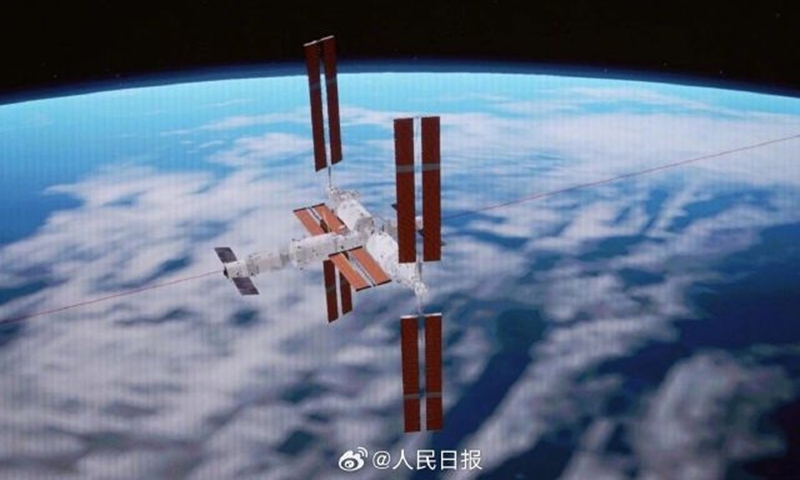
China successfully launched Tianzhou-10 and docked it with the Tiangong space station, marking the 10th consecutive successful Tianzhou cargo mission. The spacecraft will deliver nearly 6.2 tons of supplies, including 700 kg of propellant, six scientific payloads, a new treadmill, and the third set of new-type extravehicular spacesuits, while remaining in orbit for 12 months. The mission also featured a new onboard fault-diagnosis system, "BianQue," as a technology verification flight.
This is less about a single launch success than a signal that China’s orbital logistics stack is moving from bespoke missions to a repeatable, higher-uptime operating model. The second-order implication is a lower marginal cost of maintaining the station, which tends to compress the volatility premium on the program and shift value from launch cadence to subsystems: docking hardware, cold-chain payload handling, on-orbit power management, and autonomous fault recovery. That benefits the broader domestic space industrial base more than the launcher itself, because the recurring revenue pool increasingly migrates into infrastructure-like support services and mission software.
The most important near-term catalyst is not the headline launch; it is the operational validation of longer dwell time and rapid-turn cargo handling. If that cadence sustains over the next 6-12 months, suppliers tied to life-support, environmental monitoring, radiation protection, thermal control, and robotics should see a step-up in order visibility. The embedded diagnosis/replanning capability is also a quiet de-risking for future launch reliability, which should reduce insurance, contingency, and spare-capital buffers over time.
Contrarian read: the market may be overestimating how immediately monetizable this is for broad Chinese space exposure. The near-term P&L impact is likely concentrated in a narrow set of state-linked contractors, while most listed proxies remain story stocks until there is evidence of exportable hardware, commercial station services, or civilian spinouts. The healthcare/biotech angle is more optionality than revenue today; the real value is the creation of a persistent microgravity experimentation platform that can shorten development cycles for advanced materials and bio-manufacturing, but that payoff is measured in years, not quarters.
AI-powered research, real-time alerts, and portfolio analytics for institutional investors.
Request DemoOverall Sentiment
mildly positive
Sentiment Score
0.32
Ticker Sentiment
