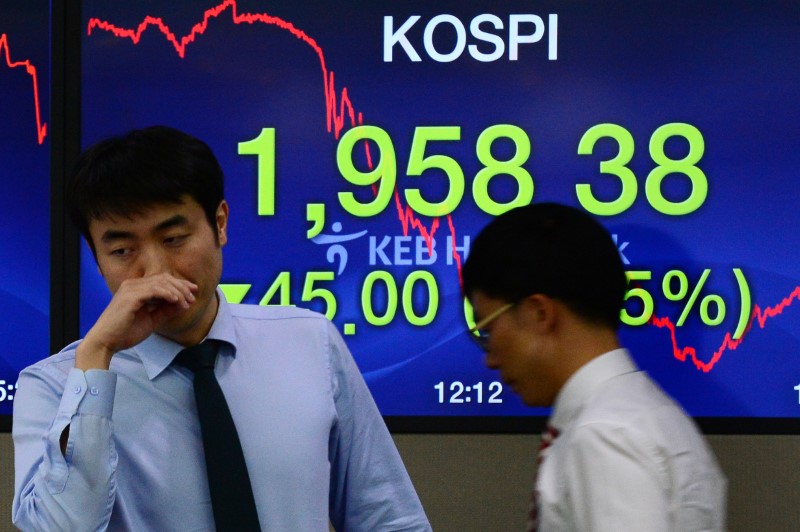
South Korea’s Kospi fell 6.12% to 7,493.18, its worst day in roughly two months, as Asia-Pacific markets declined amid U.S.-China tensions over Taiwan. Samsung Electronics dropped 8.6% and SK Hynix fell 7.7% after the union reaffirmed an 18-day strike plan beginning May 21, raising disruption risks at the memory-chip sector. Broader regional indices also weakened, with CSI300 down 1.1%, Hang Seng off 1.6%, and Nikkei 225 down 2%.
The market is starting to price AI as a geopolitical asset class, not just a capex cycle. Trump’s visible alignment with Nvidia and Tesla in Beijing raises the probability that Washington will tolerate a narrower set of “approved” AI supply chains, while anything adjacent to China-facing hardware becomes more fragile. That bifurcates the tape: U.S.-listed AI leaders can keep rerating on policy support and strategic scarcity, but Asia semiconductor names tied to China demand are now more exposed to headline risk than to fundamentals.
The bigger second-order effect is portfolio de-risking around concentrated winners. When a handful of chip names dominate a local index, any shock to labor stability, cross-strait rhetoric, or export policy can force index-level selling unrelated to company earnings. That creates a short-window dislocation: good operating data can be overwhelmed by forced unwind flows, especially in crowded long-only and passive baskets.
For NVDA, the setup is constructive over months but tactically vulnerable over days if Beijing rhetoric escalates or if investors start questioning whether geopolitical theater constrains future China monetization. TSLA is more of a sentiment lever than a direct beneficiary; the presence of its CEO in the delegation can support a “strategic industrial champion” narrative, but the stock still needs proof that policy access translates into demand or regulatory wins. SMCI and APP are less directly implicated here, but they can benefit from any rotation into U.S. AI infrastructure names if money leaves Asia hardware exposure.
Consensus may be underestimating how fast this can reverse once the event risk passes. If Taiwan rhetoric cools and Korea labor disruption is contained, the current risk-off move in Asia semis can mean-revert sharply because the underlying AI demand backdrop remains intact; in that case, the dip is more a flow shock than a thesis break. The key is that this is a 1-4 week positioning trade unless the diplomatic tone hardens into actual trade controls or supply-chain restrictions.
AI-powered research, real-time alerts, and portfolio analytics for institutional investors.
Request DemoOverall Sentiment
mildly negative
Sentiment Score
-0.35
Ticker Sentiment
