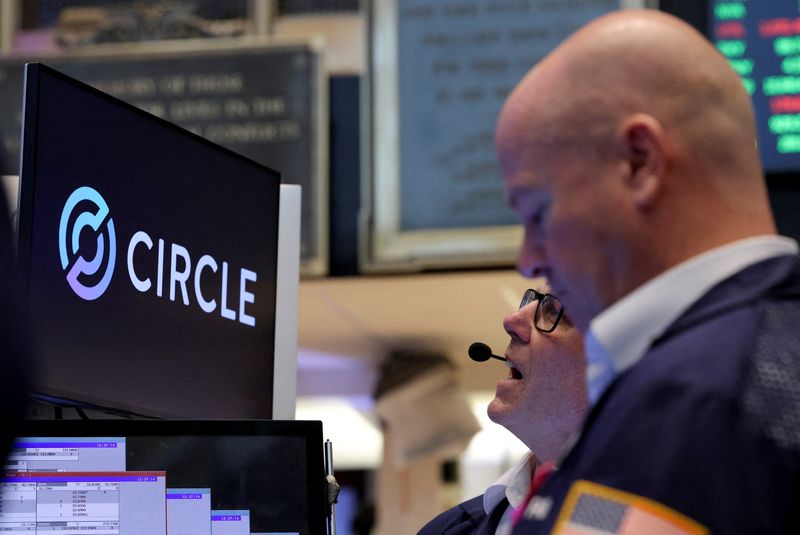
Circle posted Q1 fiscal 2026 adjusted EPS of $0.21, beating the $0.18 consensus by $0.03, but revenue and reserve income of $694 million missed estimates of $715 million and shares fell 3% premarket. USDC in circulation rose 28% YoY to $77.0 billion, onchain transaction volume jumped 263% to $21.5 trillion, and adjusted EBITDA increased 24% YoY to $151 million. The company reaffirmed FY2026 guidance and unveiled new Agent Stack products, while announcing a $222 million ARC Token presale at a $3 billion valuation.
The market is still treating CRCL like a single-line stablecoin proxy, but this print argues it is evolving into a platform-risk story. The takeaway is not the slight revenue miss; it is that distribution of USDC is becoming more endogenous to product velocity, developer tooling, and institutional sponsorship. That broadens the addressable market, but it also makes the stock more sensitive to execution on ecosystem monetization than to simple circulation growth.
The biggest second-order effect is competitive pressure on incumbents in crypto infrastructure and on payment rails that sit above stablecoins. If agentic commerce actually starts routing payments through USDC wallets and marketplaces, the relevant winner is the stack owner with the lowest friction, not the one with the largest balance sheet. BlackRock’s involvement matters less as a headline and more as a signaling mechanism that can reduce procurement friction for treasurers and asset allocators, but it also means the strategy becomes crowded faster than the company may want.
For risk, the near-term catalyst window is days to weeks: post-print de-risking can continue until the market gets comfort around whether the revenue miss was timing or a structural take-rate issue. The medium-term risk is six to twelve months: if the company keeps growing circulation but monetization lags, the multiple compresses even with strong headline volume. The hidden tail risk is regulatory or reserve-income sensitivity; if rates ease while product revenue is still nascent, earnings quality deteriorates faster than consensus models imply.
The contrarian view is that this is not yet a clean winner-take-all platform compounding story; it is still a funding-market-enabled growth story with emerging monetization optionality. The market may be underestimating how quickly stablecoin infrastructure can be commoditized once distribution is proven. That argues for owning the ecosystem exposure only selectively, while fading any assumption that circulation growth alone justifies an expanding multiple.
AI-powered research, real-time alerts, and portfolio analytics for institutional investors.
Request DemoOverall Sentiment
mildly positive
Sentiment Score
0.35
Ticker Sentiment
