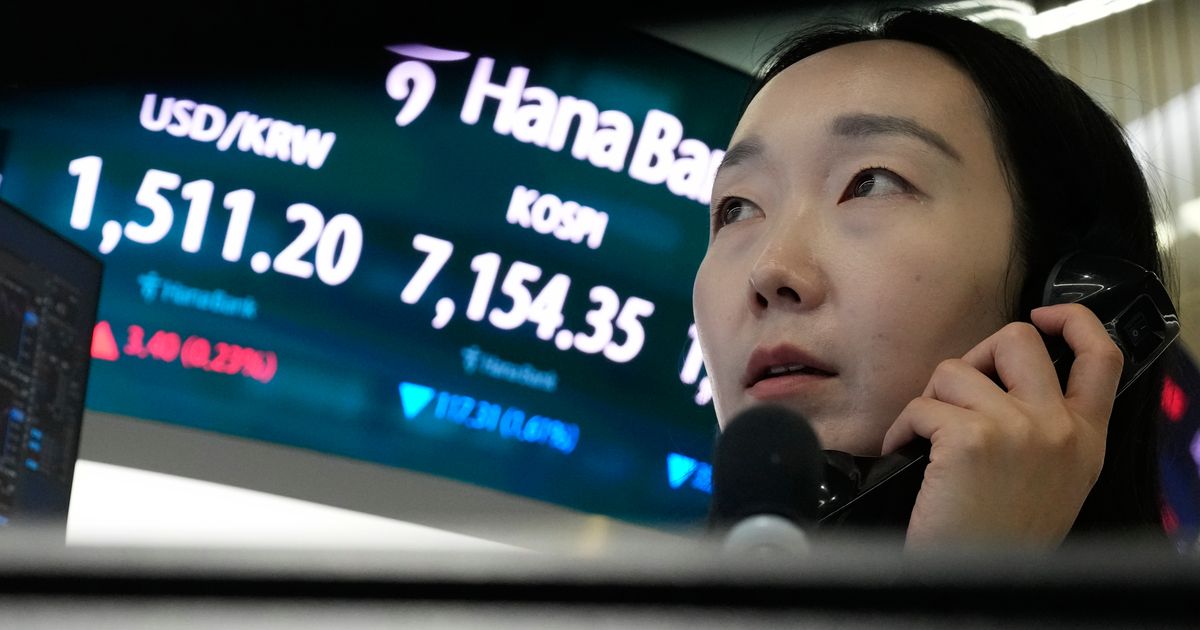
Asian shares fell broadly as rising bond yields and war-related inflation fears pressured risk assets, with Japan’s Nikkei down 1.2%, Hong Kong’s Hang Seng off 0.7%, and Australia’s ASX 200 down 1.3%. The U.S. 10-year Treasury yield rose to 4.66% from 4.61%, while Japan’s 10-year government bond yield held just below 2.8%, its highest since 1997. Markets are also awaiting Nvidia results as the AI-driven tech rally shows signs of fatigue; oil remains elevated at $103.11 per barrel for U.S. crude and $110.12 for Brent.
The market is transitioning from a pure duration/liquidity regime to one where equity multiples are being stress-tested by the cost of capital. That’s most damaging for the AI complex because the story has depended on long-dated cash flows, heavy upfront capex, and a benign financing backdrop; even a modest move higher in real yields can compress valuation more than it hurts near-term earnings. The first-order loser is the mega-cap tech basket, but the second-order loser is the broader infrastructure ecosystem that benefits from data-center buildout: memory, networking, power equipment, and industrial software names can all de-rate together if capex budgets get reviewed.
Nvidia is the key catalyst because it functions as a sentiment-clearing event, not just an earnings release. A beat is not enough if guidance implies slower digestion by hyperscalers or if management sounds more cautious on supply normalization and customer concentration; in that case, the market will likely reinterpret strong demand as deferred demand rather than durable acceleration. Conversely, a clean guide would likely trigger a sharp relief rally in semis, but I’d expect it to be sold if Treasury yields keep grinding up over the next 1-2 weeks, because the multiple headwind would still dominate.
Home Depot’s relative resilience is telling: the consumer is not breaking, but price sensitivity and housing affordability are capping upside. That favors high-quality retailers with operating leverage to share gains, while punishing weaker discretionary and home-improvement adjacencies that rely on financing-sensitive purchases. The stronger read-through is that elevated rates are beginning to act like a tax on remodeling and big-ticket durables, which should pressure housing-linked cyclicals over the next quarter rather than immediately.
The underappreciated contrarian point is that this may be less about earnings deterioration and more about a crowded long-duration positioning unwind. If yields stabilize, the selloff in tech could reverse quickly because fundamentals have not yet rolled over; that makes this a tactical de-risking window, not a structural call to abandon AI exposure. The best risk/reward is to fade the weakest balance-sheet, highest-duration names while keeping dry powder to add back on yield stabilization.
AI-powered research, real-time alerts, and portfolio analytics for institutional investors.
Request DemoOverall Sentiment
moderately negative
Sentiment Score
-0.45
Ticker Sentiment
