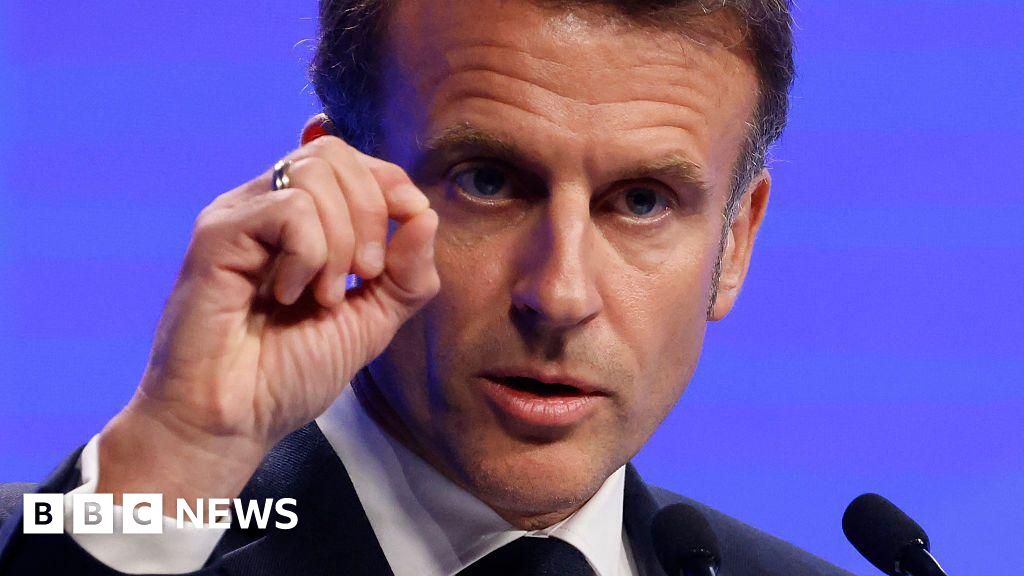
President Macron warned that the West risks losing credibility over the Ukraine and Gaza conflicts, potentially impacting global stability and trust in international alliances. Speaking at the Shangri-la Dialogue, he urged the U.S. and Europe to resolve these wars to avoid accusations of double standards and emphasized the need for a new European-Asian alliance to avoid becoming collateral damage in the U.S.-China power struggle. Macron also criticized the perceived Western "free pass" for Israel in Gaza and highlighted the importance of working towards a ceasefire and mutual recognition of a Palestinian state.
French President Emmanuel Macron's address at the Shangri-la Dialogue underscored significant risks to Western credibility arising from the protracted conflicts in Ukraine and Gaza, positing that failure to achieve resolution could lead to accusations of "double standards" and diminish U.S. and European influence in managing future global crises. Macron explicitly warned that continued Russian advances in Ukraine could set a precedent impacting other regions, such as Taiwan or the Philippines, stating, "What is at stake in Ukraine is our common credibility." Regarding Gaza, he acknowledged perceptions of a Western "free pass" for Israel and advocated for a ceasefire and mutual recognition of a Palestinian state, with France co-hosting a UN conference with Saudi Arabia to pursue a two-state solution. This stance has drawn sharp criticism from Israel. Macron further proposed a vision of "strategic autonomy," urging a new alliance between Europe and Asia to navigate the U.S.-China power struggle without becoming "collateral damage," and to maintain a rules-based global order not dominated by superpowers. His commentary also highlighted the interconnectedness of global security challenges, referencing North Korea's military aid to Russia. Analysts suggest Macron's remarks imply criticism of U.S. Middle East policy and represent his strongest position yet on Taiwan, likely to draw a response from China, while his call for strategic autonomy may appeal to Asian nations seeking to avoid alignment with either the U.S. or China. The general sentiment surrounding these developments is mildly negative and cautious, reflecting concerns over escalating geopolitical instabilities and their potential to erode established international norms, carrying a moderate market impact.
AI-powered research, real-time alerts, and portfolio analytics for institutional investors.
Request DemoOverall Sentiment
mildly negative
Sentiment Score
-0.25
Ticker Sentiment
