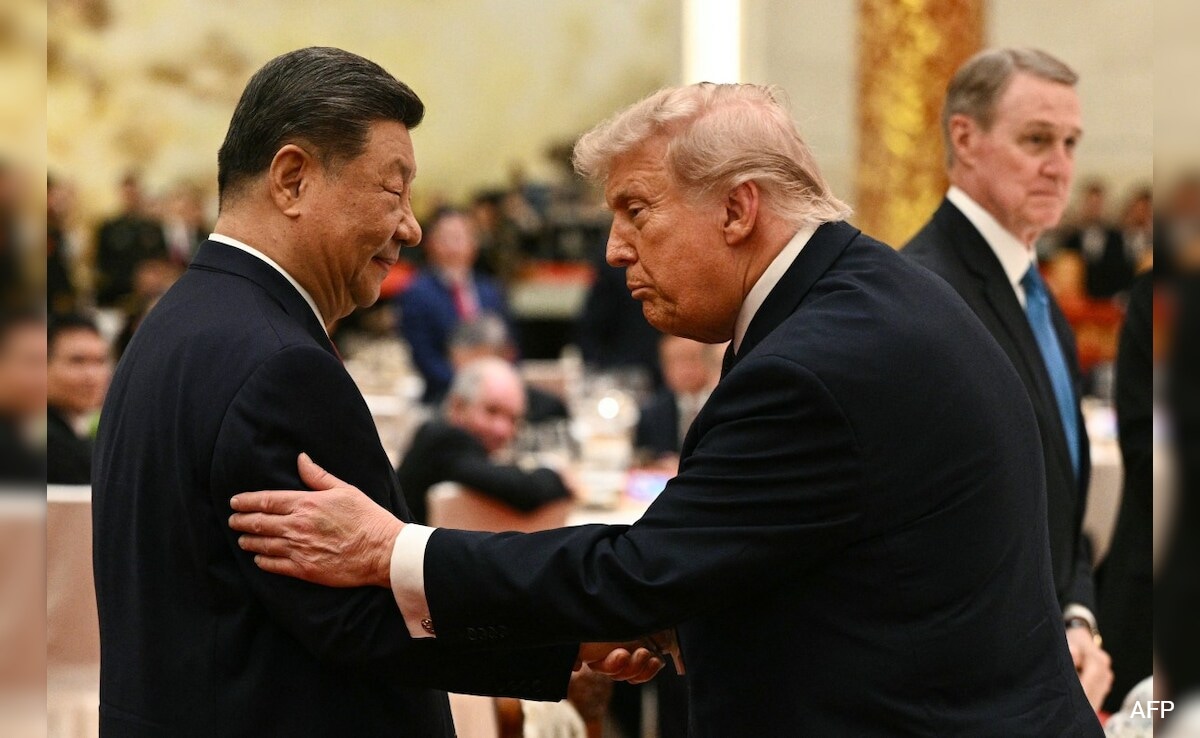
Trump used his Beijing visit to claim Xi Jinping congratulated him on U.S. economic and military successes while warning that U.S.-China differences over Taiwan, Iran, and fentanyl remain unresolved. Xi reportedly cautioned that mishandling Taiwan could lead to "clashes and even conflicts," underscoring persistent geopolitical risk between the two powers. The article is mostly political rhetoric, but the Taiwan and trade/supply-chain tensions keep broader market and defense implications meaningful.
The immediate market read is not about the rhetoric itself but about the signaling function: both sides appear to want to de-risk headline volatility without paying the domestic political cost of a formal concession. That tends to compress short-dated geopolitical risk premia first, then bleed into sectors exposed to tariffs, export controls, and supply-chain re-routing over the following 1-3 months. The bigger second-order effect is that ambiguity becomes policy: firms that rely on China demand, China inputs, or China-based logistics get a narrower operating window for capex and inventory decisions, which can pressure margins even if headline diplomacy sounds constructive.
The most asymmetric beneficiaries are defense and non-China supply-chain re-shoring names. A warmer tone reduces the odds of immediate escalation, but it does not solve the structural mistrust around Taiwan, fentanyl precursors, or strategic tech controls; that keeps defense spending and industrial base investment sticky for years, not quarters. On the flip side, semis and hardware tied to China final demand may see a reflex rally, but unless there is evidence of relaxation in export restrictions, any move is likely to be a positioning squeeze rather than a durable rerating.
The market may be underestimating how much domestic politics can override summit optics. If either leader needs a tougher tone for internal audiences, the relationship can deteriorate quickly and with little warning, which argues for owning convexity rather than chasing spot moves. The cleanest setup is to fade any broad cyclical optimism into strength while preferring relative-value exposure to sectors that benefit from persistent strategic competition.
Trade implementation should focus on time horizon: days for headline risk, months for policy drift, years for capex winners. The near-term catalyst is any follow-up on tariffs, fentanyl enforcement, or export-control language; absent that, the move fades. The contrarian angle is that a softer tone does not equal détente — it may simply prolong strategic decoupling while lowering realized volatility, which is usually bullish for defense and selective reshoring, but not for China-exposed growth names.
AI-powered research, real-time alerts, and portfolio analytics for institutional investors.
Request DemoOverall Sentiment
neutral
Sentiment Score
-0.05
