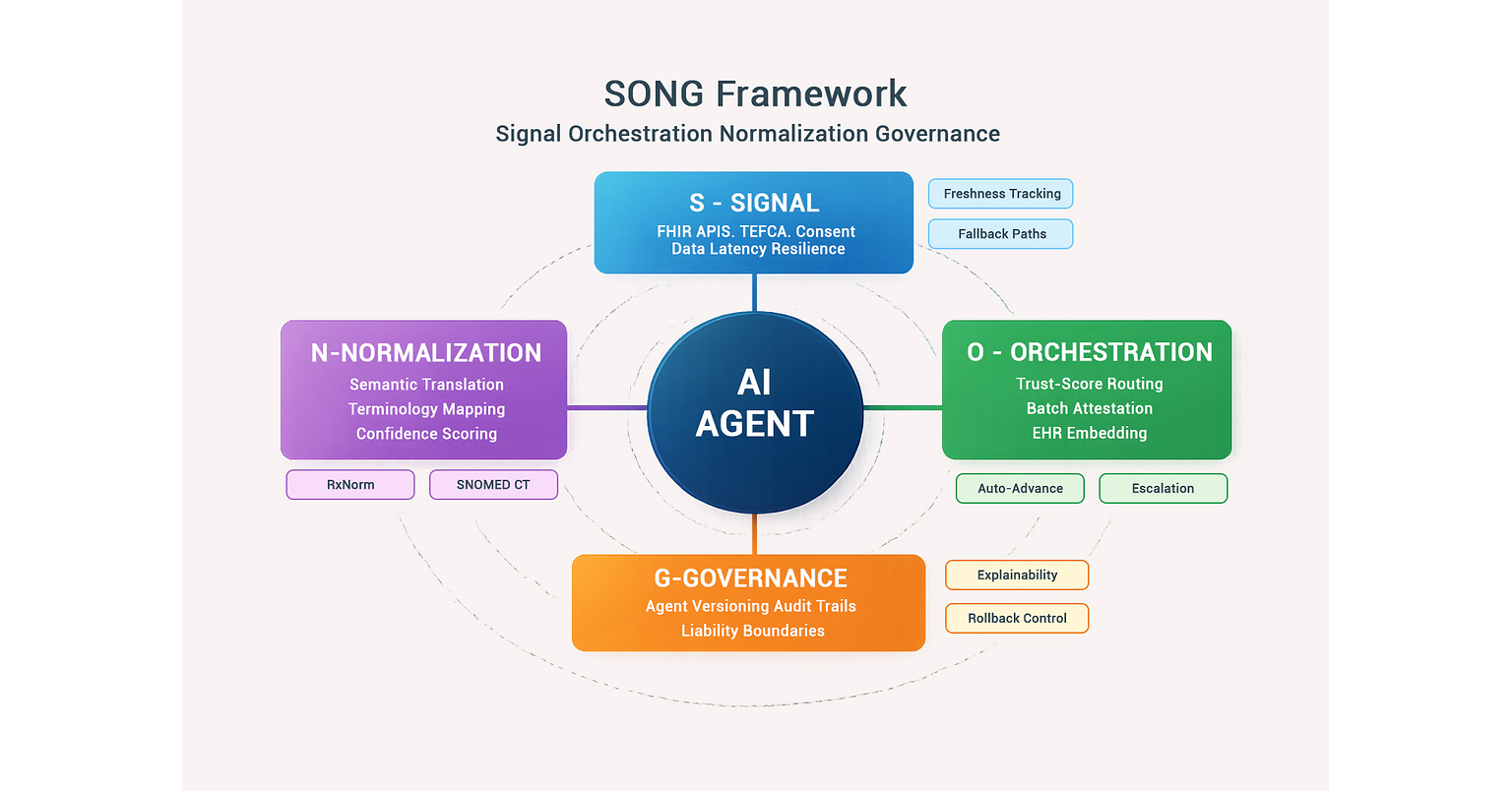
Article highlights that ~80% of healthcare AI pilots fail to reach production due to non-model issues (data/workflow interoperability), not model accuracy. Pegasus One’s SONG framework evaluates readiness across Signal, Orchestration, Normalization, and Governance, and cites a deployment replacing insurance-eligibility verification that cut average processing from 4 minutes per case to 11 seconds with higher accuracy. Overall message is supportive of commercialization prospects, but it is a company/technology diagnostic rather than a market-wide financial catalyst.
This is less a new AI demand signal than a procurement filter: healthcare buyers are likely to move budget away from standalone model demos toward integration-heavy platforms, workflow automation, and audit layers. That should favor incumbents with embedded data pipes and distribution over pure-play “agent” vendors, because the economic moat is now implementation friction, not model quality. The first-order winner set is workflow software and revenue-cycle infrastructure; the loser set is point-solution startups selling pilot success without production governance.
The second-order effect is on selling cycles. If buyers adopt a readiness framework like this, the near-term result is fewer pilots, but higher conversion rates and larger ACVs for vendors that can prove interoperability, versioning, and liability coverage. That is constructive for EHR-adjacent platforms and enterprise software names with healthcare penetration such as ORCL, VEEV, and broader healthcare IT baskets, while standalone healthcare-AI names may see multiple compression if they cannot show live deployments and measurable labor substitution.
Contrarian view: the market may be underestimating how much of the value accrues to systems integrators and workflow owners rather than the AI layer itself. The article’s production example suggests the real ROI is in replacing multi-portal manual ops, which is a revenue-cycle and admin-cost story, not a frontier-model story. Falsifier: if buyers still fund pilots without demanding governance/interoperability proof, or if a few large health systems show rapid production rollouts with weak integration, the thesis that production constraints dominate would weaken over the next 1-3 quarters.
AI-powered research, real-time alerts, and portfolio analytics for institutional investors.
Request DemoOverall Sentiment
mildly positive
Sentiment Score
0.12
Ticker Sentiment
