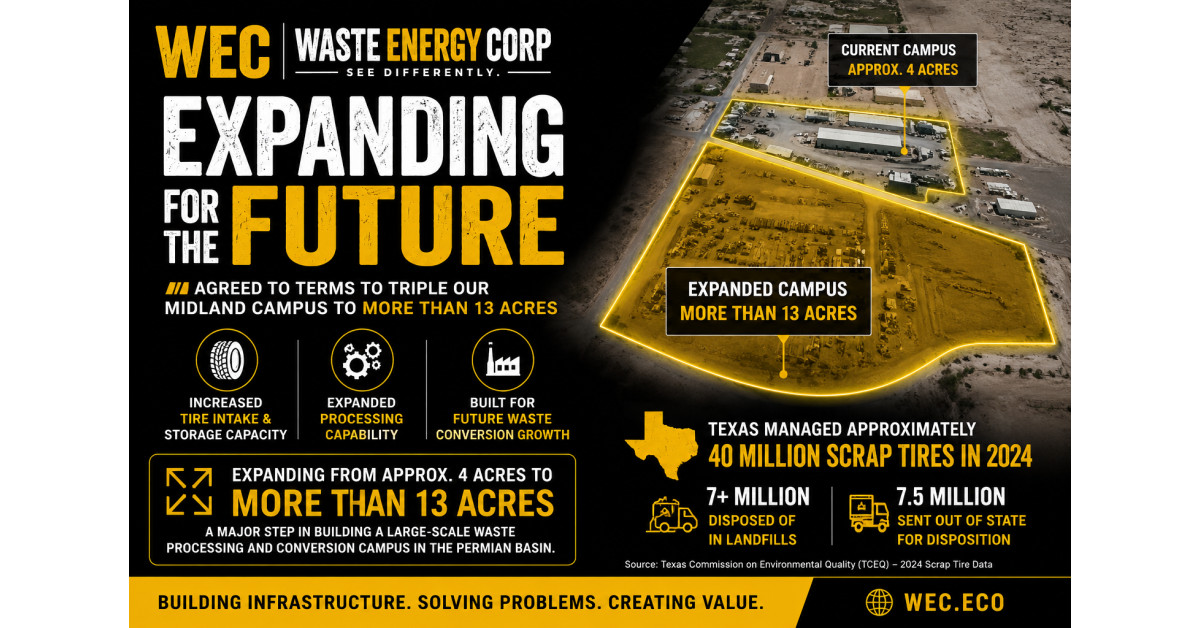
Waste Energy (WAST) agreed to expand its Midland, Texas waste conversion campus from ~4 acres to >13 acres (+~9 acres), more than tripling the site footprint to increase waste tire intake, processing/storage, and future conversion capacity. Closing is expected around Sept. 1, 2026, subject to final documentation, as the company transitions its first system from commissioning toward commercial operations. The move targets a large Texas scrap-tire stream cited at ~40M tires managed in 2024, supporting a scaling narrative but with completion/financing and commissioning risks still tied to definitive terms.
The market should treat this less as an operating update and more as a financing/credibility checkpoint. For a microcap OTC name, acreage is only valuable if it converts into permitted throughput, feedstock contracts, and evidence that the first system is running at acceptable uptime; otherwise the larger site mainly increases fixed-cost drag and future dilution risk. The near-term stock reaction can be positive on optionality, but that is usually a one- to three-day event unless the company pairs it with a funded buildout or verified commissioning milestones.
Second-order, the only real competitive spillover is local: if WAST ever becomes functional, it could marginally tighten scrap-tire feedstock in the Permian/West Texas corridor and pressure smaller haulers, aggregators, and landfill/export channels. That does not move public waste incumbents like WM, RSG, or CLH in any meaningful way; their exposure to scrap-tire processing is immaterial. The bigger read-through is that in-state waste conversion economics remain highly dependent on policy, collection density, and transport costs, so the business model is more logistics-arbitrage than technology story.
Contrarian view: consensus may be overestimating the value of announced footprint expansion and underestimating execution friction. The key falsifiers over the next 1-3 months are a delay in definitive documentation, lack of disclosed project financing, or no evidence of throughput/revenue traction by the next filing cycle. Over 6-18 months, the thesis only works if WAST can prove commercial-scale economics without serial dilution; otherwise the acreage merely gives it room to burn cash faster.
AI-powered research, real-time alerts, and portfolio analytics for institutional investors.
Request DemoOverall Sentiment
mildly positive
Sentiment Score
0.15
Ticker Sentiment
