
AllMind vs Marvin Labs
AllMind is an AI research system for institutional investors, holding licensed data classes and the firm’s own systems as one ontology. Marvin Labs is a seat-priced copilot over what a covered company published, cited to the passage, from $89 per user per month.
The split is scope: Marvin answers inside one company, AllMind across a whole coverage list.

Holds licensed data classes and your own Snowflake, Databricks or S3 data as one ontology, runs agents for minutes or hours across many data points, and hands back a cited Word memo, Excel model or deck.
A seat-priced copilot over what management published, with passage-level citations, guidance and sentiment scoring, and Deep Research Agents that trigger on an earnings release. The prices are on the page rather than behind a call.
If the answer lives inside one company’s own disclosure and you want it this week, Marvin is the shorter path. If it crosses a coverage list, entitled content or your warehouse, that is the AllMind case.
Feature by feature
Coverage and sources
Companies in scope
- AllMind
- 40+ exchange and venue feeds
- Marvin Labs
- 300+ on Standard
SEC filings (10-K, 10-Q, 8-K)
- AllMind
- Supported
- Marvin Labs
- Supported
Earnings call transcripts
- AllMind
- Supported
- Marvin Labs
- Supported
Sell-side broker research
- AllMind
- AMR included; live via RMS
- Marvin Labs
- Excluded by design
Expert-call transcripts
- AllMind
- Supported
- Marvin Labs
- Not supported
Live earnings and financials
- AllMind
- Within minutes
- Marvin Labs
- Within minutes
Market and pricing data
- AllMind
- 40+ exchange and venue feeds
- Marvin Labs
- Price charts, no live quote
Alternative and supply-chain data
- AllMind
- Supported
- Marvin Labs
- Not supported
Non-US filings
- AllMind
- EDGAR, SEDAR+ and global filings
- Marvin Labs
- Inside the plan’s covered list
Scope of a question
Cross-company or sector scan
- AllMind
- Supported
- Marvin Labs
- Declined by design
Relationship traversal across companies
- AllMind
- Ontology graph
- Marvin Labs
- One company at a time
Answers cited to the passage
- AllMind
- Supported
- Marvin Labs
- Supported
Automation
Scheduled and earnings-triggered runs
- AllMind
- Supported
- Marvin Labs
- Standard and Pro plans
Companies per automation
- AllMind
- Up to 200 (AllMind states)
- Marvin Labs
- One company per report
Custom agents
- AllMind
- Agent Studio
- Marvin Labs
- Pro plan only
Deliverables
Word memo or research note
- AllMind
- Supported
- Marvin Labs
- Supported
PowerPoint decks
- AllMind
- Supported
- Marvin Labs
- Not named on the site
Excel models (DCF, LBO, comps)
- AllMind
- Supported
- Marvin Labs
- Vendor points to modeling tools
Edit an existing PPTX, DOCX or XLSX
- AllMind
- Supported
- Marvin Labs
- Not named on the site
Firm house format
- AllMind
- 20+ investment-bank templates
- Marvin Labs
- Logo and template upload
Internal and connected data
Snowflake, Databricks and S3 queried in place
- AllMind
- Supported
- Marvin Labs
- Not supported
Folder sync from Drive or SharePoint
- AllMind
- Drive and OneDrive on Data Rooms
- Marvin Labs
- Enterprise plan only
Upload your own documents
- AllMind
- Supported
- Marvin Labs
- PDF, text, Markdown to 500 MB
MCP connectors
- AllMind
- Bloomberg and AlphaSense bridges
- Marvin Labs
- Supported
Buying and governance
Published list price
- AllMind
- Not supported
- Marvin Labs
- Supported
Free self-serve tier
- AllMind
- Not supported
- Marvin Labs
- Supported
SOC 2 Type II
- AllMind
- Supported
- Marvin Labs
- Not supported
ISO 27001
- AllMind
- Targeted Q1 2027
- Marvin Labs
- Not supported
Encryption in transit and at rest
- AllMind
- TLS 1.3, AES-256
- Marvin Labs
- TLS 1.2+, AES-256
No training on customer data
- AllMind
- Supported
- Marvin Labs
- Supported
Marks come from published sources read on 30 August 2026: marvin-labs.com, its app documentation and changelog, and AllMind’s own product and security pages. A dash means not offered; a text cell means a plain yes or no would have misled. “Not named on the site” is an absence of evidence, not a denial: Marvin’s published sitemap and its documentation carry no mention of PowerPoint or pptx. “40+ exchange and venue feeds”, “within minutes” and “up to 200 companies in one automation” are AllMind’s own statements; Marvin’s coverage and latency figures are its own. Marvin’s homepage says “within seconds of a release” where its June 2026 documentation says “within minutes”; the slower wording is used above.
See AllMind on your own coverage→What changes when the question does not fit inside one company
Marvin pins every run to one company on purpose, and that sets the ceiling
Marvin scopes every agent run to a single company by design. Its own documentation lists what the agent will not answer: a scan across a whole sector, a macro or cross-asset view, a real-time share price, and a valuation or investment recommendation. A margin comparison against four competitors runs as five scoped analyses, one per company, then gets assembled into a table. That keeps an answer accountable, and it is also the ceiling.
AllMind holds a financial ontology instead: a maintained map of companies, suppliers, customers, estimates, filings and the firm’s own research. An agent walks relationships several nodes out rather than retrieving documents company by company, and a single run can work for minutes or hours before it answers. AllMind’s compare pages state that one automation can cover up to 200 companies and deliver Word or PDF, with Agent Studio building the custom ones. Marvin’s agents fire per company and email a report per name.
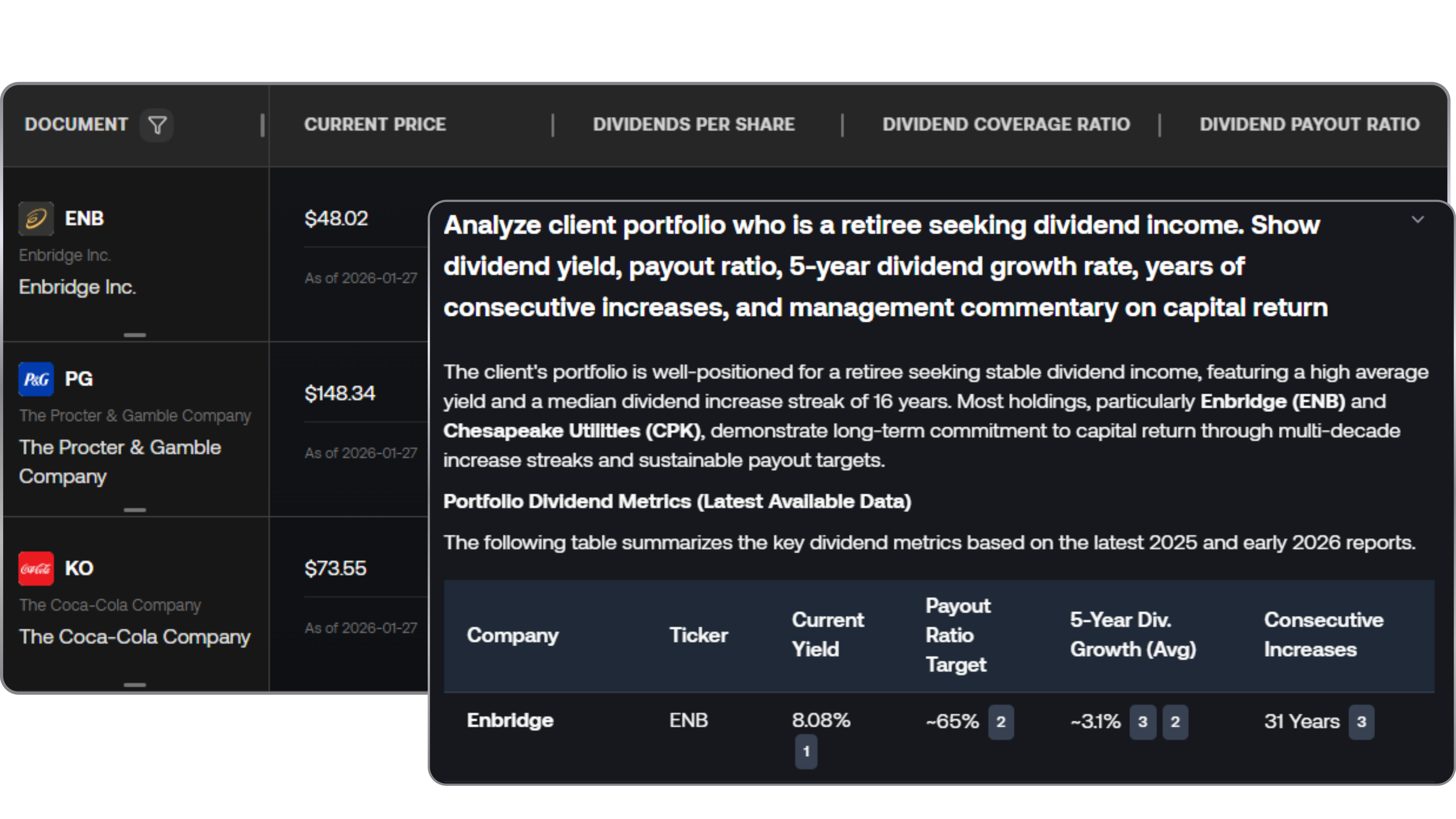
Marvin reads what management published; AllMind also reads what your firm owns
Marvin’s corpus is one class of content, what management itself published. Its coverage documentation excludes third-party analyst research, financial media and social media, on the argument that primary sources carry accountable statements. The corpus is predictable, and it also means there is no broker research and no expert-call class in the product, so research goes in as an uploaded PDF and the licensing question stays with the desk.
AllMind runs the other bet: 6,800+ premium data sources held as classes, broker research and Expert Insights, S&P, FactSet, LSEG and MSCI data, global investor-relations data, live news from thousands of sources, live earnings and financials within minutes, and alternative data. Expert Insights is built in, so a desk reads expert calls without its own network contract. Snowflake, Databricks and S3 connect through a scoped IAM role and are queried in place, so internal numbers sit beside the licensed corpus rather than in a silo. AllMind’s own caveat: live embargoed broker research needs the firm’s RMS entitlement, and aftermarket research arrives on a delay that varies by broker.
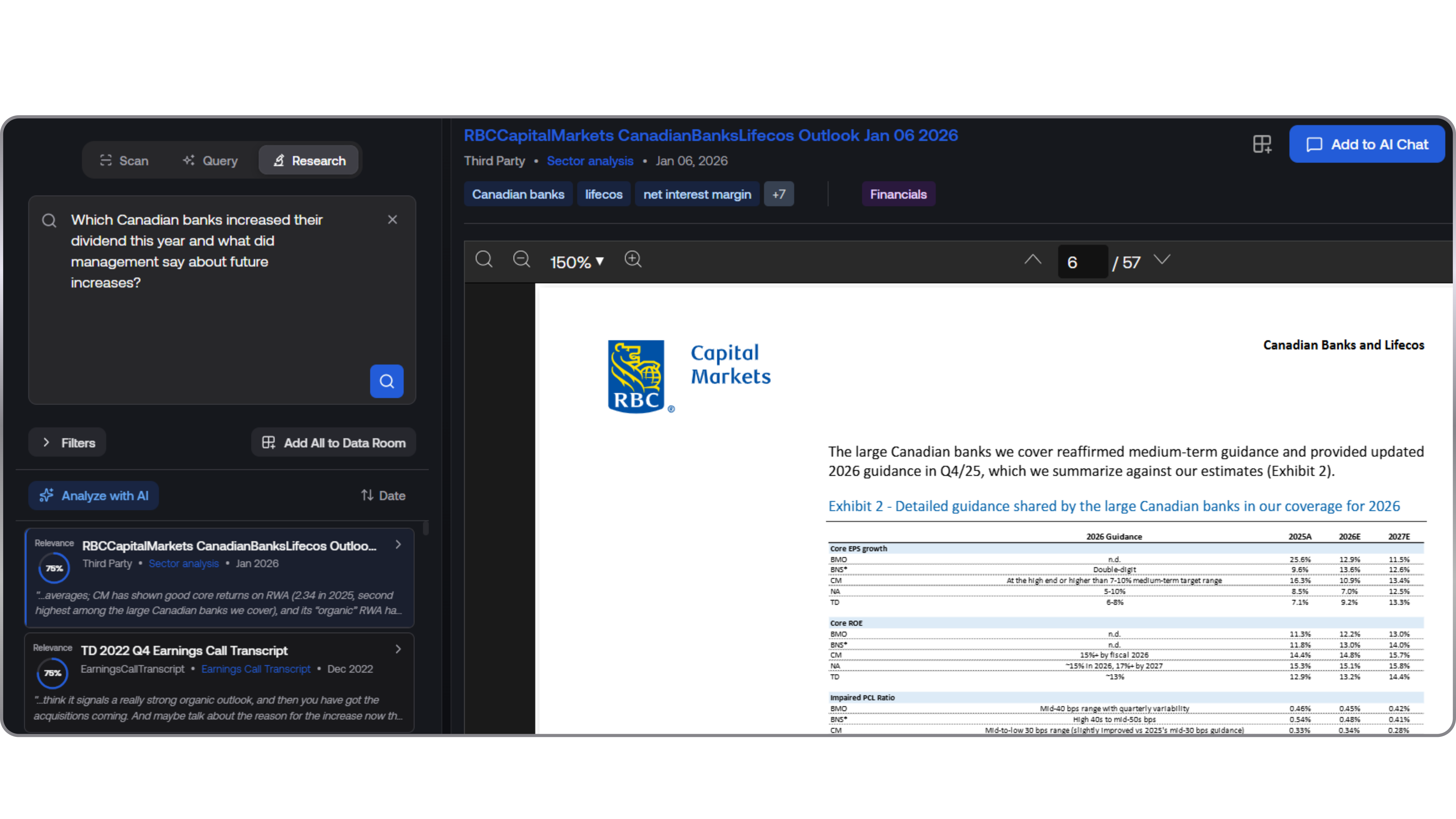
Marvin exports a document, AllMind builds the artifact, and the certification line decides the rest
Marvin exports a document; AllMind builds the artifact. Marvin exports PDF, DOCX, Markdown or plain text with citations and branding intact, on a template uploaded once. Its own chat documentation draws the line: full financial models and custom valuation frameworks belong in dedicated modeling tools, and no PowerPoint output is named on its site. AllMind generates decks from 20+ investment-bank templates, Word memos, and Excel models including DCF, LBO and comps with live formulas, and edits existing PPTX, DOCX and XLSX files. Those land in supplied templates, so a bespoke house format still needs a formatting pass.
The certification line then decides the rest. Marvin’s security page says it holds no SOC 2, ISO 27001 or equivalent certification today, publishes no SLA and no status page, and gates MFA and SSO to Pro. AllMind has been SOC 2 Type II certified since November 2025, with entitlements agents inherit and can never widen, and every access logged. Neither is ISO 27001 certified; AllMind’s is targeted for Q1 2027.
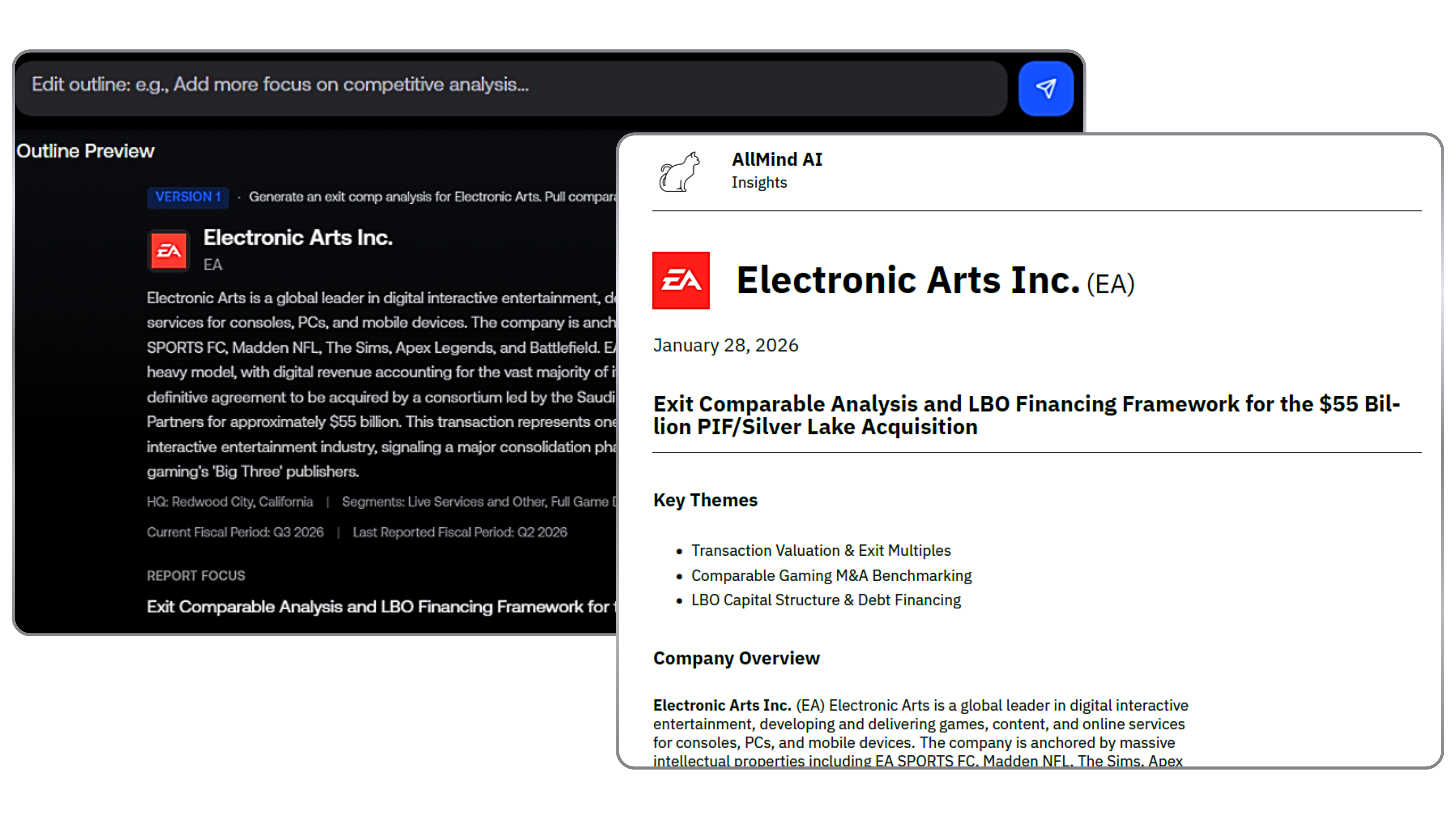
Where Marvin Labs is strong
Marvin Labs puts specific engineering on the public record rather than decoration. Filings are held complete rather than sliced into fragments, so a citation opens the right section (changelog, 20 August 2026). Calculations run in sandboxed Python, and answers pass a citation check that raises a Correction banner when a claim drifts from its source (15 July 2026). Guidance Tracking is the standout: every forward-looking statement captured when it was made, linked across restatements, and scored beat, met or missed once the period closes, with accuracy and discipline scores. AllMind publishes no named equivalent.
The commercial side is handled just as plainly. Prices sit on the page at $89 and $399 per user per month, the free tier runs on 15 companies with no sales call, and the security page lists its own gaps in public. For one analyst covering large caps who wants primary-source depth this week, that is a low-risk offer, and the stated scope limits make it easy to tell in advance whether the tool fits.
One analyst on one company, or a desk on a whole coverage list
AllMind
AI research system for institutional investors
AllMind holds licensed content, live market data and the firm’s own systems as one ontology of entities and relationships: companies, suppliers, customers, estimates, filings and the desk’s own research.
Agents run over that map for minutes or hours across many data points and return work traced to the passage it came from. It is bought by banks, hedge funds and large corporates, often to consolidate several point subscriptions into one system.
Marvin Labs
Self-serve copilot for a single analyst
Marvin Labs is a seat-priced copilot over what a covered company itself published: filings and amendments, earnings call transcripts, earnings releases and decks, investor-relations materials and selected conferences. It answers with passage-level citations and runs Deep Research Agents manually, on a schedule, or on an earnings trigger, emailing the report by default.
The company was incorporated in London in July 2023, describes itself as founded in early 2024, self-reports 2 to 10 employees, and says it is bootstrapped; the UK registry shows no filed equity round.
What each one is good at, and what it costs you
AllMind
- Broker research, Expert Insights, alternative data and S&P, FactSet, LSEG and MSCI fundamentals in one corpus
- An ontology of companies, suppliers, customers and estimates that agents traverse across a coverage list
- Your own Snowflake, Databricks or S3 read in place, plus Drive and OneDrive sync on Data Rooms
- Decks from 20+ investment-bank templates, Word memos, and DCF, LBO and comps models with live formulas
- One automation across up to 200 companies, per AllMind’s compare pages
- SOC 2 Type II certified in November 2025, per-user entitlements agents inherit, every access logged
- No card checkout and no monthly plan, so an evaluation starts with a sales conversation
- Depth comes from connecting internal systems, so onboarding is a data conversation, not a signup
- A deliverable lands in a supplied template, so a bespoke house format needs a formatting pass
- Live embargoed broker research runs on the firm’s own RMS entitlement; aftermarket comes on a delay
Marvin Labs
- Published list prices: a free Evaluation tier, $89 and $399 per user per month, on a card
- Guidance Tracking scores each management commitment beat, met or missed once the period closes
- A daily 0 to 100 sentiment score per company, comparable against peers
- Agents fire on the earnings release, then the transcript, then the filing, emailed by default
- MCP in both directions: hosted connectors and your own servers, in-house figures win and clashes are flagged
- Calculations run in sandboxed Python, and a citation check raises a Correction banner
- No SOC 2 or ISO 27001 today, no published SLA and no public status page
- No EU data residency by default, one AWS US region, and MFA and SSO on Pro only
- Declines a sector scan, a macro view, a live share price and a valuation call
- No PowerPoint and no financial models; the vendor points to dedicated modeling tools
What AllMind and Marvin Labs actually cost
AllMind
Quote-based, no self-serve checkout
AllMind sells through a sales conversation. There is no monthly plan and no card checkout, which is a genuine cost to an analyst who wants to start this afternoon. AllMind also publishes no breakdown of what a quote turns on, so this page does not invent one.
- Any plan
- Quote-based
- Monthly or self-serve plan
- None
- What the quote turns on
- No public breakdown
Marvin Labs
List prices published, per user per month
Three plans on the page and a fourth on request. Both paid plans are per user with no published volume break, and the plan a desk needs is usually set by security and coverage rather than by usage: scheduling starts at Standard, custom agents and team sharing at Pro, and MFA, SSO, EU hosting and private-cloud or on-premises deployment at Pro or Enterprise.
- Covered universe
- 15 free, 300+ Standard, +50 on Pro
- Financial history
- 4 quarters free, 20 quarters plus 4 of expectations on Standard
- AI Credit caps
- 1,500 one-time free, 2,000/day Standard, 10,000/day Pro
What changes the quote
On Marvin, seats first, then the size of the covered universe, then AI Credits. Credits behave as a throughput limit rather than a soft meter: one balance funds both chat and agents, an agent run costs more than a chat turn, and the daily and weekly caps apply together, 4,000 a week on Standard and 20,000 on Pro, so whichever you reach first stops the work. Nominated Pro names typically go live within 24 hours. On AllMind, none of that is published. The number is set in the sales conversation, and what moves it does not appear on a public page.
Two things keep this from being like-for-like. Marvin’s published price has no independent corroboration, because no third-party pricing directory carries the company; the software-directory listings for “Marvin” belong to an unrelated business. And the two contracts buy different things: a per-seat copilot over a fixed universe of what companies published, against a firm system with included aftermarket broker research, publication-time research through the firm’s RMS entitlement, Expert Insights and a connection to the firm’s own systems. Marvin’s own pages also disagree on how many credits a chat turn costs, so no per-turn figure appears here.
Which one you want, task by task
I cover 25 US large caps and I want an earnings review in my inbox the morning after each print.
Marvin’s Deep Research Agents fire on the earnings release, then the transcript, then the filing, with email delivery on by default, and that sits on the $89 Standard plan as long as the names are inside its 300+ universe. This is the job the product was shaped around.
I need to screen 120 names in a sector for margin inflection, then join the result to our own positions table in Snowflake.
The ontology lets an agent traverse relationships across a book, and Snowflake, Databricks and S3 are queried in place through a scoped IAM role. Marvin declines a sector scan by design, and its internal-data routes are upload, a customer-run MCP server or Enterprise-only folder import, none of which query a warehouse.
The investment committee wants a deck and a working DCF by Friday, off filings, broker research and our internal notes.
Decks from 20+ investment-bank templates and Excel models, over a corpus with aftermarket broker research by default, publication-time research through the firm’s RMS entitlement, and the Data Room. Marvin exports PDF, DOCX and Markdown; its documentation says models belong in dedicated tools. AllMind’s deck arrives in a supplied template; a house format takes a pass.
I want to know which management teams actually delivered the guidance they gave, name by name.
Guidance Tracking captures every forward-looking statement when it is made, links it across restatements, and scores it beat, met or missed once the period closes. AllMind carries company guidance with revision histories but no named scorecard, and would run this as a general automation. The limit is Marvin’s universe: the name has to be covered.
Vendor risk will not onboard anything without a current SOC 2 report and per-user entitlements.
AllMind is SOC 2 Type II certified as of November 2025, with per-user entitlements agents inherit and can never widen and every access logged. Marvin’s security page says it holds no SOC 2 or ISO 27001 today, no SLA and no status page, and gates SSO and MFA to Pro. Neither is ISO 27001 certified.
I want to try an AI copilot on real work this week while the firm runs a longer platform evaluation.
Marvin’s Evaluation tier runs on 15 companies with no registration and no sales call, so real work can start the same day. AllMind has no self-serve checkout. Its 6,800+ premium data sources are already present; evaluation includes a data conversation because connecting internal systems adds the firm-specific layer and determines deployment scope.
Pick on how wide the question is: AllMind when the work crosses a coverage list, entitled content and your own systems, or Marvin Labs when one analyst is going deep on one company at a published price.
AllMind’s mechanisms are an ontology that walks from a company to its suppliers and customers, a warehouse queried in place, broker research and Expert Insights, and a finished deck, memo or Excel model.
Marvin’s is the opposite: each run pinned to one company, a corpus of what management published, a price on the page. Where a desk needs a current SOC 2 report before onboarding, Marvin’s security page settles it. Where the budget is one analyst’s and the names are covered, the price card settles it the other way.
AllMind vs Marvin Labs, answered
Marvin Labs costs $89 per user per month on Standard and $399 on Pro, with a free Evaluation tier; AllMind is quote-based and publishes no price. Those figures are the list prices on marvin-labs.com as of 30 August 2026, and an Enterprise plan is quoted on request, adding private-company coverage and optional on-premises or private-cloud deployment. Payment is by card through Stripe, with a 14-day money-back guarantee.
AllMind has no self-serve checkout and no monthly plan, and publishes nothing about what a quote turns on. So this is a per-seat tool an analyst can expense, set against a firm system priced in a sales conversation.
See AllMind on your own coverage
Join leading hedge funds and institutional investors who trust AllMind.Join leading hedge funds and institutional investors who trust AllMind to accelerate their research and analysis.