
AllMind vs Hudson Labs
AllMind is an AI research system for institutional investors: 6,800+ premium data sources and the firm’s Snowflake, Databricks and S3 tables held in one ontology. Hudson Labs is a filings-first platform for US public markets, built around its Co-Analyst, restatement-adjusted figures and a forensic risk score.
The two meet on SEC filings and earnings transcripts, and separate almost everywhere else.
Breadth across content classes, your own systems joined to it, and a document at the end. Expert Insights, broker research, live earnings and fundamentals from S&P, FactSet, LSEG and MSCI sit in one ontology beside your warehouse. Output is a cited memo, model or deck.
Depth on one corpus. All US public issuers and over 1,400 ADRs, restatement-adjusted history, guidance extraction, tone screening, and a forensic risk score from 0 to 100 across eight categories on the Institutional plan. No broker research, no expert-call transcripts, no filings from non-US regulators.
Ask where your next hard question comes from. If it stays inside EDGAR, Hudson Labs answers it precisely and you can buy it today on a card. If it needs entitled content, your own estimates, non-US filings or a finished deliverable, that is AllMind’s job.
Feature by feature
Coverage and content
US SEC filings and earnings transcripts
- AllMind
- Supported
- Hudson Labs
- Supported
Filings from regulators outside the US (SEDAR and beyond)
- AllMind
- Supported
- Hudson Labs
- ADRs and 20-Fs via EDGAR only
Broker and sell-side research as a content class
- AllMind
- Aftermarket, on a delay
- Hudson Labs
- Not supported
Expert-call transcripts as a content class
- AllMind
- Supported
- Hudson Labs
- Not supported
Alternative and supply-chain data
- AllMind
- Supported
- Hudson Labs
- Not supported
Fundamentals and consensus estimates from named providers
- AllMind
- S&P, FactSet, LSEG, MSCI
- Hudson Labs
- S&P Global Market Intelligence only; no segment consensus
Filings precision and risk
Restatement-adjusted multi-period figures
- AllMind
- Not documented
- Hudson Labs
- Supported
Forensic or fraud risk score
- AllMind
- Not documented
- Hudson Labs
- Institutional plan
Tone and sentiment screening on management language
- AllMind
- Not documented
- Hudson Labs
- Supported
Guidance tracking across a coverage list
- AllMind
- Supported
- Hudson Labs
- Supported
Passage-level citation back to the source
- AllMind
- Supported
- Hudson Labs
- Supported
Money-backed accuracy guarantee
- AllMind
- Not documented
- Hudson Labs
- $50 per confirmed numeric hallucination, narrow scope
Deliverables
PowerPoint decks from investment-bank templates
- AllMind
- Supported
- Hudson Labs
- Not supported
Excel models (DCF, LBO, comps) with live formulas
- AllMind
- Supported
- Hudson Labs
- Not supported
Word memos and research notes
- AllMind
- Supported
- Hudson Labs
- Structured reports
Edits existing PPTX, DOCX and XLSX files
- AllMind
- Supported
- Hudson Labs
- Not supported
Internal data and firm systems
Snowflake, Databricks and S3 queried in place
- AllMind
- Supported
- Hudson Labs
- Not supported
Document upload and a firm data room
- AllMind
- Supported
- Hudson Labs
- Upload “coming soon”, Jun 2026
MCP connector for Claude
- AllMind
- Not documented
- Hudson Labs
- Institutional plan, per Aug 11 2026 post
Automation and delivery
Scheduled monitoring agents over a coverage list
- AllMind
- Supported
- Hudson Labs
- Supported
Delivery into Microsoft Teams
- AllMind
- Not documented
- Hudson Labs
- Supported
Commercials and governance
Published list price
- AllMind
- Not supported
- Hudson Labs
- Core: $99/mo annual, $119/mo monthly
Self-serve trial without a sales call
- AllMind
- Not supported
- Hudson Labs
- 14 days
SOC 2 Type II certified
- AllMind
- Yes, Nov 2025
- Hudson Labs
- States SOC 2 alignment
Hudson Labs marks come from its own pages, all opened August 30 2026: /pricing, /products, /security and /technology; the coverage FAQ dated June 23 2025 (all US public issuers and over 1,400 ADRs, no forensic risk coverage for ADRs, no asset-backed securities); the product update dated June 19 2026 (OneNote connector in beta, OneDrive and upload described as coming soon); the No Hallucination Guarantee post dated June 17 2026; the alternatives post dated June 3 2026, which carries the usage limits and the Institutional starting figure that /pricing does not; and the Claude connector post dated August 11 2026, the only page stating that connector is Institutional-only. Its security page states alignment with SOC 2 standards and claims no attestation, which is not the same as being uncertified, so ask them directly. AllMind marks come from allmind.ai. “Not documented” means the capability is absent from AllMind’s approved public claims, not that it was tested and found missing.
See AllMind on your own coverage→Three places the two products stop overlapping
A filings corpus can only answer filings questions
Everything Hudson Labs can answer comes out of US primary disclosure. It covers all US public issuers and over 1,400 ADRs (company FAQ, June 23 2025; the current products page drops the count), reading EDGAR filings, earnings and conference transcripts, investor decks, press releases and S&P Global Market Intelligence fundamentals, with web results on a few named workflows. Its own June 11 2026 comparison lists what it cannot reach: expert transcripts, broker research, global newswires, segment consensus and pre-made models.
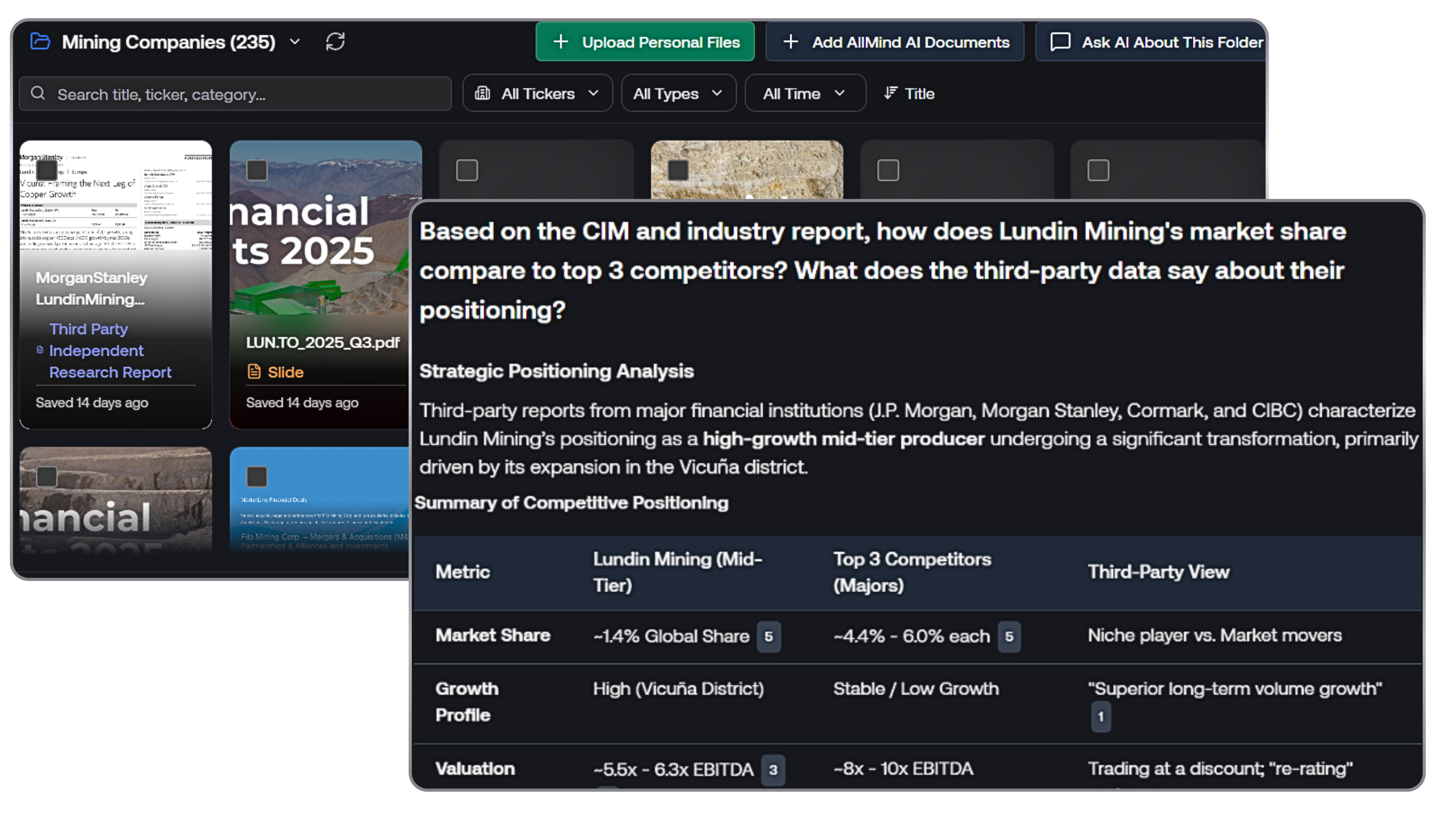
AllMind starts from a different inventory. Its Data Engine carries 6,800+ premium data sources, and the classes matter more than the count: live earnings and financials within minutes, global investor-relations data, Expert Insights, broker research, live news and newswires from thousands of sources, consensus estimates alongside guidance, segment detail and operating KPIs, prebuilt company models, alternative data, fundamentals from S&P, FactSet, LSEG and MSCI, and founder-stated sector collections such as mining and healthcare. Every class on Hudson Labs’ own cannot-reach list is in that inventory. The limits on our side: live embargoed broker research needs the firm’s own RMS entitlement, aftermarket research arrives on a delay that varies by broker, and live markets span North America and Europe rather than every region.

The differentiated view sits in systems no public corpus can see
AllMind reads the firm’s own systems and joins them to the external corpus. Snowflake, Databricks and S3 are reached through a scoped IAM role and queried where they sit rather than copied, Data Rooms sync folders from Google Drive and OneDrive, and everything connected lands in the same ontology as the public content, so an agent traverses entities and relationships instead of retrieving documents one at a time. Per-user entitlements carry into every agent and can never widen, and every access is logged.
Hudson Labs is earlier here. Its June 19 2026 release listed a OneNote connector in beta with OneDrive and upload described as coming soon, and the independent hands-on review published January 1 2026 by Buyside AI Reviews found uploaded files were not supported at that date, the platform working instead from Hudson Labs’ own maintained library. The cost on AllMind’s side is worth naming: real depth means a data conversation with your engineers, not a signup.
Hudson Labs sells research projects, AllMind runs them inside your workspace
Hudson Labs sells Deep Dive as a priced research project rather than a workspace feature. Launched June 18 2026 under the line “Tegus for Agentic Research”, it runs parallel agents across 500 or more documents and web sources, and bills per project by data-point volume at an introductory rate the vendor itself calls limited-time. A Deep Dive is commissioned through a request form rather than run on demand, and the same post states that after two weeks a commissioned Deep Dive becomes available to all Hudson Labs subscribers, which applies to those projects and not to ordinary Co-Analyst answers or agent output.
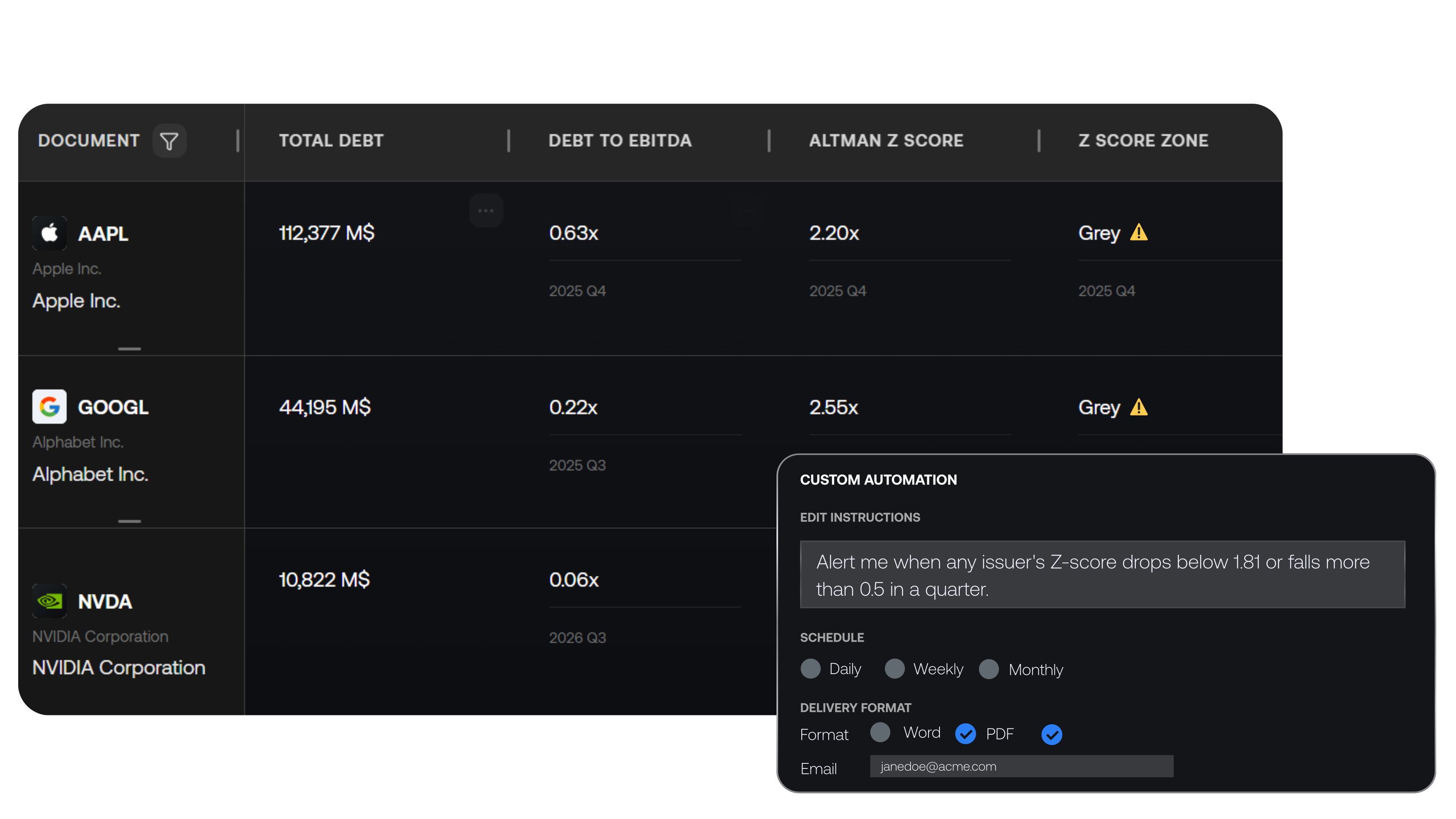
AllMind runs the equivalent work inside your own governed workspace. Agent Studio builds the agent, AllMind’s compare pages state one run can span up to 200 companies and land as Word or PDF, and a verification pass re-checks the figures before the report ships, each one traceable to the passage it came from. Nothing leaves the firm’s per-user entitlements, which the agent inherits and cannot widen.
Where Hudson Labs is strong
Hudson Labs says it has built finance-specific language-model software since 2019, and the discipline shows in what it refuses to do. It stays inside US issuers and ADRs, doing a short list of things thoroughly. Prioritizing the restated figure over the as-first-reported one is the clearest example, a choice few research tools advertise. The forensic risk score has a public record: Forbes ran “AI Spotted Super Micro Risks Two Years Before Filing Fiasco” on August 30 2024, CNBC’s Fast Money covered the same call that November, and Wall Street Journal reporting on AI construction-in-progress accounting used its data in December 2025.
An independent review published January 1 2026, whose author states no financial relationship with the vendor, checked a multi-year income statement and segment test cell by cell, found every figure correct and praised the citation design. Hudson Labs also runs that reviewer as a named testimonial, so read it as an independent test the vendor is glad to quote. And it publishes its price, which almost nobody here does.
One public corpus done thoroughly, or every source joined in one workspace
AllMind
AI research system for institutional investors
AllMind is built on a financial ontology: companies, suppliers, customers, estimates, filings and a firm’s own research held as entities with relationships between them, not as documents waiting to be searched.
Agents work over that map for minutes or hours, joining entitled content to internal data reached from Snowflake, Databricks and S3 through a scoped IAM role. Output lands as a cited memo, a live-formula model or a deck. It is not a trading or execution terminal, and there is no self-serve checkout.
Hudson Labs
Filings-first AI research and forensic risk screening for US public markets
Hudson Labs sells the Co-Analyst, which reads SEC filings, transcripts, investor decks and press releases across all US public issuers and over 1,400 ADRs (company FAQ, June 2025), returns restatement-adjusted figures linked to the source, and scores each company for accounting and governance risk.
It is independent and private, based in Toronto, and came through Y Combinator’s Summer 2021 batch as Bedrock AI. Core is published at $99 a month on annual billing with a 14-day trial; forensic risk, export and team sharing sit on the quote-only Institutional plan.
What each one is good at, and what it costs you
AllMind
- 6,800+ premium data sources spanning broker research, Expert Insights, alternative data and S&P, FactSet, LSEG and MSCI fundamentals
- Snowflake, Databricks and S3 queried in place through a scoped IAM role, never copied out
- Expert-call transcripts as a built-in content class, without a separate expert-network contract
- Word memos, DCF, LBO and comps models with live formulas, and decks from 20+ investment-bank templates
- Agents that work one question for minutes or hours rather than answering in one shot
- SOC 2 Type II certified since November 2025, with per-user entitlements agents inherit and cannot widen
- No self-serve checkout and no monthly plan, so buying starts with a sales conversation
- Live embargoed broker research needs the firm’s own RMS entitlement, and aftermarket arrives on a delay
- No self-serve checkout and no monthly plan, so a non-institutional buyer is better served elsewhere
- ISO 27001 is targeted for Q1 2027, while SOC 2 Type II is certified
Hudson Labs
- Published price with a 14-day self-serve trial: $99 a month on annual billing, $119 monthly
- Restatement-adjusted multi-period figures as a first-class primitive, not a derived view
- Forensic Risk Score decomposed into eight categories and refreshed with every 10-K and 10-Q
- Tone screening that turns management stress, confidence and deflection into a screenable axis
- A $50 refund per confirmed numeric hallucination on core document types, paid subscribers only
- Coverage of every US public filer, with a Claude MCP connector on Institutional plans
- No broker research, expert-call transcripts or newswires; the corpus is US primary disclosure
- No filings from non-US regulators, so foreign issuers arrive only through EDGAR
- Forensic scores, export, team sharing and the Claude connector all sit on the quote-only Institutional plan
- No decks or financial models, and upload was still listed as coming soon in June 2026
What AllMind and Hudson Labs actually cost
AllMind
Quote-based, with no published list price
AllMind is sold through a sales conversation. No self-serve checkout exists and nothing is offered month to month, so a single analyst cannot put it on a card and start. AllMind also does not publish what a quote is built from, so any seat number, module list or usage tier you read elsewhere is somebody guessing.
- Self-serve checkout
- None
- Monthly plan
- None
- What a quote is built from
- Not publicly documented
Hudson Labs
Published: Core at $99 a month on annual billing
The $99 and $119 figures are one plan on two billing terms rather than a contradiction. The pricing page loads on the annual view and shows $99 a month with $1,188 a year beneath it, and the homepage advertises a 14-day free trial “from $119 monthly”. The tier split matters more than either number, because the forensic risk scores the company is known for are not in Core.
- Core, annual billing
- $99 / month ($1,188 / year)
- Core, monthly billing
- $119 / month
- Institutional, indicative
- “starts at around $15,000 per team per year”
- Deep Dive project
- $25 under 500 data points, $50+ above
What changes the quote
Four levers move the Hudson Labs number. Tier decides what you get: forensic risk scores, unlimited automations, team sharing, export and the Claude connector all sit on Institutional. Usage sits behind “5x the usage” on the pricing page, though a June 3 2026 company post puts Core at 25 queries a day with one automation and Institutional at 140 a day per seat. Seats push you up, since Core reads as an individual plan. Deep Dive adds a variable per-project line on top. AllMind pricing is quote-based and its levers are not public, so this page does not invent them.
The two contracts are not like-for-like. A Hudson Labs subscription buys analysis over a licensed public corpus, with no data feeds, expert-call hours or broker-research entitlements to add, because it does not sell those classes. An AllMind contract covers entitled content, connections into the firm’s own systems and document generation, so the fair comparison is against what a desk already pays across several subscriptions rather than against $99. No third-party estimate of Hudson Labs Institutional pricing turned up in the procurement directories checked on August 30 2026, so the vendor’s own blog line is the only public anchor for that tier.
Which one you want, task by task
Pull a five-year restatement-adjusted income statement on a US name before tomorrow’s call.
Restatement adjustment is a first-class primitive at Hudson Labs, which says it prioritizes restated figures and assembles the comparable series from filings, transcripts and press releases in one query. AllMind’s approved public claims document no equivalent normalization layer.
Screen the whole US market for accounting red flags and related-party exposure before sizing a short.
The Forensic Risk Score decomposes from 0 to 100 across eight categories and refreshes with every 10-K and 10-Q, with a public track record behind it. Budget for the Institutional plan, because the pricing page puts forensic risk there rather than in Core.
Build the IC memo and the deck from our own estimates in Snowflake, plus broker research and expert-call transcripts.
A scoped IAM role reads the Snowflake tables where they sit and the ontology joins them to entitled content in the same pass, after which the memo, the model and the deck come out of a supplied template. Hudson Labs sells none of those content classes.
Watch a US coverage list through earnings season and still ship the client note.
Hudson Labs Topic Agents push themed filing and transcript signals into email or Microsoft Teams on a schedule from $99 per month. The note itself, in your own template with a verification pass on the figures, is AllMind’s half of the job.
Initiate coverage on a Canadian small cap and check every figure against its SEDAR filings.
Hudson Labs reaches issuers outside the US only where they file into EDGAR as ADRs or 20-Fs, and it excludes ADRs from forensic risk coverage entirely. AllMind covers EDGAR, SEDAR+ and global filings, with the honest limit that live markets run to North America and Europe.
AllMind and Hudson Labs get bought for different jobs: AllMind when the research crosses content classes, your own systems and a finished document, or Hudson Labs when the job is US filings, priced and precise.
The mechanisms separate them. AllMind joins entitled datasets, Expert Insights and your Snowflake or Databricks tables in one ontology, puts long-running agents on top, and returns a cited memo, model or deck under entitlements the agent inherits and cannot widen.
Hudson Labs reads one public corpus carefully and prints what that costs: restatement-adjusted figures, guidance, tone screens and a forensic risk score across US issuers and ADRs. Plenty of desks will run both. If you are buying one, buy for the shape of the questions you ask most weeks.
AllMind vs Hudson Labs, answered
Yes for SEC filings, and no once the question leaves EDGAR. Hudson Labs covers all US public issuers and over 1,400 ADRs (company FAQ, June 23 2025), prioritizes restatement-adjusted figures, extracts hard and soft guidance, cites every number to its document, and refunds $50 per confirmed numeric hallucination on core document types under a narrow guarantee.
It carries no broker research, no expert-call transcripts, no newswires and no filings from SEDAR, the LSE or the ASX, and its own June 11 2026 comparison lists pre-made models among the things it cannot give you. AllMind is the broader system, Hudson Labs the deeper one on a narrower corpus.
See AllMind on your own coverage
Join leading hedge funds and institutional investors who trust AllMind.Join leading hedge funds and institutional investors who trust AllMind to accelerate their research and analysis.