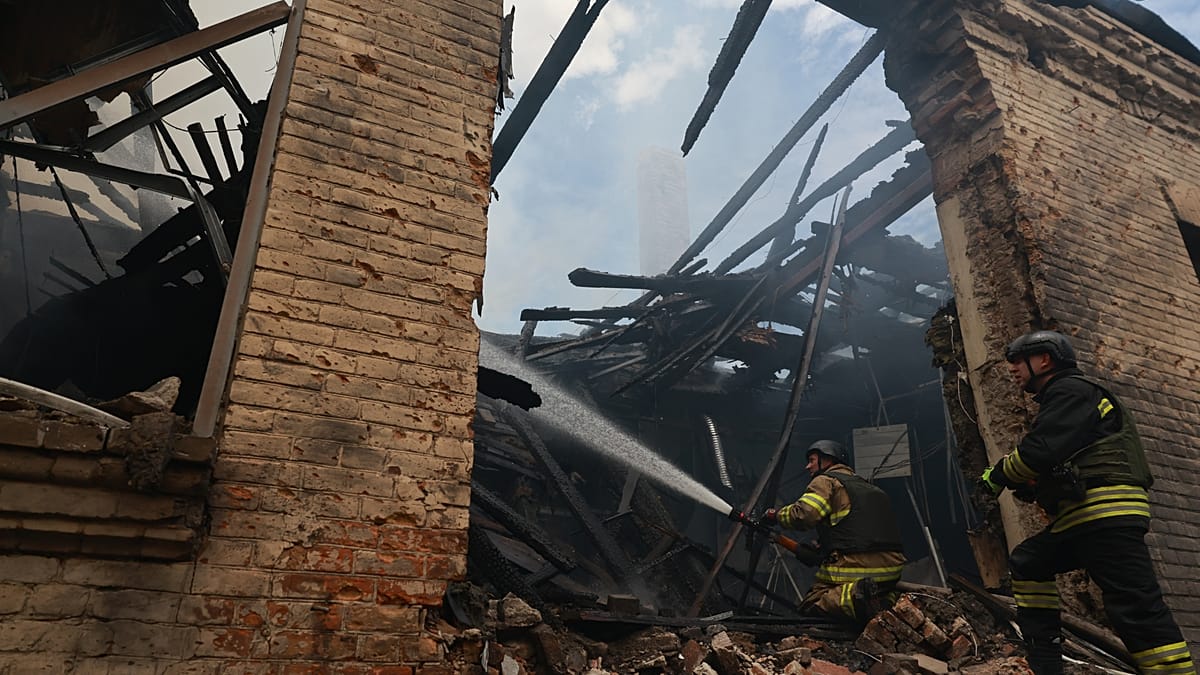
Ukraine said it struck Russia's Titan-Barrikady weapons plant overnight with FP-5 Flamingo cruise missiles, while Russian attacks across Ukraine killed at least two people and injured more than 20. Kyiv also reported 129 Russian drones in the latest barrage, with 113 destroyed or jammed, and said it hit Russia's Vtorovo oil pumping station for the second time in June. The attacks underscore escalating cross-border strikes on defense and energy infrastructure and keep regional risk elevated.
This is a material escalation in the quality of Ukrainian strike capability, not just the volume of strikes. A locally produced long-range cruise missile hitting a defense-industrial target deep in Russia raises the probability that Moscow must divert scarce air-defense assets from front-line and energy-protection duties to protect rear-area manufacturing nodes, degrading its ability to absorb sustained pressure elsewhere. The second-order effect is that “safe” Russian industrial geography is shrinking, which should increase risk premia around defense logistics, rail, power, and chemical inputs even if headline battlefield lines do not move.
The energy angle is more immediate for Russia than for global crude. Repeated hits on pumping and processing infrastructure matter less through outright supply loss and more through operational friction: extra freight, insurance, temporary shutdowns, and export scheduling delays that widen regional differentials. That is bearish for Russian fiscal resilience but not automatically bullish for Brent unless there is a broader campaign against export capacity; the market tends to overreact to isolated infrastructure damage, then fade it once throughput normalizes over days to weeks.
For defense equities, the key insight is that this supports the industrialization of the conflict and thus a longer spend runway, but not all names benefit equally. The winners are missile-defense, sensors, and guidance stack providers with replenishment demand; the losers are companies dependent on stable Eastern Europe supply chains or exposed to European industrial power prices if escalation broadens. The contrarian view is that the strike success may accelerate negotiations around stockpile depletion and air-defense scarcity, increasing pressure on Western suppliers to deliver faster rather than simply higher budgets, which can cap near-term pricing power in legacy primes.
AI-powered research, real-time alerts, and portfolio analytics for institutional investors.
Request DemoOverall Sentiment
strongly negative
Sentiment Score
-0.70
