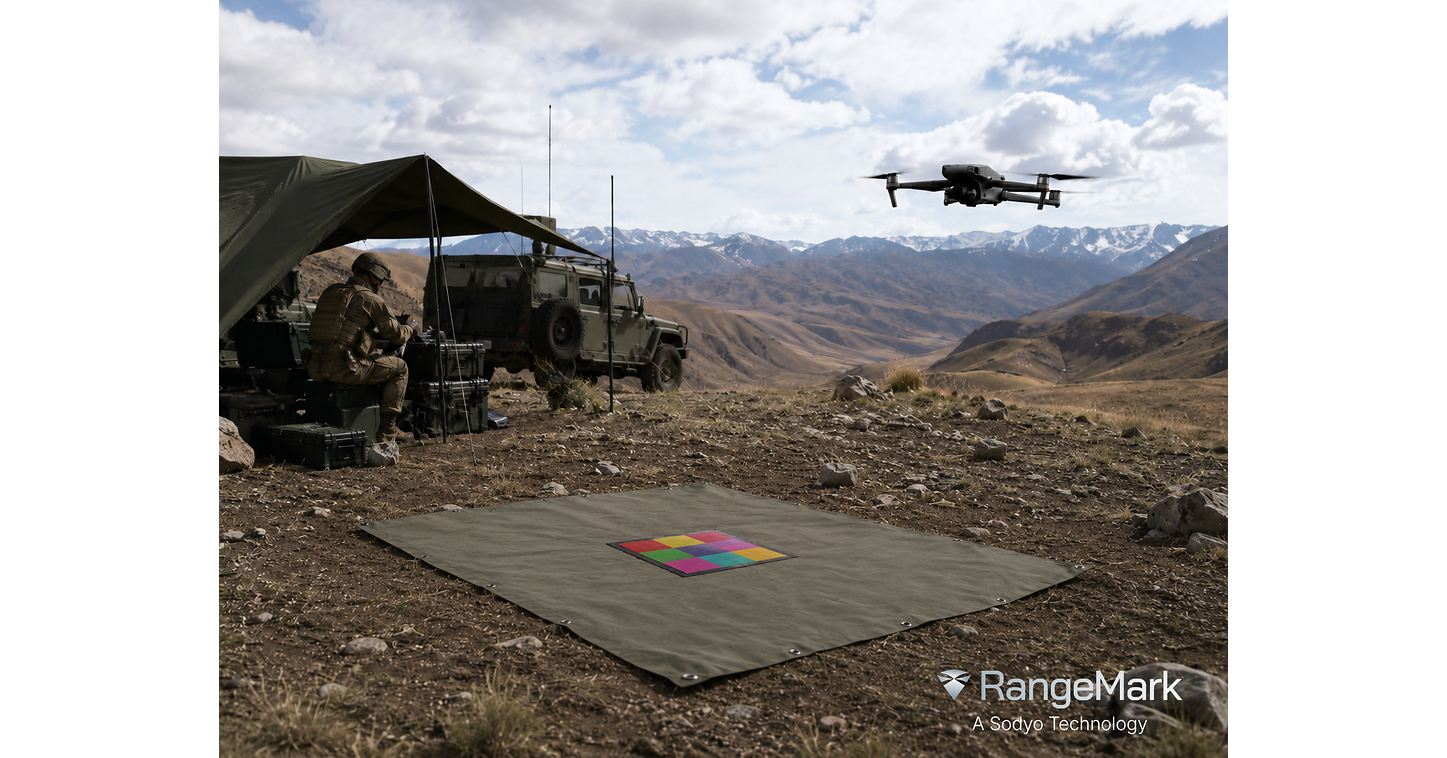
RangeMark by Sodyo launched a patented long-range drone marker identification system that can detect a passive, battery-free printed marker from up to 1 km away and return deterministic (not probabilistic) identity verification using only a camera. The company reports flight validation of a 100 cm marker at up to 500 m and a 50 cm marker at up to 250 m, with no GPS, cellular, RF, or network connectivity required. Partner-led licensing is planned, debuting at Commercial UAV Expo Americas 2026 (Sept 1–3).
This reads less like a product launch and more like an enabling layer for regulated autonomy. The economic value is in reducing the gap between “can fly” and “can be certified to act,” which should matter most in defense, utilities, ports, and other fixed-site operations where the buyer can control the physical environment. That favors incumbents with existing contracts and integration teams; the real monetization likely accrues to drone OEMs and autonomy platforms that can bundle the capability into procurement-compliant systems, not to the marker vendor alone.
Second-order, this could be a quiet wedge against pure vision-based autonomy stacks that rely on probabilistic identification. If deterministic ID becomes part of BVLOS, counter-UAS, or friendly-force workflows, it lowers liability and should help regulatory acceptance over 6-18 months. The catch is operational friction: the system only scales where someone can place and maintain markers, so the TAM is likely managed infrastructure, not open-world consumer drones. That makes the near-term revenue impact modest, but the policy impact meaningful if standards bodies or defense buyers start specifying optical ID requirements.
Consensus may be missing that this is not a universal drone breakthrough; it is a niche that becomes highly valuable in jammed/GPS-denied environments and less useful in unconstrained outdoor operations. The contrarian risk is that the market overestimates addressable volume before seeing procurement language, while underestimating the moat created if a single identification scheme gets embedded into OEM design. Falsifier: if upcoming BVLOS or defense specifications require open-environment identification without preplaced markers, this stays a narrow point solution rather than a platform shift.
AI-powered research, real-time alerts, and portfolio analytics for institutional investors.
Request DemoOverall Sentiment
mildly positive
Sentiment Score
0.18
