
Společnost Huawei představila novou výpočetní architekturu UnifiedBus pro systémy SuperPoD a clustery
Source: PR Newswire
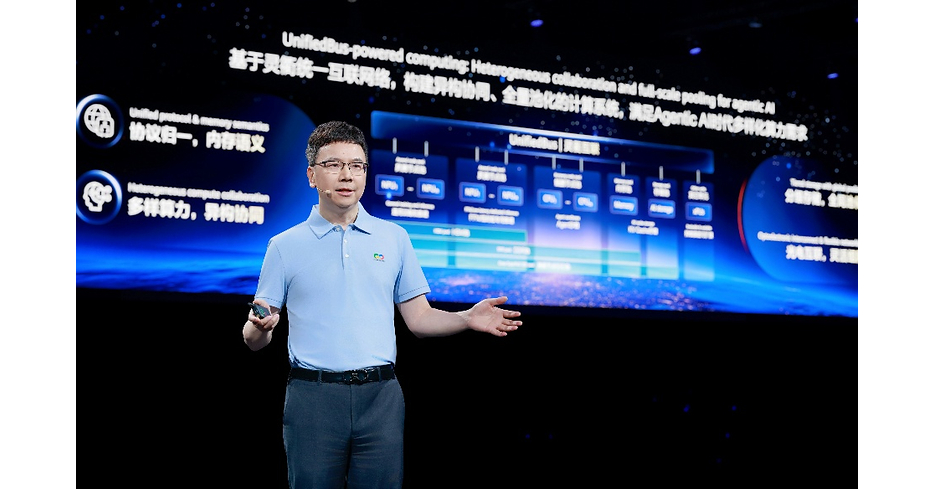
Huawei unveiled its UnifiedBus computing-interconnect architecture and an agentic-AI SuperCluster designed to scale from single systems to clusters with up to 1 million NPUs. The company claims UnifiedBus raises interconnect throughput from roughly 100 GB/s to TB/s levels and cuts round-trip latency from 7 microseconds to 2 microseconds, targeting bottlenecks in training trillion-parameter AI models. New LinkDevice hardware supports 176 ports at 1.6 Tbit/s each and 280 Tbit/s optical interconnection, while Huawei is also introducing one- to eight-NPU devices for local enterprise deployment of trillion-parameter models.
Analysis
The investable implication is not a direct Huawei beta but a potential acceleration of China’s vertically integrated AI stack. If the architecture delivers materially higher cluster utilization, it lowers the effective cost per trained token for customers unable to procure frontier U.S. accelerators, strengthening domestic substitution demand for Ascend-adjacent compute, networking, servers and local software. That is most relevant over 6-18 months for SMIC (0981 HK/688981 CH) and Cambricon (688256 CH), while NVIDIA (NVDA) and AMD (AMD) face a modest incremental risk that China’s constrained market becomes structurally less accessible rather than merely delayed by export controls.
The more non-obvious pressure point is memory mix. A credible shift toward pooled DDR/SSD tiers as substitutes for accelerator-attached high-bandwidth memory could reduce HBM content per unit of Chinese AI compute, a negative read-through for SK Hynix and Micron (MU) at the margin; however, lower system cost can expand total deployed accelerator count, making this a mix risk rather than a near-term volume short. Conversely, the emphasis on optical scale-out reinforces the long-run value of optical interconnect, but Huawei’s internalization means Western suppliers such as Broadcom (AVGO), Marvell (MRVL), Coherent (COHR) and Lumentum (LITE) should not be assumed beneficiaries of Chinese deployment.
Near term, this is unlikely to move U.S. AI leaders without independent benchmarks, customer orders, or evidence of production-scale availability. The key falsifier is whether third-party tests show training/inference economics competitive with NVIDIA’s current systems after accounting for software portability, failure rates and power consumption; a technical claim without broad developer adoption is principally a geopolitical narrative, not an earnings event. A further catalyst over 1-3 months would be additional U.S. restrictions on networking, memory or advanced packaging inputs, which could turn an apparent domestic-stack win into a supply-chain bottleneck.
Consensus may overstate the immediate competitive threat to NVDA: hardware interconnect claims do not solve the ecosystem lock-in created by CUDA, libraries, model tooling and enterprise support. The more probable first-order result is segmentation—Huawei gains in Chinese sovereign and regulated workloads, while NVDA retains premium economics where compliant supply and software compatibility matter—rather than rapid global share displacement.
AllMind Terminal
AI-powered research, real-time alerts, and portfolio analytics for institutional investors.
Request TrialMarket Sentiment
Overall Sentiment
strongly positive
Sentiment Score
0.58
Key Decisions for Investors
- No directional NVDA short on this announcement alone. Maintain core exposure but buy 3-6 month downside protection only if China revenue sensitivity is revised upward or independent Ascend benchmarks demonstrate comparable cost-per-token; the thesis is invalidated if NVDA’s China-compliant product demand and gross-margin guidance remain resilient.
- Watch-list long Cambricon (688256 CH) versus short a broad China semiconductor ETF only after verified customer deployments or order disclosures. Use a 3-6 month horizon: the pair isolates domestic AI-accelerator substitution, but avoid entry on product rhetoric because valuation and supply availability data are missing.
- Reduce any tactical long bias in MU tied solely to AI-HBM scarcity if evidence emerges that Chinese clusters are materially substituting pooled DDR/SSD for HBM. Do not initiate a standalone MU short: global HBM demand remains driven primarily by non-China hyperscalers, and incremental system deployment could offset lower content per accelerator.
- Prefer AVGO and ANET over pure China optical-exposure names for AI-networking exposure over 6-18 months. Their upside is anchored in Western hyperscaler capex; avoid treating Huawei’s scale-out roadmap as a catalyst for MRVL, COHR or LITE until supplier content is independently identified.
More News
- Taiwan benchmark Taiex rises to record intraday high as tech stocks advance
- AMD joins the $1 trillion club as chip rally surges - our AI Strategy saw it early
- Jamie Dimon says hyperscaler AI spending could hit $1 trillion next year
- Factbox-Key issues for this week’s Trump-Xi summit in Washington
- Here's who we know is going to the Trump-Xi dinner so far
- +17% in a single session: This AI-picked stock catches a data-center breakout