
CHINA'S AUTOMOTIVE PLAYBOOK IS REWRITING GLOBAL COMPETITION, MOBILITY GLOBAL FINDS
Source: PR Newswire
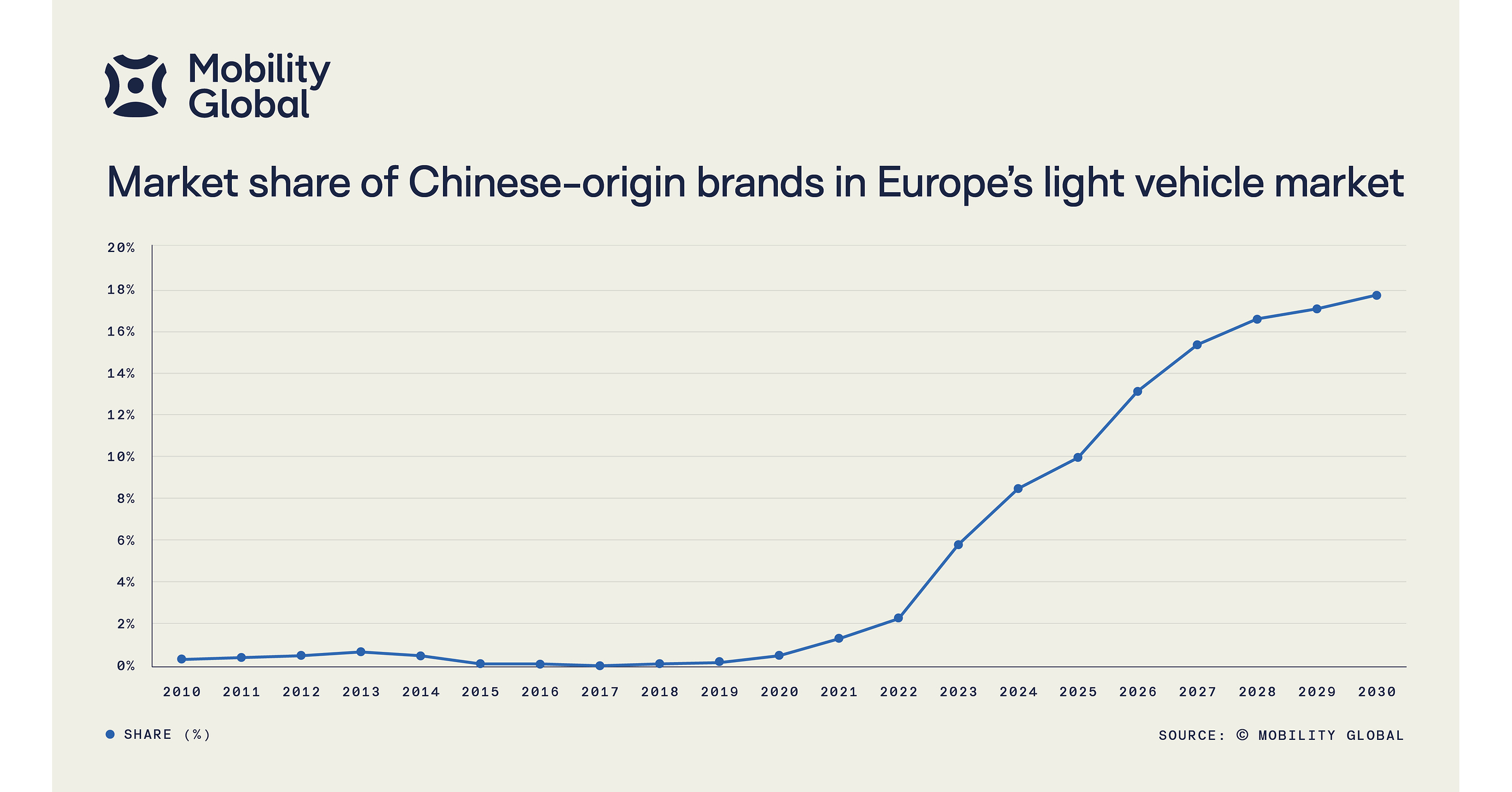
Mobility Global projects Chinese-origin brands could capture nearly 20% of Europe's light-vehicle market by 2030, while foreign automakers' share of China falls from roughly 60% in 2014 to 20%; China is forecast to retain about 50% of global EV production, versus 60% today. The report warns Western automakers face pressure from lower-cost, faster-moving competitors and says 100% U.S. tariffs on Chinese EVs and IRA sourcing requirements may shield them temporarily but risk delaying structural reform. It outlines a divided global industry, with a scale- and innovation-led Chinese ecosystem and a more regionalized Western market.
Analysis
The investable implication is not a near-term volume forecast but a potential change in industry economics: localized trade barriers may preserve Western unit sales while encouraging duplicated capacity and supply chains, limiting scale benefits and keeping capital intensity elevated. If Chinese brands gain share in Europe, pressure could reach beyond incumbent automakers to residual values, leasing economics, dealer pricing power, and suppliers tied to legacy architectures. Conversely, platform consolidation can benefit suppliers of standardized components, power electronics, and software while disadvantaging firms whose revenue depends on complex, model-specific parts. The report’s “Western Renaissance” versus “Managed Retreat” framing is useful as a diligence checklist, not a catalyst: it supplies no company-level evidence on costs, investment, or execution, and its market-share projections are forecasts from the report publisher rather than verified outcomes.
Over days, this is weak standalone trading news. Over 1–3 months, look for evidence in OEM guidance, platform cancellations or consolidation, EV pricing, and European policy decisions. Over 6–18 months, the key risk is a protected North American market masking slower cost and development-cycle improvement until competition or policy changes expose it. The contrarian point: tariffs may delay import competition but cannot assure attractive returns if they also reduce competitive urgency and fragment production. No broad short is warranted on this release alone.
AllMind Terminal
AI-powered research, real-time alerts, and portfolio analytics for institutional investors.
Request TrialMarket Sentiment
Overall Sentiment
mildly negative
Sentiment Score
-0.25
Key Decisions for Investors
- No immediate directional trade from the report. Treat its 2030 projections as scenarios; require corroboration from OEM disclosures, registration/share data, and independent cost or development-cycle evidence before changing sector exposure.
- Build a relative-value watchlist: favor automakers that demonstrate measurable platform consolidation and lower complexity over mass-market incumbents relying primarily on protected segments. Initiate only after evidence in product plans or guidance; falsify if simplification fails to reduce disclosed costs or investment needs.
- Within suppliers, screen for standardized components, power electronics, and software exposure; scrutinize suppliers reliant on model-specific legacy parts. Do not trade the theme until customer concentration, contract terms, and revenue exposure confirm which side of the transition each supplier occupies.
- Track European trade measures and North American sourcing rules as 1–3 month catalysts. A material easing of barriers or faster-than-expected Chinese localization would strengthen the competitive-pressure thesis; durable restrictions paired with improving Western cost and launch metrics would weaken it.
More News
- Why is Domino’s Pizza Enterprises stock sliding today?
- Taiwan agrees to buy 30% of gas from Alaska LNG project, Trump says
- South Korean carmaker Hyundai plans 'strategic' investment of $15.5 billion in India by 2032
- Speculation Over STT Cut Lifts Sentiment for Indian Stocks
- Applied Materials’ $5 billion AI lab aims to cut chip development time in half—and restore Silicon Valley’s edge
- Namibia battles cattle disease outbreak as EU suspends several meat imports