
Supermicro Brings NVIDIA Aerial RAN Computer Solutions to the Network Edge with Nokia to Enable Low-latency AI Services
Source: PR Newswire
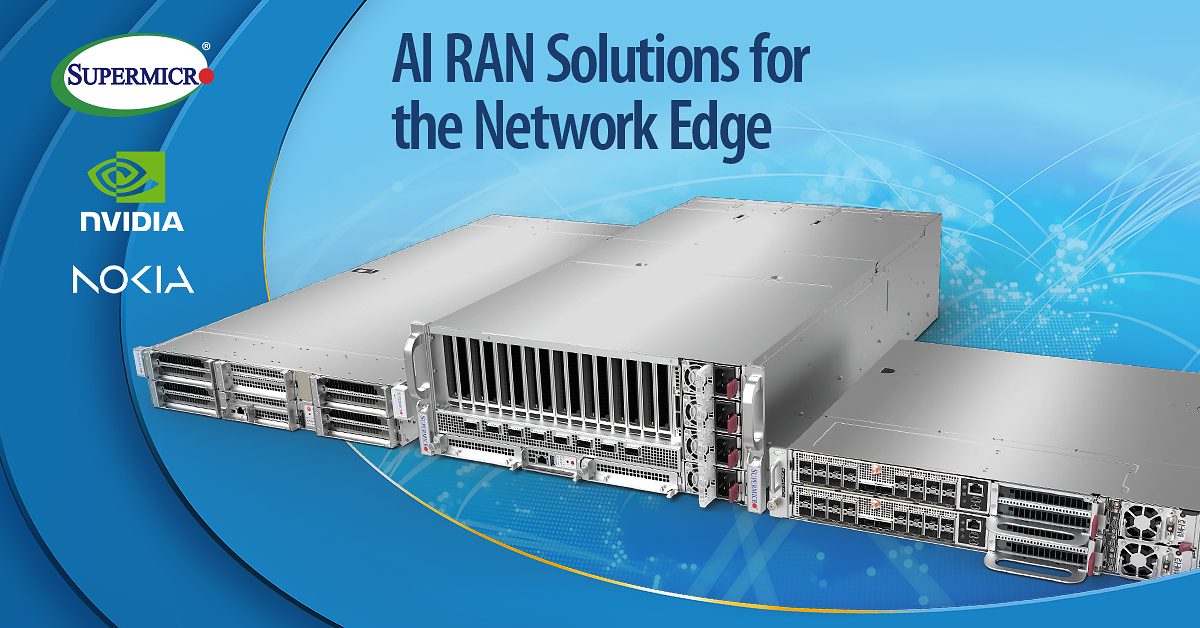
Supermicro, Nokia, and NVIDIA are deploying an integrated AI-RAN platform that combines Supermicro infrastructure, NVIDIA Aerial RAN computing, and Nokia RAN software for distributed cell sites through centralized network hubs. The systems are designed to run radio and AI workloads on shared infrastructure, improve spectral efficiency and network automation, and support low-latency edge AI services with a software-upgrade path toward 6G. Supermicro says its servers for NVIDIA ARC are generally available now; the dual-Vera 2U system is expected later in 2026, while the 2U ARC-Pro is planned for customer testing later this year and general availability in H1 2027.
Analysis
The strategic prize is operator economics, not the server launch itself: if shared compute improves RAN utilization enough to offset power, cooling, and site costs, Nokia could gain software differentiation and NVIDIA could extend its platform into telecom infrastructure. But the release establishes a solution, not operator deployments, purchase commitments, or evidence that edge-AI revenue clears those costs. That leaves near-term revenue visibility low for all three; SMCI’s roadmap also has staggered availability, so product announcements should not be treated as equivalent to shipment contribution.
Over 1–3 months, the key catalyst is named carrier trials, orders, or deployment economics—not additional demos. Over 6–18 months, successful multi-site deployments could support a shift from dedicated RAN equipment toward shared accelerated infrastructure, pressuring traditional RAN vendors such as Ericsson and potentially conventional compute suppliers. The counter-risk is that power, footprint, and workload-utilization constraints make centralized inference more economical than cell-site deployment, limiting the addressable opportunity.
Contrarian read: AI-RAN may be strategically important but is not yet a near-term earnings catalyst. The market could over-attribute the announcement to NVIDIA given its scale, while underestimating Nokia’s potential differentiation if operators adopt the software stack. Watch operator capex and verified workload economics before assigning a durable multiple premium.
AllMind Terminal
AI-powered research, real-time alerts, and portfolio analytics for institutional investors.
Request TrialMarket Sentiment
Overall Sentiment
mildly positive
Sentiment Score
0.35
Ticker Sentiment
Key Decisions for Investors
- Do not chase SMCI on the announcement alone. Reassess only with evidence of customer orders, shipment contribution, or guidance impact; verify which configurations are actually available and in production.
- Treat NVDA as a watch item rather than a standalone trade: the potential telecom compute expansion is conditional, and no deployment volume or economics are disclosed. Look for operator commitments and repeatable utilization data.
- For NOK, consider a tactical long only if named carrier deployments or commercial contracts emerge and the shares respond without a broad telecom-capex deterioration. Falsify the thesis if trials fail to progress to orders or Nokia’s RAN commentary weakens; compare deployment wins with Ericsson’s.
- Track operator total cost per unit of RAN capacity, site power/cooling requirements, and revenue from edge-AI workloads over the next 6–18 months. If shared infrastructure cannot improve those economics, the AI-RAN investment case—and the implied pressure on conventional RAN architectures—remains unproven.
More News
- The U.S. market has never been more focused on one single bet—but AI’s payoff will likely take decades
- CoreWeave’s market confidence erodes as bond yields spike and stock sinks
- SpaceX gives the AI trade a shot in the arm. What it means for our stocks
- Apple's iPhone Duo in short supply — plus, the 2 stocks fueling an AI rebound
- To help world gorge on GPUs, Nvidia brings cash bucket to fatten wafer-thin supply chain
- +48%, +39%, +22%: Our AI just called these blue-chip breakouts