
Eminent Hits 57.9 m @ 0.3 g/t Au of Oxide Gold on the Otis Fault, Ending in 3.0 m @ 2.1 g/t Au
Source: PR Newswire
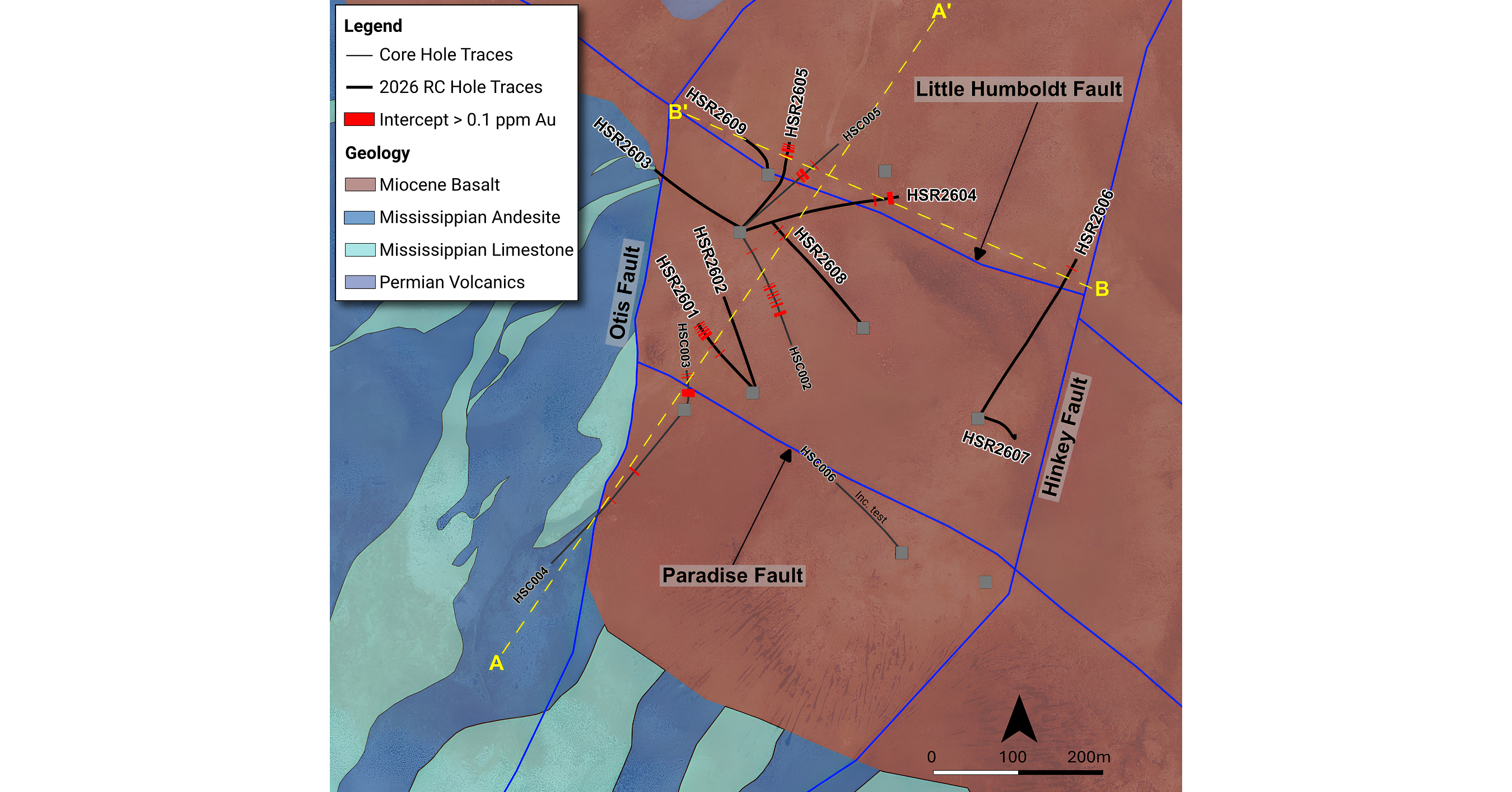
Eminent Gold reported its widest mineralized intercept to date at the Otis target in Nevada: 57.9 m grading 0.3 g/t gold, including 6.1 m at 0.9 g/t and 3.0 m at 2.1 g/t at the bottom of the hole. The hole ended in mineralization, while drilling and pathfinder data indicate gold strengthens northeastward and at depth, defining a larger untested core-drilling target. Additional Little Humboldt intercepts included 35.0 m at 0.3 g/t gold, including 3.0 m at 1.1 g/t; the company plans to re-enter HSR2601 with core drilling and continue drilling Otis, Eden and Celts.
Analysis
EMNT’s valuation remains binary: broad, low-grade near-surface mineralization has limited standalone economic meaning until deeper core establishes continuity, true width, metallurgy and a grade-volume relationship capable of supporting a resource. The market may reward the apparent vectoring signal in the next several sessions, but the more investable catalyst is the re-entry/core result over the next 1-3 months; core can either validate a coherent higher-grade feeder system or reveal that the strongest interval is isolated and uneconomic.
The key second-order issue is financing. A successful deep intercept would likely improve EMNT’s ability to raise capital and reduce the discount required in a future placement, whereas inconclusive core results leave a junior explorer with ongoing drill commitments, no cash-flow support, and heightened dilution risk. Nevada jurisdiction and regional analogues can support speculative optionality, but neither substitutes for a compliant resource estimate; nearby large deposits should not drive a look-through valuation.
Consensus may overvalue the phrase “open at depth”: termination in mineralization is not evidence of extension, particularly where RC sampling, unknown true widths and structural complexity constrain interpretation. Conversely, the stock could be underappreciated if core confirms materially higher grades over mineable widths beneath the oxide zone, since that would shift the narrative from surface anomaly to discovery potential. There is no read-through to Barrick (GOLD) or Newmont (NEM) earnings at this stage; their relevance is limited to regional strategic interest should EMNT ultimately demonstrate scale.
AllMind Terminal
AI-powered research, real-time alerts, and portfolio analytics for institutional investors.
Request TrialMarket Sentiment
Overall Sentiment
moderately positive
Sentiment Score
0.42
Ticker Sentiment
Key Decisions for Investors
- Treat EMNT as a catalyst watch, not a core long, until the re-entry core program publishes assay, lithology and structural results. A starter-sized speculative position is defensible only for funds able to tolerate illiquidity and total-loss exploration risk; add only if core shows sustained higher-grade mineralization rather than isolated narrow intervals.
- For a 1-3 month event trade, buy EMNT only after confirming post-release liquidity and financing runway; use a hard thesis stop if the next core hole fails to extend mineralization or management announces an equity raise at a material discount. Upside is potentially multi-bagger on discovery confirmation, but downside from a failed vector or dilutive financing is plausibly 50%+.
- Do not use GOLD, NEM, GDX or GDXJ as direct expressions of this result. Their diversified asset bases make the company-specific discovery signal immaterial; use EMNT exposure only where mandate permits micro-cap exploration risk.
- Monitor gold price, cash balance/burn, drill cadence and placement terms. A sustained gold-price decline or a discounted financing before core validation would compress junior-explorer risk appetite and invalidate a near-term long thesis even if assays remain technically encouraging.
More News
- Italy to deploy warships to protect shipping through Bab al-Mandeb
- Oil prices fall as Saudi supply hopes outweigh fresh Houthi strikes
- Oil prices fall for 3rd day as supply concerns ease, diplomacy in focus
- Oil Traders Stymied by Iran War Stalemate: Evening Briefing Americas
- Saudi Pivots Oil Routes After Pipeline Attack
- This AI-picked stock jumps 18% on Amazon’s $8 billion power deal
From AllMind Research
- Anthropic IPO Preview: Valuation, Timing, and What to Watch
- Shein After the IPO: Venue, Valuation, and What Must Be Proved
- What AI Research Tools Should a Small Hedge Fund Buy First?
- AI Portfolio Monitoring: Build an Alert Policy Analysts Can Audit
- The Great Divergence: North American Banking at the Crossroads of Monetary Policy and Agentic AI (Q4 2025 Bank Earnings)