
More Than 1 in 4 U.S. Adults Live With a Disability. New ASI Group Report Maps the Accessibility Gap in Commercial Restrooms
Source: PR Newswire
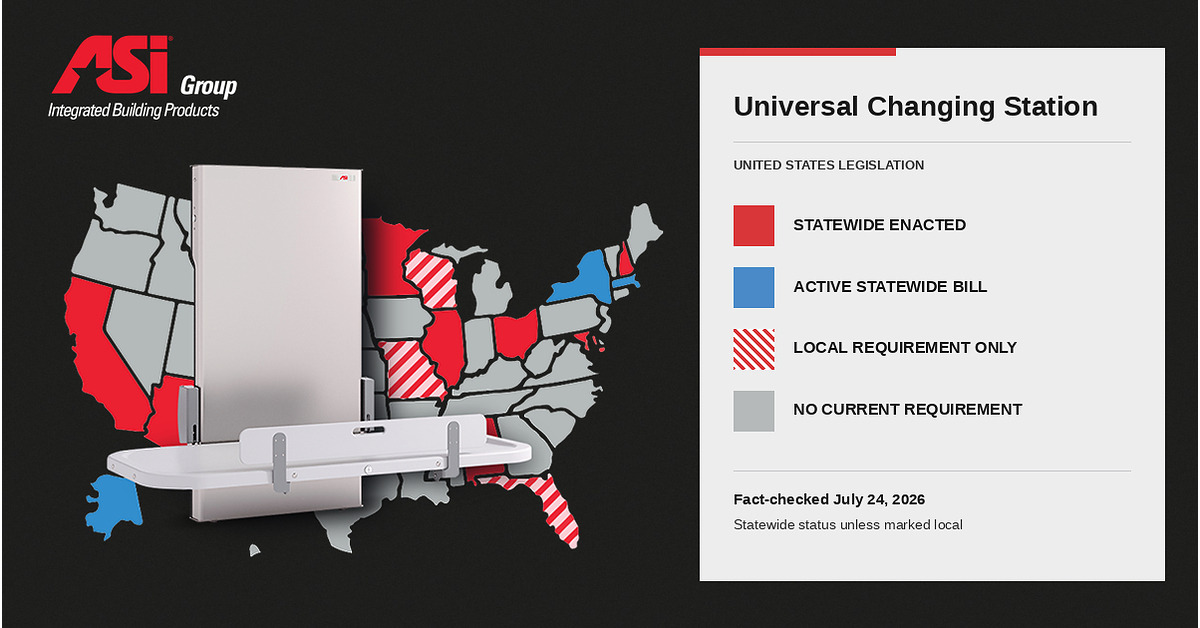
ASI Group reports that 28.7% of U.S. adults live with a disability while current federal ADA and ABA guidelines do not require adult changing tables, highlighting an accessibility gap in commercial restrooms. The 2024 International Building Code introduces adult changing-station requirements in specified occupancies, while Minnesota rules and federal airport-grant requirements beginning in fiscal 2030 broaden adoption. ASI launched a height-adjustable Universal Changing Station designed for dedicated care rooms, potentially benefiting from the expanding regulatory category.
Analysis
This is a specification-driven retrofit/new-build niche rather than a broad commercial-construction demand signal. The economic value accrues first to manufacturers with code-ready, architect-specified systems and to design firms that influence room programming early; once floorplans are finalized, the cost of creating a compliant care room rises sharply, making product substitution less likely. ASI is private, so there is no direct public-equity exposure; listed building-products peers with adjacent commercial-accessory channels, including Masco (MAS), Fortune Brands (FBIN), and LIXIL (5938.T), have only indirect upside and should not be assumed beneficiaries without evidence of qualifying product portfolios.
Near term, the investable effect is negligible: model-code adoption is fragmented and enforcement occurs through local permitting, producing a multi-year, geographically uneven revenue ramp. The more material 6-18 month read-through is for airport, education, healthcare, retail, and public-facility renovation pipelines, where dedicated-room requirements can expand project scope beyond a fixture purchase into partitions, doors, controls, and accessible-route work. Contractors and architects may face margin pressure on fixed-price projects if accessibility programming is discovered after design development, while specialty suppliers gain pricing power only where approved-specification lists are narrow.
Consensus risk is to extrapolate disability-prevalence statistics into immediate demand. The binding variables are state/local IBC adoption dates, fixture-count thresholds, airport grant-funded project starts, and whether owners elect voluntary installation absent enforcement. A weaker nonresidential construction cycle could delay discretionary retrofits even as regulatory momentum improves. Conversely, adoption by large airport authorities, health systems, or national retailers could create a repeatable specification template and accelerate category penetration faster than code-cycle assumptions imply.
AllMind Terminal
AI-powered research, real-time alerts, and portfolio analytics for institutional investors.
Request TrialMarket Sentiment
Overall Sentiment
mildly positive
Sentiment Score
0.28
Key Decisions for Investors
- No directional equity trade on this release; ASI is private and the disclosed demand catalyst is too small and delayed to alter earnings estimates for diversified public building-products companies.
- Create a 1-3 month regulatory watchlist for state and municipal adoption of 2024 IBC provisions, beginning with large-population jurisdictions and airport capital plans. Upgrade the theme only after identifying public suppliers with certified 400-lb, height-adjustable systems and meaningful commercial distribution.
- For construction exposure, monitor airport operators and contractors tied to federally funded terminal projects rather than buying broad infrastructure ETFs. A confirmed wave of terminal design awards would be a more investable catalyst than the fiscal-2030 grant-assurance deadline.
- Use MAS and FBIN only as relative-demand monitors: a sustained increase in commercial/accessibility product orders or backlog commentary would validate broader accessory spillover. Falsify any positive read-through if management continues to cite residential-led demand or if commercial renovation backlogs contract.
More News
- Looters hit 3,000 French businesses. Within hours, the haul was trending on Vinted under the riot’s date
- Kinder Morgan, Energy Transfer and Williams could benefit from cheap natural gas
- Vertex reports positive IgAN trial data, FDA decision due Nov. 30
- The real test for Moderna’s cancer vaccine isn’t about beating Keytruda. It’s keeping cancer from coming back in the long term.
- Elon Musk’s dangerous grip on outer space
- US-Iran war, then and now: How the landscape has changed since February